|
| Torâh | Haphtârâh | Âmar Ribi Yᵊhoshua | Mᵊnorat ha-Maor |
|---|---|---|---|

 |
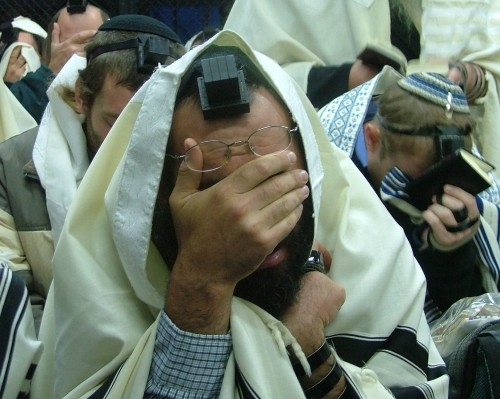
| Israeli soldier praying toward Yᵊrushâlayim. |
During times of crisis, as when thousands of missiles are raining down on the Gâ•lilꞋ, I hear questions from Jews, no less than goy•imꞋ, whether י--ה will deliver Israel from her enemies. Jews question whether their own conduct merits י--ה's yᵊshu•âhꞋ or whether the crisis is a sign from י--ה that tᵊshuv•âhꞋ is required. However, no one can "merit" yᵊshu•âhꞋ. The best Israel can do is avoid deliberate aveir•âhꞋ, which י--ה has set for Himself as a barrier to delivering Israel. What Israel can and must do for yᵊshu•âhꞋ is our utmost to keep תּוֹרָה, or make tᵊshuv•âhꞋ to do so, so that we aren't rebelling, which can prevent yᵊshu•âhꞋ.
One of the events that is often cited to ponder י--ה's power and willingness to deliver Israel is the Yᵊtzi•âhꞋ. This week's pâ•râsh•âhꞋ teaches (7.17) that even when the goy•imꞋ outnumber her, Israel is not to fear, but remember the paradigm of the Yᵊtzi•âhꞋ. Like today, Israel was outnumbered by the goy•imꞋ, but י--ה promised (7.22) that, even after neis•imꞋ of the Yᵊtzi•âhꞋ, He would thrust out the goy•imꞋ from hâ-ÂꞋrëtz, little by little.
Examining times of crisis described in Ta•na"khꞋ, comparing and contrasting them with Israel's plight today, informs us what we should expect. One of the first recorded crises took place even as תּוֹרָה was being handed down at Har Sin•aiꞋ. When Mosh•ëhꞋ and Yᵊho•shuꞋa Bën-Nun were descending Har Sin•aiꞋ to return to the Israeli camp, they heard the tumult of Israel partying in A•vod•âhꞋ Zâr•âhꞋ. Nevertheless, following tᵊshuv•âhꞋ, י--ה authorized a second set of tablets, demonstrating the power of tᵊshuv•âhꞋ.
When ten of the 12 members of the recon team sent out by Mosh•ëhꞋ returned disbelieving, and sowing doubt, fear and disbelief in Israel, concerning י--ה's instruction to conquer Kᵊna•anꞋ, that entire generation was lost—but only that one generation.
What was so vastly worse—even than A•vod•âhꞋ Zâr•âhꞋ—in the first century C.E. that resulted in the destruction of the Beit ha-Mi•qᵊdâshꞋ ha-Sheini and, in 135 C.E., expulsion from Israel and dispersion for nearly two millennia? The most controversial and widely debated crisis in Israel's entire history has been the cause that י--ה allowed the destruction of the Beit ha-Mi•qᵊdâshꞋ ha-Sheini in 70 C.E. and the ensuing destruction in 135 C.E. resulting in the dispersion, renaming Israel to "Palestine," and the occupation of Israel by goy•imꞋ for two millennia. Why?
Christians have argued for millennia, and Muslim since the 6th century, blaming the Jews' rejection (or killing) of Yësh"u as the cause of all of these catastrophes as well as ensuing misojudaism, Crusades, the Inquisition, pogroms and the Holocaust. תּוֹרָה incontrovertibly precludes that (Dᵊvâr•imꞋ 13.1-6). But if not that, then what? Jews have never provided an adequate answer. That's a significant reason that Christian polemics continue to be more persuasive than Jewish apologetics.
This answer is long overdue and there is a logically compelling, historically accurate reason: in the 1st century, the priesthood had been thoroughly apostatized into a Hellenist puppet of the Roman Empire; so much so that most of the Jewish community referred to the High Priest as the Ko•heinꞋ hâ-RëshꞋa (see the account in our Kha•nukh•âhꞋ page—link in glossary).
 |
| Anti-Israel Ultra-Orthodox Kha•reid•imꞋ |
How does all of this apply to all of the destruction in the Gâ•lilꞋ in the ongoing Israeli-Khizb-Allah War in 2006? Today's Kohan•imꞋ are merely ceremonial reminders who are not Biblically legitimate and would not be valid to serve if there were a physical Beit ha-Mi•qᵊdâshꞋ ha-Shᵊlishit. The counterpart of Israel's ancient Kohan•imꞋ are the modern rabbis. Just as the 1st-century Kohan•imꞋ were Ko•han•eiꞋ hâ-RëshꞋa, the preponderance of today's rabbis – particularly Ultra-Orthodox / khareid•imꞋ – are רֹעָי הָאֱלִיל (see Zᵊkhar•yâhꞋ 11.17). The destruction of the Beit ha-Mi•qᵊdâshꞋ ha-Sheini in 70 C.E., and later the Tᵊphutz•âhꞋ of 135 C.E., teaches us that when Israel's "priests" stray, Israel must follow Israel's Instruction Manual, תּוֹרָה, rather than transfer faith from His תּוֹרָה to straying priests of the day. It was for this reason that Israel was expelled from hâ-ÂꞋrëtz in the 2nd century and, if Israel repeats this straying, we will again be expelled from hâ-ÂꞋrëtz. י--ה promises this in תּוֹרָה.
On the other hand, if Israel adheres to י--ה's תּוֹרָה, then He has promised that Israel will become a מַמְלֶכֶת כֹּהֲנִים וְגוֹי קָדוֹשׁ (Shᵊm•otꞋ 19.6).
One of the biggest dangers for Israel has always been prosperity. When people are prosperous they tend to forget that living well is an even greater reason to be grateful to י--ה and please Him. Knowing that, to the contrary, prosperity turns people's heads. תּוֹרָה warns of straying amidst prosperity in this week's pâ•râsh•âhꞋ (8.11).
The reward of Israel's yᵊshu•âhꞋ comes when Israel will Shᵊm•aꞋ (7.12). This has been true throughout Israel's history and it will remain true in the current conflict—not constrained to Lebanon but the wider conflict with Islamocaliphist jihadists.
 |
 |
| Setting: ca. B.C.E. 1427. Location: Area of Shit•imꞋ & Har Nᵊvo, east of NᵊharꞋ ha-Yar•deinꞋ, opposite Yᵊrikh•oꞋ (see map below: 31° 46' N, 35° 43' E). |
|
 0250x250.jpg "Map Shitim Baal Peor (images.google.co.il)") |
 1000x1000.jpg "Click to enlarge") הַר פְּעוֹר – northeast of Yâm ha-MëlꞋakh, east of Yᵊri•khoꞋ and Shit•imꞋ (images.google.co.il) |
11.13 – וּלְעָבְדוֹ, בְּכָל-לְבַבְכֶם וּבְכָל-נַפְשְׁכֶם
Commenting on this passage, the rabbis concluded "What is service of the לֵבָב? This is tᵊphil•âhꞋ." (Tal•mudꞋ, Ma•sëkꞋët Ta•an•itꞋ 2a; see also Ho•sheiꞋa 7.14 and Tᵊhil•imꞋ 108.2 & 111.1).
To the rabbis' commentaries on service of the לֵבָב, I would ask, Why, then, does the passage stipulate that we serve with both – לֵבָב and נֶפֶשׁ? The requirement to serve with both confirms the rabbis conclusion and further demonstrates that each of us comprise at least two facets: [1] our corporeal לֵבָב and body in this corporeal universe and [2] our incorporeal נֶפֶשׁ in the incorporeal Realm.
(If the above clues aren't enough, I explain this in detail in my docunovel, The Mirrored Sphinxes Live-LinkT  )
 |
The service of tᵊphil•âhꞋ, then, bridges the two realms (corporeal physical and incorporeal eternal-spiritual) – the second and third קָדוֹשׁ of Yᵊsha•yâhꞋu 6.3 – and we must serve with both facets of ourselves – simultaneously, in both realms. For this reason, we must be קֹדֶשׁ in both of these facets: קֹדֶשׁ לֵבָב and קֹדֶשׁ נֶפֶשׁ.
Mi•shᵊl•eiꞋ ShᵊlomꞋoh 28.9 clarified the qualifying first קָדוֹשׁ Gate (later reiterated by Yᵊsha•yahꞋu ha-Nâ•viꞋ, 1.13 – see the Ha•phᵊtâr•âhꞋ for pâ•râsh•âhꞋ Dᵊvâr•imꞋ), permitting ki•purꞋ access, provided by י--ה to the next two Gates—enabling a trans-realm communication circuit!
This convergence of the two realms, first investigated unsuccessfully by the Egyptians (probably the origin of astral projection), was revealed by י--ה to the Egyptian Pharaonic Prince Mosh•ëhꞋ, first announced publicly, to Yi•sᵊrâ•eilꞋ, in the 1st century C.E., by Yokhâ•nânꞋ 'ha-Ma•tᵊbilꞋ' Bën-Zᵊkhar•yâhꞋ Bën-Tzâ•doqꞋ ha-Ko•heinꞋ ("the Realm of the heavens has converged with us"; The Nᵊtzârim Reconstruction of Hebrew Matitᵊyâhu (NHM, in English) 3.2), and clarified by RibꞋi Yᵊho•shuꞋa Bën-Dâ•widꞋ ("the Realm of the heavens has converged," NHM 4.17; "the Realm of the heavens has come near," 10.7).
Tᵊphil•âhꞋ is the trans-realm communication up-link and down-link that enables us to serve with both facets, לֵבָב (our physical body or avatar) and נֶפֶשׁ (the incorporeal self) – and in both realms simultaneously. This link between the Singularity-Creator and His creature, has always been implicit in the Biblical concept that man was created בְּצַלְמֵנוּ — bᵊ-Reish•itꞋ 1.26-27).
"The heart and not the hour dictated the occasion for prayer… But the need for regularity brought about a synchronization of the times of prayer and of qor•bânꞋ: morning worship corresponded to the morning oblation… afternoon orisons to the late afternoon qor•bânꞋ' Nightfall' so that prayers came to be offered thrice daily" ("Prayer," EJ, 13.980).
There has been much discussion about the priority of tᵊphil•âhꞋ relative, for example, to the study of תּוֹרָה, which is deemed to be a higher priority to the extent that "some scholars, whose main occupation was study [of תּוֹרָה], only prayed periodically (Ma•sëkꞋët Shab•âtꞋ 11a; Ma•sëkꞋët Rosh ha-Shân•âhꞋ 35a)" (ibid.). See also "•marꞋ RibꞋi Yᵊho•shuꞋa," below, for his teaching in this area.
|
|
Dᵊvâr•imꞋ 7.17— "Perhaps you will say in your לֵבָב, 'These goy•imꞋ are more numerous than I; how will I be able to drive them away?' "
Why should the answer—to remember Mi•tzᵊr•ayꞋim—make any sense? What's so important about Mi•tzᵊr•ayꞋim?
 |
| B.C.E. 9th-8th-century Assyrian perception of Kᵊruv•imꞋ (ivory sculptural relief) © 2004 by Yi•rᵊmᵊyâhꞋu Bën-Dâ•widꞋ. See The Mirrored Sphinxes Live-LinkT |
Study Egyptian history. Beginning about B.C.E. 3000, Egypt was the undisputed world power for two and a half millennia!!! Thus, the impact of this pâ•suqꞋ would be equivalent today to Jews rising up against the U.S. and leaving en masse with the ten plagues bringing the U.S. to her knees—and the U.S. still has almost three millennia to go before drawing close to Egypt's record as undisputed world power. For the Habiru-Hyksos (see The Mirrored Sphinxes Live-LinkT ) Hebrews to rise up and assert their freedom over what is still the greatest world power ever to exist was astounding. And the point of this pâ•suqꞋ was that since י--ה had brought the greatest world power the earth (still) has ever known to her knees in liberating His people, the Hebrews, there was no threat that could remotely approach Egypt. So what was there to fear?
Should we, then, fear the U.S.? How much less so should we fear Iran? Syria? The Arabs, the Muslims, whether individually or all together?
There are greater implications to the teaching of the Yᵊtzi•âhꞋ in the pësꞋakh SeiꞋdër than even Orthodox Jews realize!
|
|
11.1 "You shall love י--ה your Ël•oh•imꞋ, and sho•meirꞋ His mishmar; and His khuqot and His mi•shᵊpât•imꞋ, and His mi•tzᵊw•otꞋ all the days."
 |
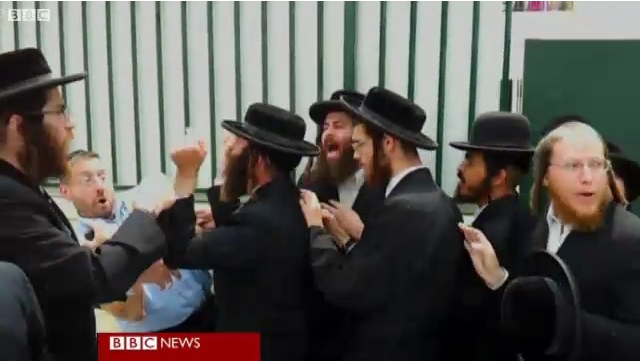 BBC video 2011.10.10 – Ultra-Orthodox Kha•reid•imꞋ spit on an eight year old Orthodox elementary schoolgirl, calling her a פְּרוּצָה (whore), a זוֹנָה (slut-prostitute) and a שיקצע or שיקסע" (assimilated German – namely, Yiddish – for "detestable goyah girl"); according to mother, Hadassah Margolis (dossim.com/ContentPage.aspx?item=352). They also assault an Orthodox rabbi (blue shirt) for being moderate – Beit ShëmꞋ ësh, Israel  |
This mi•tzᵊw•âhꞋ (also corroborated in parallel passages), that the practice of obedience is to issue and flow from our love for י--ה rather than the oppressive imposition of minutiae, is lost on (Ultra-Orthodox) khareid•imꞋ. Only a week ago, The Jerusalem Post reported attacks on women government workers in Yᵊrushâlayim by khareid•imꞋ (who felt slacks and jacket, or a sleeveless blouse, is indecent), khi•lulꞋ י--ה that serves to turn these victims of ultra-orthodox abuse away from תּוֹרָה. Those who turn people away from תּוֹרָה are doing the work of Sâ•tânꞋ!
The image that these victims, and other victims, of ultra-orthodox fanaticism, have of י--ה is often the medieval European costumed Ultra-Orthodox Kha•reid•imꞋ – the intolerant, sin•atꞋ khi•nâmꞋ of the ultra-orthodox who, speciously, claim to represent י--ה while spitting—even throwing bags or dirty diapers of their feces—on Orthodox Jewish women, cursing them and calling them whores. Such behavior by the ultra-orthodox is incontrovertibly khi•lulꞋ י--ה.
Nor are the leaders of the ultra-orthodox community, by the tacit approval implied by their silence, any less guilty.
On a different track, pâ•suqꞋ 8 contains a statement of pivotal messianic importance: "And you shall sho•meirꞋ all of the mi•tzᵊw•âhꞋ which I, Myself, mᵊtzawëh today."
Read it again and you will notice that תּוֹרָה requires non-selective observance of the khuq•imꞋ and mi•shᵊpât•imꞋ—the Biblical components of Tor•âhꞋ shë-bᵊ•alꞋ pëh = Oral Law, stipulated in pâ•suqꞋ 1.
This makes it impossible for a Mâ•shiꞋakh who satisfies the prophecy of Dᵊvâr•imꞋ 13.2-5 to advocate selective observance, abrogating khuq•imꞋ or mi•shᵊpât•imꞋ, the Biblical components of Oral Law.
Of course, Dead Sea Scroll 4Q MMT is the latest in a long string of documentation that proves that the historical RibꞋi Yᵊho•shuꞋa could never have advocated selective observance or abrogation of any aspect of תּוֹרָה, mi•tzᵊw•otꞋ, khuq•imꞋ or mi•shᵊpât•imꞋ without being immediately expelled by all religious Jews!!! Selective observance, the corrolary of Displacement Theology, was a product of Roman gentiles, not historical RibꞋi Yᵊho•shuꞋa or his original Nᵊtzâr•imꞋ followers. (For documentation and further reading cf. "Who Are The Nᵊtzarim? Live-LinkT (WAN)")
|
|
This pâ•râsh•âhꞋ begins:
7.12 – וְהָיָה, עֵקֶב
 |  |
Artscroll makes an excellent point in their note that "no Jew may pick and choose among the commandments; [Ël•oh•imꞋ's] blessings were contingent on Israel's acceptance of the entire תּוֹרָה." It should suffice to note that י--ה doesn't change.
This is precisely what RibꞋi Yᵊho•shuꞋa taught (NHM 5:17-19):
"Don't think that I came to uproot the תּוֹרָה or the Nᵊviy•imꞋ.
Rather, I came to reconcile them with the Oral Law of ë•mëtꞋ. Should the heavens and hâ-ÂꞋrëtz exchange places, still not even one י or one
of the Oral Law of Mosh•ëhꞋ shall so much as exchange places until it shall become that it is all being fully ratified and performed non-selectively.
For whoever deletes one Oral Law from the תּוֹרָה, or shall teach others such, by those in the Realm of the heavens he shall be called 'deleted.'
Find אָזֵיל Both he who preserves and he who teaches them shall be called RibꞋi in the Realm of the heavens.
For I tell you that unless your tzᵊdâq•âhꞋ is over and above that of the So•phᵊr•imꞋ and [Herodian] Rabbinic-Pᵊrush•imꞋ, there is no way you will [even] enter into the Realm of the heavens."
Christians should take note that they are a long way from even equaling these So•phᵊr•imꞋ and Pᵊrush•imꞋ in being sho•meirꞋ-תּוֹרָה. Consequently, Christians are a much further from qualifying for "salvation" than are Tei•mân•imꞋ and moderate Orthodox Jews – according to the teaching of RibꞋi Yᵊho•shuꞋa!
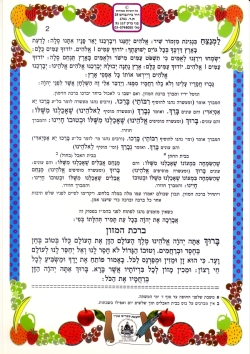
8.10— This is one of the bases for the mi•tzᵊw•âhꞋ of reciting the בִּרְכַּת הַמָּזוֹן (Blessing of Sustenance, recited after meals with bread).
11.13-21 — This is the second, of three parts, of the Shᵊm•aꞋ.
11.22 — This pâ•suqꞋ corroborates the many instances, including the teaching of RibꞋi Yᵊho•shuꞋa, that emphasize the requirement of keeping the entirety of תּוֹרָה (which includes not only Tor•âhꞋ shë-bi•khᵊtâvꞋ but also Tor•âhꞋ shë-bᵊ•alꞋ pëh = mi•shᵊpât•imꞋ = Oral Law = Ha•lâkh•âhꞋ).
כִּי אִם-שָׁמֹר תִּשְׁמְרוּן
The doublet use of this verb stem equates to the English "absolutely" followed by the verb. Therefore, we can understand this to read "For if you will be absolutely sho•meirꞋ".
But absolutely sho•meirꞋ what?
all – the entirety (i.e., not selective) – of the mi•tzᵊw•âhꞋ!
|
|
This פרשה begins: … ,וְהָיָה | עֵקֶב תִּשְׁמְרוּן
The cantillation indicates no pause between עֵקֶב and תִּשְׁמְרוּן
The sense of this phrase is then "Then it shall be consequent to [i.e., contingent upon] you m.p. hearkening (in future, to these mi•shᵊpât•imꞋ)." This seems to be an alternate form, somewhat similar in meaning (e.g. "if it were to be that…, then", "if it should become that…, then"), to the English if-then structure:
| Hebrew | English |
|---|---|
| אִם א', וּב' | If 'א, then 'ב |
| וְהָיָה 'א, וּב' |
Adding a ן (nun) suffix to the verb was not unusual in Biblical usage, apparently a poetical embellishment and perhaps a familiar ending conveying endearment, as found in the ון (un) endings such as Zᵊvul•unꞋ and Yᵊshur•unꞋ.
 |
 |
7.12 can then be understood as 12a "Contingent upon you m.p. hearkening [in future], to these mi•shᵊpât•imꞋ, who have been watchguarding [past tense], and …, 12b then י--ה your Ël•oh•imꞋ (conversive ו) shall have been sho•meirꞋ regarding the Bᵊrit for you, and regarding the khësꞋëd that He swore to your fathers."
7.13 "And He shall love you m.s. …"; the singular implying on an individual basis. (He shall love you,m.s. each individually, who shall be among you,m.p. collectively, who shall hearken.)
English translations give no hint of any difference between the future structure of "you m.p. shall hearken" and the past tense of the remainder of the pâ•suqꞋ: "and watchguarded and made or did [the mi•tzᵊw•otꞋ] –
The sense of this switch in tense seems to be: "You shall Shᵊm•aꞋ, and when you've been sho•meirꞋ and done them, then י--ה your Ël•oh•imꞋ shall have been sho•meirꞋ concerning the Bᵊrit and the khësꞋëd that He swore to your fathers."
How often do we hear people say "I want to serve god, but how can I know what He wants of me"? 7.13 provides that answer! If we do what 7.12a requires, 7.12b-13 promises: then י--ה will love and bless us.
7.12 requires:
Shᵊm•aꞋ to the mi•shᵊpât•imꞋ,
be sho•meirꞋ concerning the mi•shᵊpât•imꞋ, and
do (practice, not discuss or "believe in") the mi•shᵊpât•imꞋ.
How is it that sho•meirꞋ-תּוֹרָה Jews have known this for millennia, yet—still—the goy•imꞋ, including Christians and Muslims, remain stubbornly, defiantly and high-handedly (blasphemously) clueless?
|
|
Last week we examined the תּוֹרָה requirements for eternal life. This week we find complete consistency in Dᵊvâr•imꞋ 10.12-13:
וְעַתָּה יִשְׂרָאֵל, מָה י--ה אֱלֹהֶיךָ שֹׁאֵל מֵעִּמָךְ; כִּי אִם-לְיִרְאָה, אֶת-י--ה אֱלֹהֶיךָ ללֶכֶת בְּכָל-דְרָכָיו וּלְאַהֲבָה אֹתוֹ, וְלַעֲבֹד אֶת-י--ה אֱלֹהֶיךָ, בְּכָל-לְבָבְךָ וּבְכָל-נַפְשֶׁךָ: 13 לִשְׁמֹר אֶת-מִצְוֹת י--ה וְאֶת- חֻקֹּתָיו, אֲשֶׁר; אָנֹכִי מְצַוְּךָ: הַיּוֹם; לְטוֹב לָךְ:
Punctuation reflects the phraseology dictated by the cantillation. This reveals a thought not usually recognized as an indivisible phrase describing Ha•lâkh•âhꞋ: "to ho•leikhꞋ" (walk; the same verb from which the noun Ha•lâkh•âhꞋ derives)
in all of His Dᵊrâkh•imꞋ
for the love of Him ("For the love of Him" also modifies the phrase "to ho•leikhꞋ")
Q: Why ho•leikhꞋ (i.e. according to Ha•lâkh•âhꞋ) in all (i.e. non-selectively) of His Ways?
A: "for the love of Him."
From this, anyone who keeps תּוֹרָה can easily discern who loves י--ה by their Walk, their fruits! This is obvious from simple observation. No "judging of the heart" is involved. Simply put, everyone can see whether he or she is ho•leikhꞋ according to Ha•lâkh•âhꞋ in all of His Dᵊrâkh•imꞋ (e.g. sho•meirꞋ-Shab•âtꞋ, ka•shᵊr•utꞋ, etc.) to the best of their ability (with all of their לֵבָב and with all of their נֶפֶשׁ) – according to תּוֹרָה.
Or not!!!
|
|
 |
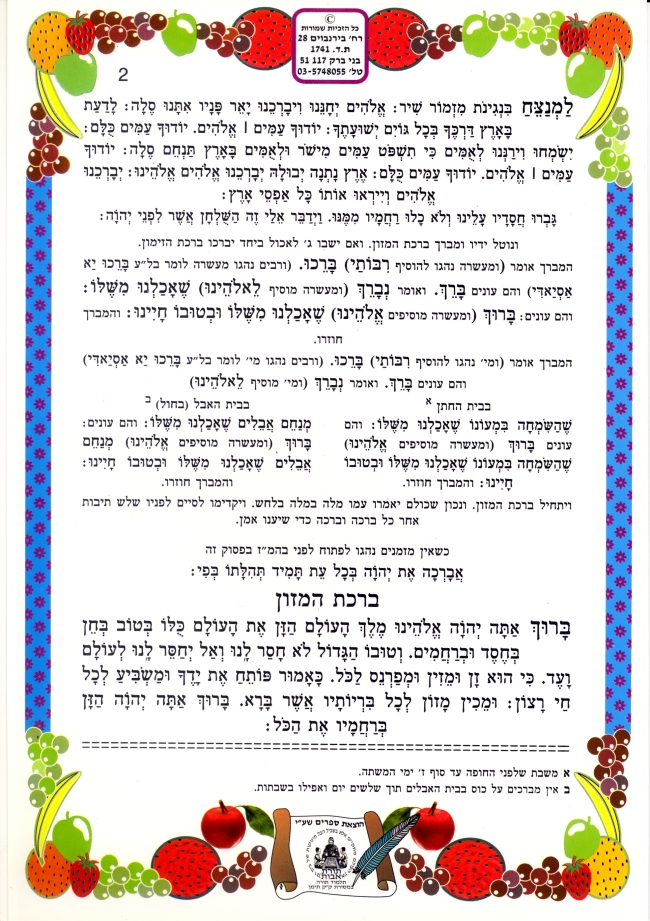 |
8.10 — "When you have eaten, and are satisfied, then you shall bless י--ה your Ël•oh•imꞋ for the good land that He has given you." This is the theme for the בִּרְכַּת הַמָּזוֹן, the blessing after meals that include bread. (Meals that don't include bread are concluded with one of several different, and shorter, bᵊrâkh•otꞋ .)
When bread is served, hand-washing with its bᵊrâkh•âhꞋ (al-nᵊtil•atꞋ; concerning the lifting ["of hands" is understood]) and the ha-mo•tziꞋ (Who issues [bread]) are required before eating and the בִּרְכַּת הַמָּזוֹן is required after eating.
While it is customary among goy•imꞋ to say "grace" before eating, the mi•tzᵊw•otꞋ require a bᵊrâkh•âhꞋ before and especially after eating.
10.19 — "And you shall love the geir, for you were geir•imꞋ in the land of Mi•tzᵊr•ayꞋim." For millennia, Jews have been persecuted by wolves in the guise of geir•imꞋ. Consequently, often they (understandably but wrongly) have a very bad disposition toward anyone claiming to be a geir. This is exacerbated by some non-Jews seeking conversion by concealing his or her Christian beliefs. Nᵊtzâr•imꞋ geir•imꞋ will, in all likelihood, have to surmount this obstacle, repeatedly and perpetually. For the individual Jews to whom your devotion and reliability have been demonstrated, however, this mi•shᵊpâtꞋ requires them to love you. If they do not, then it is they, not the geir, who is the hypocritical transgressor of תּוֹרָה, the antithesis of sho•meirꞋ Tor•âhꞋ.
The second of three passages comprising the Shᵊm•aꞋ, 11.13-21, is found in this week's pâ•râsh•âhꞋ.
|
|
7.12 — עָקַב is the root from which the name Ya•a•qovꞋ derived. Readers may remember that Ya•a•qovꞋ was so named because he held onto the heel of his twin brother at birth. עָקַב means to "come on the heels of', to "follow in the footsteps of', "in the wake of' or to "be consequent to" – not – as many advocates of Displacement Theology interject – the idea of "supplant."
This passage provides further confirmation of the mi•tzᵊw•âhꞋ to observe the corpus of mi•shᵊpât•imꞋ—also known as Ha•lâkh•âhꞋ and which for centuries was transmitted orally and was known as the Oral Law. Every one of the numerous references to מִשְׁפָּט in the Tan"kh refers to adjudication of the Oral Law, the rabbinic term for which is Tor•âhꞋ shë-Bᵊ•alꞋ Pëh or Ha•lâkh•âhꞋ.
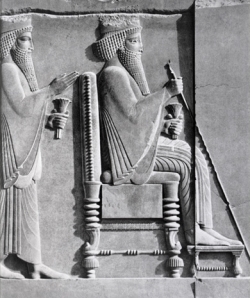 |
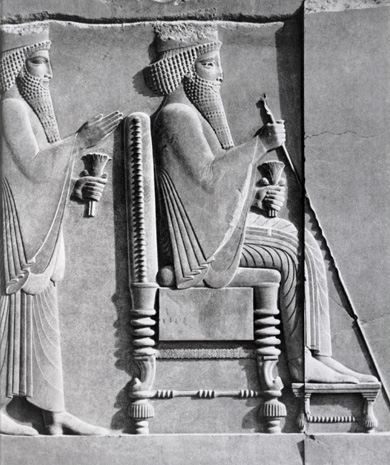 שֵׁבֶט, held in right hand by Iranian (Persian) King Darius (B.C.E. 550-486) |
7.15 — וּנְתָנָם בְּכָל-שֹׂנְאֶיךָ. The Biblical usage doesn't correlate to "hate" in the modern sense. Mi•shᵊl•eiꞋ Shᵊlom•oh′ 13.24 informs that חוֹשֵׂךְ שִׁבְטוֹ שׂוֹנֵא בְנוֹ. Surely the parent who withholds the staff usually doesn't hate his or her son. Similarly, in Dᵊvâr•imꞋ 21.15-17 two wives of a polygynous marriage are contrasted: one loved and the other שְׂנוּאָה. The contrast is not between love vs hate, but between preferred vs its opposite: "disferred" or "unpreferred." The closest English verb seems to be "eschew."
Although Mi•shᵊl•eiꞋ Shᵊlom•oh′ 13.24 is often used by parents as permission to beat their offspring – of any age, the Sages, by contrast, set an age limit. In the only Tal•mudꞋ reference to שֵׁבֶט as used in Mi•shᵊl•eiꞋ Shᵊlom•oh′ , Ma•sëkꞋ ët Mak•otꞋ 8a interprets: "Where the son is already learned, it is no longer obligatory to strike." "Learned" here refers to readiness to shoulder the obligations of Tor•âhꞋ – i.e., Bar-Mitz•wâhꞋ . For girls, this age limit is one year younger. Any reasonable person understands that one never "beats" children this young with a "rod."
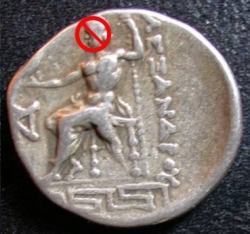 |
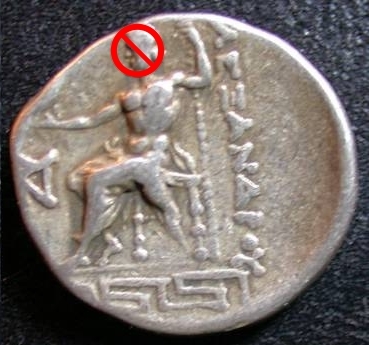 שֵׁבֶט: held in left hand by Hellenist |
The שֵׁבֶט was the symbol of authority, tracing back to the "divine" magical wands held by ancient deities that supposedly commanded divine powers over thunder, lightning, wind, etc. (Recall Mosh•ëhꞋ 's use.) Human rulers held such wands in imitation of their gods in claim of their powers and right to rule. Today's rulers do the same – claiming to be rulers by divine right, head of the church, etc.
These "magic wands" have "power" over livestock, guiding them in the direction signaled by the shepherd. Their function was to guide by a wave or signal, or to select by means of touch (whether for ma•a•seirꞋ relative to livestock or commendation or discipline relative to people). No ruler would risk breaking their "divine magic-power wand," their symbol of power, by beating someone with it. Probably, translators have confused a prod – a gentle, but unmistakably serious, poke ("strike") for direction or to command attention – into English as "beating."
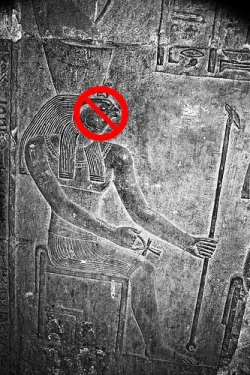 |
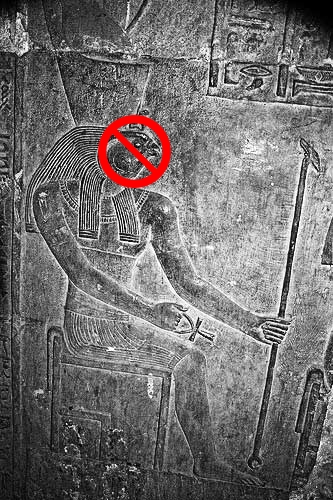 שֵׁבֶט: held in left hand by Egyptian |
Returning to the study of שׂוֹנֵא, in modern usage, the antonym of love is hate. However, pâ•suqꞋ 16 is the key to understanding the true Biblical meaning and intent of this contrast. The key is the word לְבַכֵּר. Thus, it is implied that the "loved" wife is "preferred" while the other is contrasted as שְׂנוּאָה—the antonym of "prefer." The antonym of שָׂנֵא is "prefer." Conversely, the antonym of prefer, i.e., שָׂנֵא, is eschew (to "not prefer" or "disfer")—not hate.
The evidence for this understanding of שָׂנֵא in Tan"kh and other Jewish writings of the period is overwhelming.
In LXX, by contrast, שָׂנֵא is usually Hellenized to the Greek μισεω (miseo), and it is this term reflecting שָׂנֵא and eschew, not hate, that is restored – "de-Hellenized" – in NHM narrating the teachings of RibꞋi Yᵊho•shuꞋa.
Conversely, we may deduce from this that "love" implies "preferring" over others. This is not a pedantic exercise in logic. According to this definition of שָׂנֵא if one loves so-and-so then one prefers so-and-so over others in matters where alternatives must be decided. Conversely, if one does not prefer, i.e. eschews, so-and-so in such matters then one isn't loving so-and-so. Stated differently, if one eschews so-and-so then one doesn't love so-and-so – or at least loves so-and-so less – by Biblical definitions.
This is posed frequently in Scripture, י--ה being the "so-and-so" and the "matters where choices must be made" being the observance of תּוֹרָה.
That wives are compared thusly is especially illuminating because י--ה often alludes to the Israelis as His wife and uses the metaphor of adultery when they eschew Him and His תּוֹרָה. Similarly, we are taught that we must never prefer goy•imꞋ over our brother Jews. Stated alternatively, we must never eschew our brother Jews.
This is not to say that the modern idea of "hate" is not encompassed in these terms, for it is. But hate alone is not adequate to define them. Eschew is inherent in these Hebrew and Greek terms but the Hebrew and Greek terms are broader in scope to sometimes include hate. This is similar to the adage that all horses are animals but not all animals are horses. Whether the limited meaning of eschew is intended or the more intense meaning of hatred is something that must be discerned from the context in which the term is used.
With this in mind, I refer the reader to researching in a Hebrew concordance all of the passages in Tan"kh containing שָׂנֵא. Those interested in the NT should research in a Greek concordance such as The Englishman's Greek Concordance of the NT. English concordances indexed on English words instead of Hebrew or Greek words (e.g. Strong's) are misleading and shouldn't be used.
7.16 — This unequivocal passage should be especially noted by the reader.
|
|

| Setting: ca. B.C.E. 720 (Yᵊsha•yâhꞋu chapters 1-39). Location: Yᵊru•shâ•layꞋim (31° 47' N, 35° 13' E) |
|
|
|
Pâ•suqꞋ 50.4-5
"A•don•âiꞋ י--ה has given me a tongue to teach, to know [how] to spin an issue to exhaustion; rousing me morning by morning, rousing my ears, to Shᵊm•aꞋ like ta•lᵊmid•imꞋ."
Like QoꞋrakh defied and challenged Mosh•ëhꞋ (bᵊ-Mi•dᵊbarꞋ 16.1–18.32), wannabe Christian poseurs (in the goy•imꞋ Christian world – incalculably worse than QoꞋrakh, who was at least part of Yi•sᵊrâ•eilꞋ – even a Lei•wiꞋ) routinely defy and challenge why I (in the Orthodox Israeli Jewish world) am the Nᵊtzâr•imꞋ pâ•qidꞋ. The answer is in pâ•suqꞋ 5: "A•don•âiꞋ י--ה opened my ears for me, and I, myself, didn't rebel."
 0250x237.jpg) |
 1949x1846.jpg "Click to enlarge") |
I didn't self-proclaim or in any way make my own way to this ancient and venerable office. Nor did I plan it or even preconceive it. I, along with my wife, Karen, followed תּוֹרָה and י--ה, in consequence of which י--ה opened the door of Orthodox conversion to us. In consequence of humbling ourselves before the rabbis in obedience (namely undergoing Orthodox conversions), י--ה opened the door for us to immigrate to Israel. Upon arrival, I searched for a mi•nᵊyânꞋ of Nᵊtzâr•imꞋ to follow (!!) – and found there was not a single Nᵊtzâr•imꞋ in all of Israel. Yet, Ha•lâkh•âhꞋ commands that every community of Israel have a Beit Din with a leader. (In the case, as ours was, that there isn't three Orthodox Jewish men of the [Nᵊtzâr•imꞋ] community, even as few as one is commanded to form a Beit Din.) Without me even being aware of it until that time, י--ה had raised up one, lone, candidate whom Ha•lâkh•âhꞋ commanded to restore – and thereby fill – the office. י--ה dropped the mantle on the sole existing Orthodox Jew in Israel who was a Nᵊtzâr•imꞋ.Those who presume to arrogate this office, as the "popes" have since 135 C.E., defy not me, but He Who placed me in this office.
It is י--ה Who showed me how the original teachings of RibꞋi Yᵊho•shuꞋa reconciled with Ha•lâkh•âhꞋ and, thereby, He opened the door for me to become the first open follower of RibꞋi Yᵊho•shuꞋa the Mâ•shiꞋakh to be recognized by and accepted into the Orthodox Jewish community in nearly 2,000 years. Thus, while imposters may prefer other self-declared "Netzarim leaders," posing endless Qorakh-ian arguments (see bᵊ-Mi•dᵊbarꞋ 16), it is י--ה Who selected me and placed me—alone—where He wants me.
Researching to trace through all of the deceptions and Roman gentile "spin" to get to the original—Judaic—historical RibꞋi Yᵊho•shuꞋa and his original followers, the Nᵊtzâr•imꞋ, was something that י--ה could have shown to anyone; and, perhaps, did. Forsaking Christianity, remolding myself to historical Ha•lâkh•âhꞋ and humbling myself before the Orthodox rabbis as a result was something that, perhaps, anyone else could have done—but, at least to that time, they hadn't. Whether others lacked the desire, or lacked the fire of Yᵊho•shuꞋa Bën-Nun 24.15, or something else; whatever the case, "A•don•âiꞋ י--ה opened my ears for me, and I, myself, didn't rebel."
|
|
The context introducing this week's Haphtâr•âhꞋ, meticulously ignored by, and unknown to, the rabbis, has a particularly interesting pâ•suqꞋ that, speaking to Yᵊsha•yâhꞋu (49.1 & 5), alludes, through Yᵊsha•yâhꞋu, to the Mâ•shiꞋakh.
Interesting, too, this is one of the instances in which the spelling in the text of Tan"kh is emended in the margin to read the slightly different Oral Law correction of the written text while preserving the written text untouched. The uncertain phrase is read, according to Oral Law, as וּנְצוּרֵי יִשְׂרָאֵל
While the SeiphꞋër Tor•âhꞋ reads ונצירי ישראל, without vowels or cantillation, ונצירי isn't a correct word or grammar and is probably a very early scribal error. The spelling in the text—ונצירי—is corroborated in 1QIsa—that predates MT by nearly a thousand years ).
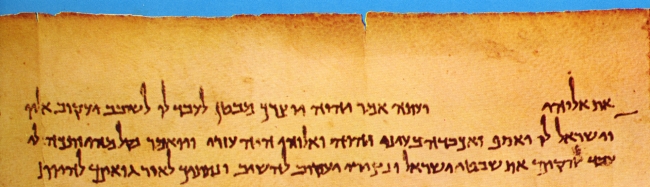 |
1QIsa corroborates this spelling, though the names are later reversed in the MT text. The last line shown here in 1QIsa reads:
49.6 – … עבד להקים את-שבטי ישראל ונצירי יעקב להשיב; …
49.6 – עַבדַי לַאְקָמָא יָת-שִבטֵי יַעְקֹב וְגָלְוָת יִשׂרָאֵל לְאָתָבָא; …
49.6 – וַיֹּאמֶר נָקֵל מִהְיוֹתְךָ לִי עֶבֶד, לְהָקִים אֶת-שִׁבְטֵי יַעֲקֹב, ונצירי וּ[נְצוּרֵי ק'] יִשְׂרָאֵל לְהָשִׁיב; וּנְתַתִּיךָ לְאוֹר גּוֹיִם, לִהְיוֹת יְשׁוּעָתִי עַד-קְצֵה הָאָרֶץ:
The oldest extant copy of MT, the Aleppo Codex, reflects the 1QIsa and MT readings (as opposed to the קְרֵי), reading: וּנְציּרֵי – more likely a nearer cognate of נֵצֶר—and an explicit prophecy, referring back to Yᵊsha•yâhꞋu 11.1; the plural describing his followers: נְצָרִים!
Then [י--ה] said, it is too slight that you be to Me [merely] an ëvꞋëd to raise up the tribes of Ya•a•qovꞋ, and restore the נצירי Yi•sᵊr•â•eilꞋ, so I will give you for an אוֹר of the goy•imꞋ, to be My yᵊshu•âhꞋ unto the extremity of hâ-ÂrꞋëtz."
It is perhaps significant that Klein provides only a tentative, or perhaps diversion, etymology for נֵצֶר, the plural of which is נְצָרִים, ignoring that, according to Jastrow, the term is identical in Aramaic.
All of these cognates derive from the verb נָצַר. The suggested etymology of the modern meaning would seem to derive from viewing the offshoots from the root of an olive tree allegorically as little "sentry guards" that grow into great "sentry guards," surrounding ("guarding") the trunk of the original olive tree.
Another cognate of נֵצֶר is the name of a forward-observer, "sentry" village in the Gâ•lil′, in the mountains on the north side of עֵמֶק יִזְרְעֶאל, directly opposite הַר מְגִדּוֹ ("Armageddon"; on the south side of עֵמֶק יִזְרְעֶאל) – namely, נָצְרַת, which was the hometown of Rib′i Yәho•shu′a, the נֵצֶר of Yәsha•yâh′u 11.1, the plural of which is נְצָרִים, the only correct name of his followers dating from his own lifetime!
Referring to the gathering of Yi•sᵊr•â•eilꞋ in 49.5, this passage refers to the days of the Mâ•shiꞋakh
The pl. compound form of נְצָרִים is …נִצְרֵי. This Servant [the נֵצֶר and his נְצָרִים] will be for a Light [of תּוֹרָה] to the goy•imꞋ, the Yᵊshu•âhꞋ of י--ה unto the limits of hâ-ÂꞋrëtz.
A play on words suggests that, therefore, both the MT version, corroborated by the Aleppo Codex, and further confirmed in the earliest extant ms. of Yᵊsha•yâhꞋu, 1QIsa, imply that the Mâ•shiꞋakh (Bën-Dâ•widꞋ) will raise up the tribes of Yi•sᵊr•â•eilꞋ / Ya•a•qovꞋ, and the נְציּרֵי Ya•a•qovꞋ / Yi•sᵊr•â•eilꞋ [not the fake, Christian poseur "Netzarim" of the goy•imꞋ!] to bring about tᵊshuv•âhꞋ among them and to bring the Light of תּוֹרָה to the goy•imꞋ!
|
|
| Nᵊviy•imꞋ | Translation | Mid•râshꞋ RibꞋi Yᵊho•shuꞋa (NHM) |
NHM |
||||||||||||
|---|---|---|---|---|---|---|---|---|---|---|---|---|---|---|---|
| Dᵊvâr•imꞋ 9.9 | In ascending the Har, to take the stone Tablets, the Tablets of the bᵊrit that 'ה cut with you; and I remained on the Har, for 40 days and 40 nights, LëkhꞋëm I did not eat, and water I did not drink. | RibꞋi Yᵊho•shuꞋa was fleeing 4.1.0 from the sâ•tânꞋ 4.1.1 and hit•pâ•leilꞋ.5.44.2 2 He fasted 6.16.1 forty days 4.2.1 on the Har.4.2.2 | 4.1-2 | ||||||||||||
| Dᵊvâr•imꞋ 8.3 | He oppressed you and caused you to be hungry, then He fed you the manna that you did not know, nor did your fathers, know, in order to make known to you that not on lëkhꞋëm alone shall hâ-â•dâmꞋ live, because it is on everything that issues from the Spokesman of 'ה that hâ-â•dâmꞋ shall live. | 3 Then, look, the sâ•tânꞋ 4.1.1 came and said to him [as he fasted], "If you are a son 3.17.2 of Ël•oh•imꞋ, say to this stone that it should become lëkhꞋëm, and eat it" 4.3.1 4 RibꞋi Yᵊho•shuꞋa said, "The writing, Dᵊvâr•imꞋ 8:3, is:
|
4.3-4 | ||||||||||||
| Dᵊvâr•imꞋ 10.20 | It is 'ה your Ël•oh•imꞋ Whom you shall revere, it is Him for Whom you shall work, and to Him you shall adhere, and in His Name you shall swear. | Another time, the sâ•tânꞋ 4.1.1 took RibꞋi Yᵊho•shuꞋa into a very high, steep har and said to him, "See all of the legions,4.8.1 and their kingships,4.17.1 and governments, and all of the good things in them." 4.8.2 Then he said to him, "It is mine, and if you will kneel down and bow to me one bow 4.9.1 I will give it to you." RibꞋi Yᵊho•shuꞋa replied, "Don't you know what is written in תּוֹרָה (Dᵊvâr•imꞋ 6:13)?" Then the sâ•tânꞋ 4.1.1 let him be.4.11.1 |
4.8-11 | ||||||||||||
| Dᵊvâr•imꞋ 11.18 | You shall put these My Dᵊvâr•imꞋ upon your heart and upon your nëphꞋësh and you shall tie them as frontlets between your eyes. | Then RibꞋi Yᵊho•shuꞋa spoke to the qᵊhil•otꞋ 4.25.1 and to his tal•mid•imꞋ 5.1.1 saying, "The So•phƏr•imꞋ 5.20.0 and those of the Rabbinic-Perushim sect of Judaism 23.25.1 who advocate that Halâkh•âhꞋ 7.1.1 must be exclusively oral 3.7.1 sit upon the bench of Mosh•ëhꞋ.23.2.1 So now, keep sho•meirꞋ 28.20.1 and do 23.3.1 concerning everything—as much as they shall tell you! Just don't imitate their Ma•as•ëhꞋ 7.20.1 because they say but they don't do. They 23.4.1 make great requirements and place great burdens 23.4.2 on the shoulders of men 8.20.1 while they themselves 23.4.3 don't lift a finger. All of their actions they do for the sake of appearances before men 8.20.1—for 23.5.1 whom they enlarge 23.5.2 their tᵊphil•inꞋ 23.5.3 and lengthen 23.5.4 the tzitzi•yotꞋ of their ta•lit•otꞋ.23.5.5 They have an affection 6.5.1 for the places-of-honor 23.6.1 at the mo•ad•imꞋ,23.6.2 to sit in the benches-of-honor 23.6.3 in the Beit ha-kᵊnësꞋët,4.23.2 to be greeted in the shuq 11.16.1 and to be called RibꞋi 23.7.1 by men.8.20.1 Don't wish to be called RibꞋi,23.8.1 for you have one Tan•âꞋ 23.8.2 and you are all brothers.23.8.3 You are not to call anyone upon the earth Father so-and-so,23.9.0 because you have One Father of the heavens;23.9.1 and you are not to be called 23.8.1 Tan•âꞋ 23.10.1 because you have one Tan•âꞋ 23.10.2—the Mâ•shiꞋakh. The great among you shall minister to you.23.11.1 Whoever shall elevate himself shall be made lowly,23.12.1 and whoever shall make himself lowly 23.12.1 shall be elevated.23.12.2 Oy 23.13.1 for you, So•phƏr•imꞋ 5.20.0 and those of the [probably Boethusian 'Herodian' 22.16.1] Rabbinic-Pᵊrush•imꞋ23.25.1 who advocate that Halâkh•âhꞋ 7.1.1 must be exclusively oral 3.7.1—hypocrites,23.13.2 because you lock up the Realm of the heavens 3.2.2 before persons,8.20.2 neither entering yourselves nor allowing 23.13.3 those who wish to enter.23.13.4 |
23.1-12 | ||||||||||||
| Yᵊsha•yâhꞋu 48.2 | …but not in ë•mëtꞋ and not in tzᵊdâq•âhꞋ ; 2 because "from Ir ha-QoꞋdësh" they shall be called, and upon the Ël•oh•imꞋ of Yis•râ•eilꞋ they rely, 'ה Tzᵊvâ•otꞋ is His Name. | Then the sâ•tânꞋ 4.1.1 took him and brought him up into the high place 4.5.1 of the Hei•khâlꞋ 4.5.2 in the Ir ha-QoꞋdësh 4.5.3 & 1.18.7 and he said to him, "If you are a son 3.17.2 of Ël•oh•aꞋ, send yourself from the top down and no harm at all will find you. For it has already been written of him, Tᵊhil•imꞋ 91:11-12: RibꞋi Yᵊho•shuꞋa said to the sâ•tânꞋ, "Isn't the writing Dᵊvâr•imꞋ 6:16? |
4.5-7 | ||||||||||||
| Yᵊsha•yâhꞋu 49.24 | Shall seized property be seized from a warrior? Shall a justly-captured be delivered? 25 For thus said 'ה, Even the captured of a warrior shall be seized, and seized property of a ruthless [person] shall be delivered; and your quarrel I Myself shall quarrel, and your children I Myself shall save. | Then a demon-possessed one 4.24.1 who was blind and mute was presented to him, and he cared for 10.8.1 him so that the mute 12.22.1 spoke and could see. 23 All of the qᵊhil•otꞋ 4.25.1 were stupefied, and said "Is this not the Bën-Dâ•widꞋ?"12.23.1 24 When those of the [probably 'Herodian' 22.16.1] Rabbinic-Pᵊrush•imꞋ sect of Judaism 23.25.1 who advocate that Halâkh•âhꞋ 7.1.1 must be exclusively oral 3.7.1 heard, they said "This one does not cast out demonic-forces 4.24.1 except in baꞋal 12.24.0 ZƏvul 12.24.1—the baꞋal 12.24.0 of the demonic-forces." 4.24.1 25 Seeing their contemplations, he said to them,12.25.1 "Every realm divided up against itself becomes desolate; and every ir 2.23.0 or house which shall fall into divisiveness among themselves won't endure.12.25.2 26 If the sâ•tânꞋ 4.1.1 throws out sâ•tânꞋ,4.1.1 he is divided against himself. How then will his realm stand? 27 If I am casting out demonic-forces 4.24.1 in baꞋal 12.24.0 ZƏvul,12.24.1 then in whom are your members 12.27.0 casting them out? 12.27.1 For this, they 12.27.2 shall be your judges. 28 If I throw out demonic-forces 4.24.1 in the RuꞋakh 1.18.6 of Ël•oh•imꞋ, then 12.28.1 the Realm 4.17.1 of Ël•oh•imꞋ has come. 29 How is anyone able to come into the house of the strong one to plunder his goods unless first he binds the strong one? Then he can plunder his house.12.29.1 |
12.22-29 | ||||||||||||
|
|
||||||||||||||
|
|
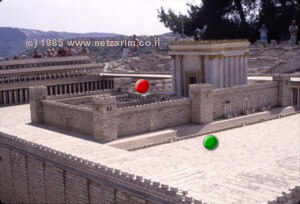 |
Beneath the red dot: Located on the balcony at the SE corner of the inner court of the Beit-ha-Mi•qᵊdâshꞋ ha-Sheini, the Beit-Din ha-Ja•dolꞋ, which supervised all of the lesser Bat•eiꞋ-Din throughout the land, convened in the Chamber of Hewn Stone. Green dot: סרג (sorëg; 1.5 m high stone lattice preventing non-Jews from approaching any closer). |
The discussion of the proper priority of tᵊphil•âhꞋ was raised in the תּוֹרָה section (2005).
•marꞋ RibꞋi Yᵊho•shuꞋa, based on the תּוֹרָה instruction to love one's fellow Jew [these passages were all authored by a Jew and addressed exclusively to Jews] as oneself, followed mainstream thought in placing the practice, the implementation, of תּוֹרָה not only above tᵊphil•âhꞋ but above תּוֹרָה study as well:
NHM 5.23-24—
So if you are about to offer your qor•bânꞋ at the Miz•beiꞋakh in the Beit-ha-Mi•qᵊdâshꞋ and there you remember that your associate is bringing litigation against you, leave your qor•bânꞋ be, right there, and go innocuously and reconcile with your associate. Then, having come, offer your qor•bânꞋ.
Here, recognizing that one may substitute tᵊphil•âhꞋ for qor•bânꞋ (see Shab•âtꞋ Shuv•âhꞋ in our Calendar page), RibꞋi Yᵊho•shuꞋa teaches explicitly that serving י--ה through serving your fellow Jew—implementation of תּוֹרָה—takes priority before study or qor•bânꞋ (i.e., tᵊphil•âhꞋ). The study referred to here is of a theoretical or philosophical nature. Obviously, basic study to know how to implement תּוֹרָה is a prerequisite to the practice of תּוֹרָה.
|
|
The recitation of the שמע according to its Ha•lâkh•âhꞋ [comprises] these three pârâshot concerning the seiꞋdër [liturgy], which is standard. Like we repeat in the section that was being recited ([Tal•mudꞋ], Ma•sëkꞋët Bᵊrâkhot 13.1): •marꞋ RabꞋi Yᵊho•shuꞋa Bën-Qarkhâh, Why does שמע [section] precede והיה אם-שמע [wᵊ-hayah im-shamoa; and it shall be, if you hearken)? In order that one accepts upon himself the Yoke of the Kingdom of the Heavens you begin [thusly], and after that he accepts upon himself the Yoke of the mi•tzᵊw•otꞋ.
והיה אם-שמע to ויאמר (wa-yomër; and he says)? That והיה אם-שמע conducts [one] between today and tonight. ויאמר doesn't conduct [one] except during the day. And they said about this in the Gᵊmâr•âꞋ (Ma•sëkꞋët Bᵊrâkhot 14.2), Tanya RabꞋi Shim•onꞋ Bar-Yo•khaiꞋ says: It is the Din that שמע precedes והיה אם-שמע, that the former learns and the latter teaches. From והיה אם-שמע to ויאמר the former teaches and the latter practices. So, in שמע [section] there is learning, not teaching or practicing. Is it not written: ושננתם [wᵊ-shinantâm; and you shall sharpen them], וקשרתם [u-qᵊshartâm; and you shall tie them], וכתבתם [u-khᵊtavtâm; and you shall write them]' (Dᵊvâr•imꞋ 6.7-9)?
In והיה אם-שמע there is teaching, not learning or practicing. Is it not written: ולמדתם [wᵊ-limadtëm; and you shall learn them] and וקשרתם, (Dᵊvâr•imꞋ 11.18-19)? So, in the שמע there is learning, and teaching and practicing. In והיה אם-שמע there is studying, teaching and practicing. In ויאמר there is only practicing.
And it is said at the end of Pirqâ Qamâ of Bᵊrâkhot 12.2: pâ•râsh•atꞋ Tzitz•itꞋ because what is the determination of the recitation of the Shᵊm•aꞋ?
•marꞋ Rav Yᵊhud•âhꞋ Bar-Khavivâ, Because there are five things in it:
Three of these categories are obvious [from the text]. However, what is the source for aveir•âhꞋ and A•vod•âhꞋ Zâr•âhꞋ? That which is taught: "After your own hearts and after your own eyes" (bᵊ-Mi•dᵊbarꞋ 15.39). "After your own hearts," is from them, It is said, •marꞋ the fool in his heart, "There is no Ël•oh•imꞋ"; [he is] corrupt and abominable of action (Tᵊhil•imꞋ 14.1).
"And after their own eyes." This ponders aveir•âhꞋ, as it is said: "But Shimshon said to his father, 'Take her for me, for she is ישרה (yâshrâh; straight) in my eyes.' "
"Which you prostitute yourself after" (bᵊ-Mi•dᵊbarꞋ, loc. cit.), Rab•âhꞋ Bar-Bar-Khânâ taught: 'This ponders A•vod•âhꞋ Zâr•âhꞋ, as it is said, "and they prostituted themselves after the bᵊâl•imꞋ" (Sho•phᵊt•imꞋ 8.33).
The mi•tzᵊw•âhꞋ from the selection is to be a warning in the recitation of the Shᵊm•aꞋ. As it has been memorized in përꞋëq 2 of the Fathers (…): Rabi Shimon says, it is [a case of] warning in the recitation of the Shᵊm•aꞋ. So, when you pray, don't make your prayer fixed but, rather, [making] pleas before ha-Mâ•qomꞋ, Bâ•rukhꞋ Hu. As it is said, "For He is gracious and compassionate, slow to anger and of great kindness" (Yo•eil 2.13). So don't be râsh•âꞋ in your self.
Although they say, in the përꞋëq we were reading (Bᵊrâkhot 15.1): he read but wasn't grammatical with the letters that went forth. The mi•tzᵊw•âhꞋ from the selection is for being grammatical. As we say about this (op. cit., 15.2), Rav Ovadyâh taught, "And you shall teach them"– in order that there may be a learned there, in order that he may allow space between adherences. Many responses are in two-words, for example: "על-לבבך" (al-lᵊvâvëkhâ; upon your sing. hearts, Dᵊvâr•imꞋ 6.6), "על-לבבכם" (al-lᵊvâvkhëm; upon your pl. hearts, op. cit., 11.18), "בכל-לבבך" (bᵊ-khâl-lᵊvâvkhâ; in all of your sing. heart, op. cit., 6.5), "עשב בשדך" (eisëv bᵊ-sâdᵊkhâ; grass in your field, op. cit., 11.15), "ואבדתם מהרה" (wa-avadᵊtëm; and destroy you pl. quickly, op. cit., 11.17), "הכנף פתיל" (ha-kânâph pᵊtilꞋ; the wing [meaning shawl] pᵊtilꞋ, bᵊ-Mi•dᵊbarꞋ 15.28), "אתכם מארץ" (ëtkhëm mei-ërëtz; with you from the ërëtz of…, op. cit., 41).
So the grammar in it is, if you do the mi•tzᵊw•âhꞋ then you are depositing a good wage, which is more lenient than His punishment. As we have said there, •marꞋ Rabi Khâmâ Bar-Khaninâ: Everyone who recites the recitation of the Shᵊm•aꞋ and parses its letters coldly, for him is Gei-Hi•nomꞋ. As it is said, "בפרש שדי (bᵊ-phâreis Shadai; in the Almighty's scattering) of kings by her [His heritage, Israel], you shall become snow-white בצלמון (bᵊ-tzalmon; in the shadow)" (Tᵊhil•imꞋ 68.15). Don't read "בפרש (bᵊ-phâreis; in the scattering) but, rather, "בפרש (bᵊ-phâreish; in the specifying), and read not בצלמון (bᵊ-tzalmon; in the shadow), but rather, בצלמות (bᵊ-tzalmâwët; in the shadow-of-death), to teach us that even obligatory punishment is more lenient than this.
|
|
|
 250x167.jpg "Shitim, across the Yardein fm Yerikho (Jericho)")
 801x536.jpg "Click to enlarge")