|
Updated: 2026.10.20 
 Inbu-Hedj (White Fortress) Ankh-Tawi Memphis Cairo Russian arch 350x170.png "Hieroglyph NL1, Inbu-Hedj 'White Fortress', later Ankh-Tawi; modern Memphis-Cairo; Karnak Temple wall relief; Wa•sërꞋët (Thebes, modern Luxor; Belova, G. 2018)") |
  White Chapel Karnak (Wiki)1922x1586.jpg "Click to enlarge") Hieroglyph YᵊnævꞋū-ᵏhãd  "White-Wall of the Mace/#1". By the time of Moses, it was called Ankh-TãūꞋi. (photo: Sketchfab 3D model of White Chapel of Sën-Wa•sërꞋët, Sr. |

 [Glos_E-J, updated: 2026.09.26]
𓈠 (YᵊnævꞋū-ᵏhãd); "White Walls", famed for being the first sᵊphãt irrigation canals system.
 72x60.png "sᵊphãt") |
| Sᵊphãt #1 |
Legitimate Kᵊmët terms have been deliberately suppressed in order to maintain the image of an ancient Greek standard against which all other civilizations have been tailored; not measured, tailored. From "Minoans" & "Natufians" to "Egypt"; all within the Greek world. Make no mistake: since LBAC, this lie has been the cause of millennia of ignorance shrouding early civilizations, and since the Excised-Apostate Hellenist Paul, a matter of religious supremacy and clergy-dominanation by the Hellenist-Greek/Roman-Catholic-adoption of the epiphany of the Excised-Apostate Hellenist Paul's recast of the Hellenic-Roman Pantheon with an deified-exaggeration of a Jew, his mother and his ta•lᵊmid•imꞋ: morphing Hellenic Roman-Christianity!
 White Chapel reliefs NE wall Nome 1 sketchfab-com 0350x200.png "ccc") |
 White Chapel reliefs NE wall Nome 1 sketchfab-com 1920x1080.png "Click to enlarge") Hieroglyph YᵊnævꞋū-ᵏhãd
"" (stone relief recorded as Sᵊphãt #1 by later ParꞋōh—whose name, sanitized of presumptuous Greek-Coptic→Latin→English AI-trained "scholarliness", is key:  Sën וָשֶׂרִת Sr., in his list of Sᵊphãt•imꞋ under his rule. (Karnak Temple ( White Chapel of
Front-right, NE, exterior corner, Wa•sërꞋët) listed as Sᵊphãt #1). |
My work, logic, cuts through all religion/clergy, excluding none―while focusing squarely on the Creator-Being of the universe. So I don't fit in any group. I'm not clergy. I'm not leading anyone. I'm a pointer. Analyze it yourself, here's the the onramp sign to אָחוֹר, aka דֶרֶךְ יְהוָׂה, and here's the בְּרִית!
Hellenist supremacy, undergirding Christianity, has always been the underlying—denied of course—impetus for arts-degreed pseudo-scientists to impose Greek/Roman/Christian supremacy. Hence, yet another out-of-order Greek term: "nome". The legitimate Kᵊmët term is in order to preclude the importance of Semitic-Hebrew, the Hebrew Ta•n״kʰ and, most of all, the full and religionized/clergy-ized/ap-priest-iated 😼 teachings of Avᵊrã•hãm and Moses!
In avoiding all of this, the natural similarities between ancient Kᵊmëtan and its only geographic, historic ( Yo•seiphꞋ), trade and contemporary languages intertwined neighbor: A•dãm•ãhꞋ (later distinguishing Kᵊna•an•imꞋ and Yi•sᵊr•ã•æl•im´) Semitic languages. The sole ancient language common to both spoken today is Hebrew! Greek doesn't even have the alephbeit required to reproduce several of the ancient sounds. Hebrew does! Simple conclusion: use Hebrew transliterations (instead of chicken-scratches and Greek simply because Greek was on the Rosetta Stone and, as outlined above, for the European Christian world of early "Indiana Jones" types who, to guard Christianity, Greek *had* to supersede Hebrew!
Not in my house! Hebrew is the only ancient language still written and, despite Hellenist ( Σελευκιδῶν SãꞋtrap An•tiꞋ•ökh•ös ö Ëp•i•phan•æsꞋ) decrees backed by the death penalty, was revived and is still spoken!
in grasping the best understanding of ancient Kᵊmët. While Greek is entirely inadequate for the task, the Kᵊmët term for an ancient Kᵊmët regional-governmental administration province most naturally transliterates to its sister-language, Hebrew—as סְפָאת (sᵊphãt) https://en.wiktionary.org/wiki/sp%EA%9C%A3t#Egyptian . So I•nëbꞋū-HëdꞋyᵊ was the 1ˢᵗ sᵊphãt. (Similarly, there was no Greek "nomarch". Rather, the
Sᵊphãt was ruled by a חָרֵי־תֹף (ᴷhãr•æꞋ Tōph, Summits/Heads of the drum[summons]).
 txt |
 29x24.png "sᵊphãt") sᵊphãt, administered by a ᴷhãr•æꞋ Tōph, answering to the נֶסוּת nᵊsūtꞋ ―in its capital city of Ankh-TãꞋūi!
This 1ˢᵗ sᵊphãt necessarily long predates any unification of another 21 sᵊphãts that didn't yet exist ≈BCE 2686–2181)! The preponderance of "scholars" seem to have that backwards; the cart before the ox.
| txt |
YᵊnævꞋū-ᵏhãd was a later administrative formation. Mën-NōꞋphër was an even later, county-like designation. (On modern maps, these ancient sites are all located in the area of Hellenized-"Egyptian" Arab-Muslim "Abū Ṣīr".)
 Ankh-Tawi Memphis Cairo (Belova 2018).) 0350x235.png "ccc") |
 Ankh-Tawi Memphis Cairo (Belova 2018).) 1642x1096.png "Click to enlarge") Prince Moses' Front [Palace] Door in hometown of then Egypt's capital Ankh-TãꞋūi (originally YᵊnævꞋū-ᵏhãd, "White Walls"). Princess daughter of Par•ōhꞋ Sënãkht-ën- As a young boy, Moses could have seen the 3 Great Pyramids |
Upon the unification of Upper & Lower Egypt, during the Middle Kingdom (c. BCE 2055–1640), the city name became known as Ankh-TãꞋūi (Life of Two-lands). This is the name by which the capital was known from the birth of Avᵊrã•hãmꞋ to the birth of Moses Bën-AmᵊrãmꞋ.
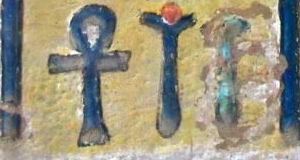 |
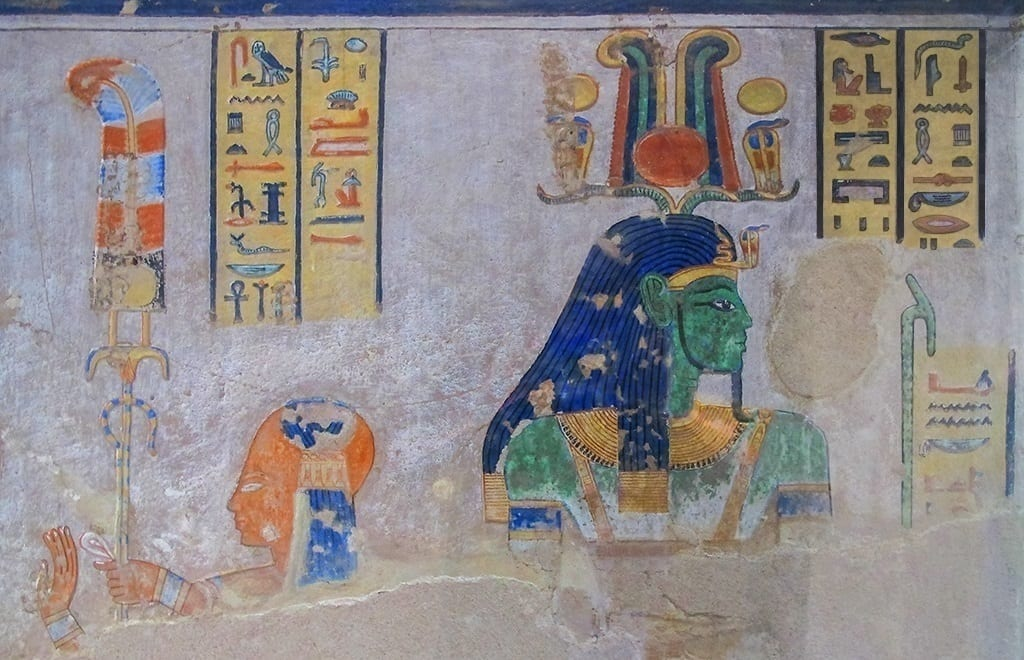 These glyphs do not spell Anᵏh-TãꞋūi directly. Rather, these glyphs spell Anᵏh- life of…: 𓋹 (sign of Life [of…]) +
𓇕 (sign of Upper/South Kᵊmët) + 𓇅 (sign of Lower/North Kᵊmët). Close-up of glyph in (enlarged) photo of vestibule, wall 3, wide-angle view in Tomb of Prince ᵏhᵊ•a-em-Wa•sërꞋët (I deduced these glyphs from translation by Egyptologist Huub Pragt) |
Claims that an ancient artifact attests the hieroglyphic spelling ꜥnḫ-tꜣwy, associated with מֶנְ־נֹפֶר, should be treated as unsubstantiated unless the artifact itself is available for direct visual inspection by the public and the claimed signs can be seen on it. Transcriptions, transliterations, photographs, and epigraphic drawings are not the artifact and cannot, by themselves, establish that the alleged hieroglyphs exist. While damaged hieroglyphs, like damaged papyrus, can be read by extraordinary modern technological instruments, such means were not, until recently, available. Consequently, any claim—in this case the term "Ankhtawy"—dangling from a report from one or a select few experts must be treated as suspect until peer reviewed and supported by publicly accessible evidence from the cited artifacts.
Interestingly, || Gallardo paper xlit: / anx-tAwj; Memphis= מֶנְ־נֹפֶר = נֹף Ptah (creator-god) = Paleo-Hbr 𐤐𐤕𐤇 = MH פֶּתַח door, doorway, entrance, portal, or means of access; that which opens, the opener
Today, this is near the village of Memphis, ≈10 mi. SE of Cairo, Egypt.
Pay it forward (Quote & Cite):
| Yirmeyahu Ben-David. Yenaev-khad, White Wall of the Mace (2026.10.20). Netzarim Worldwide (Ra'anana, Israel). https://www.netzarim.co.il/ (Accessed: MM DD, YYYY). |

 | |  |