
|
The reason this simple page of glossary definitions is ranked so popular with the search engine is because so many people click on our links to these definitions from the content in… the 'Netzarim Quarter' Village web site in Ra•a•nanꞋã(h), Israel at www.netzarim.co.il
In Hebrew, the original followers of Riyb"y were called the Nᵊtzãr•imꞋ (Hellenized-Anglicized to "Nazarenes"). The real content is in the main body of the 'Netzarim Quarter'! Click on the Netzarim logo (at top) for an exciting visit to the 'Nᵊtzãr•imꞋ Quarter' where you'll learn about Historical Riyb"y and his original, Jewish, followers—before the excision of The Apostate Paul, c. 49 CE, that resulted in his Great Jesus-Christianity Apostasy, founded (7 churches) in Anatolia (now modern Turkey). Just as importantly, learn how you (whether Jew or non-Jew) can follow the historically Ta•na״khꞋ-coherent Riyb"y, according to the bᵊrit with יְהוָׂה—which is what genuinely can make you a Jew; regardless of any pronouncement(s) by mortals! (Walking in the bᵊrit must be among Jews in order to be witnessed by Jews; but their, or any mortals', endorsement is of no spiritual relevance whatsoever.)
Until Paqid Yirmeyahu researched the Netzarim name and sect and began publishing about it in 1972 in The Nᵊtzãr•imꞋ Reconstruction of Hebrew Ma•ti•tᵊyãhꞋu (NHM, in English) no one in modern times was even aware of the name Netzarim. It stretches credulity that no one in modern times had heard of the Netzarim until Paqid Yirmeyahu published it in 1972… and then, suddenly, everybody figured it out??? Check (and verify) the dates of the earliest works about the Netzarim by the others and you'll see that they are deceiver-plagiarists. Then insist on the person whom ha-Sheim selected to entrust the knowledge, not imposters who falsely call their continuing practice of Displacement Theology "Nazarene Judaism" or directly plagiarize the name "Netzarim."
Because we teach and practice the authentic Judaic teachings of Ribi Yehoshua—not Displacement Theology—we are the only group who have restored the Netzarim to be accepted in the legitimate Jewish community in Israel—genuinely like Ribi Yehoshua and the original Netzarim. Consequently, the 'Netzarim Quarter' is the only web site of legitimate Netzarim / Nazarene Judaism.
Give all the friends you've ever known the chance to know about this exciting site; send them our web site address (www.netzarim.co.il) that opens modern eyes for the first time to the Judaic world that Ribi Yehoshua and his original Netzarim knew, practiced and taught.

𓂓  [Glos_K-M, updated: 2025.08.01]
חְאַ—note: the glottal stop ח, as in the cut-off of a snoring breath, followed by אַ "•ah" as twice in "uh-oh", may be an onomatopoeia of last breath cut-off snort (death rattle) followed by a baby's first breath — embodying the Egyptian belief in reincarnation.
חְאַ is the ancient Egyptian-religious belief in a vital essence in a human being; that part of a properly mummified body of a Par•ōhꞋ (or similarly racist/classist noble) that emanates from the divine world and reincarnates (□-Moses = □-incarnate) in Par•ōhꞋ to Par•ōhꞋ (or noble to noble). Appears in English as "Ka" and distorted into simplistic English "soul".
Unable to represent this Semitic/African language sound in Greek (Hellenized distorted to Χά (kha), later English "ka", modern Egyptologists resort to using Ivory Tower diacritics inscrutable to the οἱ πολλοί) (hoi polloi, uneducated masses): kꜣ they cannot keep straight, internally disagreeing amongst themselves (demonstrating the similarity of Gondwanan-ancestry Egyptian & Semitic vs EurAsian-ancestry Greek-based languages.

Καϊάφας [Glos K-M, updated: 2011.06.22]
(Kai•aphꞋas, popularly Caiaphas)


Roman-appointed Hellenist-Tzᵊdoq•iꞋ ("Sadducee"!) High Priest.
Since his name is grammatically unrelated to (Shim•ōnꞋ) "כֵּיפָא", his Hellenist name probably did not derive directly from כֵּיפָא despite the conjecture of later commentators who speculated that his Hellenist name might have derived from קיף (Qa•yaphꞋ; a mocking portmanteau, coined by the Pᵊrush•imꞋ, of כֵּיפָא and קוֹף—qoph; monkey; compare MishꞋnãh pãr•ãhꞋ iii. 5; Derenbourg, "Essai sur I'Histoire de la Palestine," p. 215, note 2; Schürer, "Gesch." 3d ed., ii. 218; Josephus, "Antiquities of the Jews," xviii. 2, § 2; Jewish Ency.) Certainly, their family name did not derive from Pᵊrush•iꞋ mockery.
Consulting Jastrow's Aramaic Dictionary, קפא—the name on the less-ornate Caiaphas ossuary—is the root verb meaning "to be on top, to float on the surface."
For more details, click on the less-ornate ossuary.
Καισάρεια [Glos K-M, updated: 2011.04.03]
 |
| 2001.04 Keisariyah Promontory Palace |
Kai•sarꞋei•a;
Καλλίστη  [Glos K-M, updated: 2023.02.02]
 |
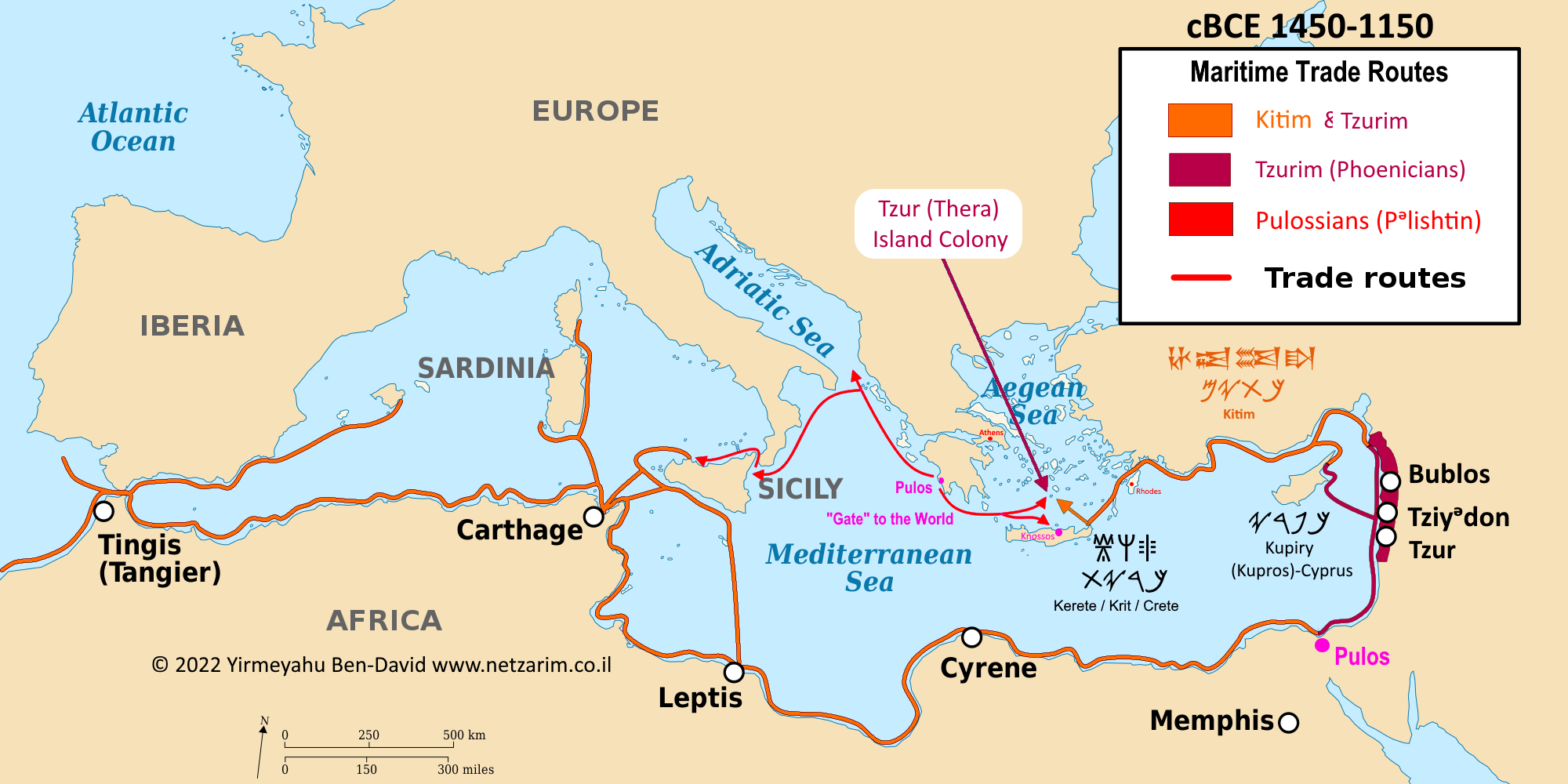 𐤑𐤓-Colony Island—Hellenized exonyms: pre-LBAC ΘΥΡΑ, post-LBAC Θήρα. 𐤑𐤓-Colony Island—Hellenized exonyms: pre-LBAC ΘΥΡΑ, post-LBAC Θήρα. |
Kal•lisꞋtæ—
 55x19.png "r•t•ph•K (Proto-Sinaitic Hebrew)") |  Abydos Ra-moses Jr NW peristyle yard 0125x250.png "Keftia (Egyptian hieroglyph; Kaphtor, Crete)") |
| KaphᵊtōrꞋ (Proto-Sinaitic Hebrew) |  Abydos Ra-moses Jr NW peristyle yard 0475x925.png "Click to enlarge") Keftia hieroglyph Keftia hieroglyph |
 Pi-Ramoses (Tanis) 350x397.png "ccc") |
 Pi-Ramoses (Tanis) 751x851.png "Click to enlarge") Mi•tzᵊr•ayꞋim & Kit•imꞋ) Ka•phᵊtōrꞋ (later renamed by Pūlossians to PūlꞋos) Mi•tzᵊr•ayꞋim & Kit•imꞋ) Ka•phᵊtōrꞋ (later renamed by Pūlossians to PūlꞋos) |
Ka•phᵊtōrꞋ—
The neighboring Egyptians transgarbled Ka•phᵊtōrꞋ to Kë•phᵊtiꞋa.
כִּכָּר [Glos K-M, updated: 2022.04.22]
ki•kãrꞋ;).
A ki•kãrꞋ (Hellenized to τάλαντον) of gold or silver, as estimated by Oxford Biblical Studies Online from many varying descriptions of the shëqꞋël, was about the weight of 2¾ standard bars of gold (i.e. 75½ lbs. U.S. Avoirdupois or 34.3 kg).
כִּלְיָה [Glos K-M, updated: 2019.06.27]
ki•lᵊyãhꞋ; (in contrast to the Egyptian—hence gentile modern—view of the heart as the seat of good or evil.
The ancient association of the kidney with good vs evil was likely expressed among the goy•imꞋ in nephromancy (divination by examination of a kidney) when seeking to resolve questions related to good vs evil.
כִּיּוֹר [Glos K-M, updated: 2025.12.15]
ki•yōrꞋ; sink.
 |
 Kamose prenomen Kamose prenomen |
Par•ohꞋ  Ka-mōs; last Par•ohꞋ of the 17ᵗʰ Dynasty/Second Intermediate Period, reigned in WãsꞋët from ≈BCE [1554–1549] to ≈BCE . Although there currently appears to be significant doubt surrounding his birth, he is thought to probably have been the son of Se-qen-en-
Rã Tao, therefore the older brother of his own successor, Par•ōhꞋ Nëv-PëᵏhꞋti Rã Yaᵏh-mose — 1ˢᵗ Par•ohꞋ of the New Kingdom/18ᵗʰ Dynasty.
The reign of Par•ohꞋ Ka-moses is most important for the decisive military initiatives he took against the KhëqᵊqãwꞋ KhãsꞋᵊt (Hyksos) Levantine immigrants, who had colonized the northern Delta and most of Lower Ancient Egypt — putting his successor (brother?) in position to achieve victory, reunifying Upper and Lower Egypt.
כָּנָף [Glos K-M, updated: 2021.06.01]
 kã•nãphꞋ
connective -כְּנַף (kᵊnaph-; a wing of…),
pl. (& dual) כְּנָפַיִם (kᵊnãph•aꞋyim: a pair of wings, pairs of wings, wings;
pl. connective -כַּנפֵי (kan•phei-; wings of…).
כַּפָּרוֹת [Glos K-M, updated: 2010.07.18]
 |
(pl.) Ka•pãr•ōtꞋ;
Performed preceding Yom ha-Ki•pur•imꞋ, כַּפָּרוֹת is the ritual atonement-sacrifice of a chicken (though practitioners deny it is a sacrifice), which originated in Dark Ages European assimilation.
This superstitious ritual is practiced only by some (not all) Ultra-Orthodox (and no mainstream Orthodox), by swinging it above one's head to absorb the demonic aura of tã•meiꞋ.
 183x150.jpg "Kaparot (Black hat Ultra-Orthodox / Khabad)") |
The כַּפָּרוֹת is then slaughtered according to shᵊkhit•ãhꞋ, cooked (the process believed to destroy by fire, on the family stove, the demonic aura of tãm•eiꞋ, which supposedly dissipates in the cooking vapors  ); then eating the כַּפָּרוֹת before the start of the tzōm.
This constitutes a "private altar" sacrifice prohibited in Dᵊvãr•imꞋ 12.8-27. See, also, our glossary entry for cognate ki•purꞋ supplemented by our explanatory discussion of ki•purꞋ.
כָּרִיךְ [Glos K-M, updated: 2021.07.02]
 0350x233.jpg "karikh (food enwrapped in bread)") |
 1080x720.jpg "Click to enlarge") Kã•rikhꞋ Kã•rikhꞋ |
Kã•rikhꞋ; lëkhꞋëm.
From practically the discovery of making bread in the ancient Middle East c. BCE 13,000 (with 3 zeros), lëkhꞋëm was used to grasp and dip meat or veggies into hot spicy sauce, which was then garnished with salad greens.
The first extant recorded name associated with the bread-meat-dip-greens combo is the kã•rikhꞋ of Hi•leilꞋ Sr. "the Babylonian"! (born c. BCE 70 in Bã•vëlꞋ, died 10 CE in Yᵊru•shã•laꞋyim). A priori, he referred to lëkhꞋëm Bã•vᵊl•iꞋ (modern Iraq)—today called "Iraqi pita".
The Hebrew term, kã•rikhꞋ, predated the development of the Arabic language. Thus, the Kã•rikhꞋ also predates the Schwarma and Laffa.
It wasn't until nearly 15 millennia later, in the mid-18th century CE, that the English called the kã•rikhꞋ after their Earl of Sandwich.
כָּרֵת [Glos K-M, updated: 2018.07.04]
 kã•reitꞋ —
See also kheiꞋrëm (shunning).
Καρπός [Glos K-M, updated: 2020.05.03]
Kar•poss i.e. parsley, celery, lettuce, etc.
In the (Hellenist Roman) Christian era, the Tzᵊdōq•imꞋ and rabbis assimilated significant Hellenism: including reclining while eating and Greek terms from synagogue to Sanhedrin and ka•rᵊpasꞋ to aphꞋi•kōmꞋon). Thus, they syncretized ka•rᵊpasꞋ into the PësꞋakh SeiꞋdër plate; displacing BH: אֵזוֹב (eiz•ōvꞋ).
They did this by transliterating Καρπός into Hebrew letters: כַּרְפַּס — despite that כַּרְפַּס is found only once in the Ta•na״khꞋ (Ës•teirꞋ 1.6)—where it means a finely-woven fabric, not a vegetable)! This is only one of a number of assimilations through the millennia that need to be restored.
כָּשֵׁר [Glos K-M, updated: 2006.04.27]
 |
| Typical Certificate of Kash•rutꞋ: Khã•lãv•iꞋ |
 |
| Typical Certificate of Kash•rutꞋ: Bᵊsãr•iꞋ |
kã•sheirꞋ (adj.);
כַּשׁרוּת (ka•shᵊr•utꞋ; the topic of what is and isn't kã•sheirꞋ).
כַּלְדִּים [Glos K-M, updated: 2022.06.05]
Ka•lᵊd•imꞋ (corrupted to Chaldeans) and introduced the dysphemism כַּשְׂדִּים, used exclusively for "Chaldeans" in modern Hebrew.
The Aramaic כַּלְדָּאִין was then Hebraized (probably in Aramaic/Middle-Semitic Hebrew) to pl. כַּלְדִּים, while the Syriac ܟܠܕܘ Hellenized to Greek as Χαλδαία, which was then Anglicized to Chaldeans.
While less likely, it is possible that a scribe wrongly copied the name from a worn scroll (or corrected from an ostracon) in a different (often far from precise) handwriting. The two could be confused from an old scroll in the Proto-Sinaitic alephbeit, confusing  with
with  , transforming כַּלְדִּים to כַּשְׂדִּים. However, the error is much less likely in the later, Middle-Semitic alephbeit or Modern Hebrew.
The כַּלְדִּים were immigrants from the Levant to Bã•vëlꞋ, who took advantage of domestic conflict to take the throne of Bã•vëlꞋ cBCE 780 and maintain rule until finally overthrown by the 𐎧𐏁𐏂𐎶 (Neo-Persian Iranian "Shãh-dom) Shãh 𐎤𐎢𐎽𐎢𐏁 in BCE 539 (soon after Dãn•iy•eilꞋ's fateful prophecy to the doomed Kalᵊdean regent-son,  , in the absence of his father, Shãh
  74x30.jpg "Nabu-na id (Akkadian cuneiform: ''Nabu is praised'', BCE 556-539); Hellenized to ''Nabonidus''") , of the "writing on the wall").
, of the "writing on the wall").
כַּוָּנָה [Glos K-M, updated: 2006.04.27]
ka•wãn•ãhꞋ;
כָּבוֹד [Glos K-M, updated: 2019.06.27]
kã•vōdꞋ;
Cognate כָּבֵד (kã•veidꞋ) — heavy, weighty, grave, gravitas (both meaning weighty or solemn, and deriving from gravity), burdensome, onerous, stressful. Also, the liver, which the ancients believed to be the body’s stress (stress-decisions) center.
The ancient association of the liver with stress was likely expressed among the goy•imꞋ in hepatomancy (divination by examination of a liver) when seeking to resolve questions related to stressful situations.
כְּהֻנָּה [Glos K-M, updated: 2020.02.08]
Kᵊhūn•ãhꞋ;
כֵּיפָא [Glos K-M, updated: 2026.07.01]
 |
 כֵּיפָא 𐤑𐤓 (Cape Tyre), ancient Phoenicia (modern Lebanon, looking South ≈25km/15½ mi down the coast into Israel. TzūrꞋ was an island. Alexander the Great, in order to conquer the island in BCE 332, built a Roman causeway from shore to the island (≈½ mi)―making it a cape! כֵּיפָא 𐤑𐤓 (Cape Tyre), ancient Phoenicia (modern Lebanon, looking South ≈25km/15½ mi down the coast into Israel. TzūrꞋ was an island. Alexander the Great, in order to conquer the island in BCE 332, built a Roman causeway from shore to the island (≈½ mi)―making it a cape! |
Kæph•ãꞋ (Hebrew) cape (geological feature, probably origin of "cape")
In the specific case of the name, Shi•mᵊōnꞋ "KæphꞋã" Bar-YōnꞋãh, KæphꞋã referenced a specific, nearby geological feature famous throughout the―post-Alexander―ancient Eastern Mediterranean world. "KæphꞋã" referred to a specific cape: of TzūrꞋ―which, before Alexander, had been an unconquerable fortress built on a rock island, then reduced to "smooth rock"
Years—more likely decades—after the death of Shim•onꞋ "KeiphꞋã" Bar-YonꞋãh, the Nᵊtzãr•imꞋ Jew, his reputation was distorted and perverted by post-135 C.E. Hellenist Christians in Rome into the "immigrant to Rome [despite his death and sepulcher, today authenticated by archaeologists and visible in Yᵊrū•shã•laꞋyim!] who, Hegesippusἐποιησάμην, was posthumously claimed as a resident of Rome and postdated by Roman Christians as the "First Pope"! In fact, even the idea of bishops naming a pope never occurred until decades after the death of Shim•onꞋ "KeiphꞋã". The Roman fake was the polar opposite, an antithetical Hellenized (i.e. Christianized) as "Simon Peter." Only then―between 142-68 CE―Hegesippusἐποιησάμην the Hellenized, mythical-Christian "Simon Peter" retroactively, long after his death, into the first ἐπίσκοπος
כְּנַעַן & 

 [Glos K-M, updated: 2025.06.23]
Kᵊna•anꞋ tribes (aka Nᵊphil•imꞋ) in the Levant; later (in the Levant Late-Bronze Age), beginning ≈BCE 1513, conquered, absorbed and subsumed in Yi•sᵊr•ã•æl´. The name first appears in documents from the BCE 15th century.
Deciphering related Egyptian hieroglyphs unveils the KhëqᵊqãwꞋ KhãsꞋᵊt (corrupted to "Hyksos") as the indigenous inhabitants of "RëtꞋnū" (i.e. Kharët-ūnꞋū rëtꞋyën) — Kᵊna•anꞋ:
 120x40.jpg "Rethnu (Kenaan)") |
| RëtꞋnū (Kᵊna•anꞋ) |
Kha•rëtꞋ ūnꞋ•ū rëtꞋyën — Glyphs read by column, top-to-bottom, then right-to-left unless some directional symbol faces left. Faces always point to the beginning of the glyph, though dieties take precedence over that to be pronounced first.
בֵּית-הַכְּנֶסֶת
height= "32" style="margin-left:4px; margin-right:4px" border= "0" alt= "Pronunciation Table" /> [Glos K-M, updated: 2023.12.04]
 |
 Beit ha-KᵊnësꞋët Mo•rëshꞋët Ãv•otꞋ – Yad Nã•ãm•iꞋ, Ra•a•nanꞋã(h). Click video icon to play (or download and save to pay forward: i.e. post & cite) short video of the congregation and me during my 10 year membership in Israeli Tei•mãn•iꞋ Orthodox beit ha-kᵊnësꞋët chanting הוֹשַׁענָא רַבָּא: Beit ha-KᵊnësꞋët Mo•rëshꞋët Ãv•otꞋ – Yad Nã•ãm•iꞋ, Ra•a•nanꞋã(h). Click video icon to play (or download and save to pay forward: i.e. post & cite) short video of the congregation and me during my 10 year membership in Israeli Tei•mãn•iꞋ Orthodox beit ha-kᵊnësꞋët chanting הוֹשַׁענָא רַבָּא:  |
Beit ha-KᵊnësꞋët; pl. בָּתֵי-כְּנֶסֶת (bãt•eiꞋ-kᵊnësꞋët); "house of assembly," widely abbreviated ביהכ"נ — Hellenized to συναγωγή. Israel's congress or parliament is called the KᵊnësꞋët. ("Shul" is Yiddish, an example of assimilation to German culture, to be avoided.)
The origins of the beit ha-kᵊnësꞋët developed in the continuing religious worship—tᵊphil•ãhꞋ, reading of Scripture and dᵊrashꞋ—after the prohibition of sacrifices in the local shrines, antedating the Beit-ha-Mi•qᵊdãshꞋ hã-Rish•onꞋ (Mᵊlãkh•imꞋ Beit 22-23). The development of the beit ha-kᵊnësꞋët surged with the Gãl•utꞋ to Bã•vëlꞋ (Yᵊkhëz•qeilꞋ 11.16; 8.6, 14.1; 20.1).
Bãt•eiꞋ-kᵊnësꞋët were typically very small and, by the first century C.E., numbered between 300 and 500 in Yᵊru•shã•layꞋim alone, including one on Har ha-BayꞋit (Sot. 7.7-8)!
The function of the beit ha-kᵊnësꞋët as a center not only for tᵊphil•ãhꞋ and dᵊrash, but as the all-embracing communal social center, dates from the earliest period (Ency. Jud., 15.583).
The beit ha-kᵊnësꞋët is the proper place for Jews to "assemble" for all matters Judaic.
כְּפָר [Glos K-M, updated: 2014.12.21]
Kᵊphãr,
כְּפִיר [Glos K-M, updated: 2018.12.20]
 |
| Kᵊphir |
kᵊphir;
Like the גּוּר, a kᵊphir is a stage of life of an אַרְיֵה.
כְּרוּב [Glos K-M, updated: 2008.06.12]
kᵊruvꞋ,
 |
| Kᵊruv: Assyria BCE 9ᵗʰ-8ᵗʰ century, Ivory |
"Hōr-em-akht (Horus in the horizon)—Hellenized, millennia later, and misleadingly called the Great "Sphinx" (a cognate of "sphincter," meaning "strangler"). Beyond a few cosmetic similarities to Greek statues of millennia later, the Greek meaning of "strangler" has nothing to do with the much earlier ancient Egyptian statues. Hōr-em-akht originally represented HōrꞋus, god of the dawn, with the head of a ram (the guardian against the demons of the netherworld) on the body of a lion (the guardian of Ra). [An enterprising pharaoh, perhaps followed by successive pharaohs, resculpted the head of "The Sphinx" to depict his own face (resulting in a head disproportionately small); a pattern imitated by kings of other middle-eastern and Mesopotamian countries.]
"Two sculptures of Hōr-em-akht, back to back guarding the comings and goings of Ra, symbolized the rule of the universe. The Egyptian Hōr-em-akht statues bear a far closer resemblance to the kᵊruv•imꞋ (corrupted to “cherubim”) and sᵊrãph•imꞋ described by Yᵊkhëz•qeilꞋ (1 & 10) and Yᵊsha•yãhꞋu (6). See also, inter alia, Ancient Mysteries, Guardian of the Ages: The Great Sphinx, A&E Television Networks and The History Channel, 1996." (The Mirrored Sphinxes, Yi•rᵊmᵊyãhꞋu Bën-Dãvid, 2007).
כְּתִיב [Glos K-M, updated: 2007.09.14]]
kᵊtiv,
כְּתֻבָּה [Glos K-M, updated: 2018.10.13]
 |
| Kᵊtub•ãhꞋ |
kᵊtub•ãhꞋ
כְּתוּבִים [Glos K-M, updated: 2006.04.27]
(pl.) Kᵊtuv•imꞋ
כֶּבֶשֹ [Glos K-M, updated: 2019.07.23]
 |
| KꞋvãs•imꞋ |
KëvꞋës;
Before there was paper money, checks, credit cards or banks, a këvꞋës served as a donation, or payment of a court-imposed fine equal in today’s currency to approx. ₪100 or U.S. $25. (A tal•ëhꞋ was more valuable.)
חב"ד [Glos K-M, updated: 2012.07.19]
Kha•badꞋ;
Thus, although חב"ד identifies with an Ultra-Orthodox view of modern Kʰa•sid•imꞋ (who are traditionally "irrationalists"), the three pillars forming the foundation of חב"ד imply their strong leaning toward a rationalist approach of Ram•ba"mꞋ to spirituality—an approach to which the Nᵊtzãr•imꞋ — Biblical (logical Orthodox), not Ultra-Orthodox — Kʰa•sid•imꞋ readily relate.
חַג [Glos K-M, updated: 2019.10.04]
Khag;
חַגְּנִיק (khagꞋniq), pl. חַגִּנִיקים khag•niq•imꞋ; “Khaj-niks” (coined here, applying a modern suffix, adopted from Russian, to describe participants of the attached noun); i.e. Khag pilgrims from the Tᵊphutz•ãhꞋ.
Khag ha-Matz•ōtꞋ — Firstmonth, the Khag of PësꞋakh and Matz•ōtꞋ/Firstfruits of Barley harvest
Khag Shãv•ū•ōtꞋ — the Khag of Weeks/Firstfruits of Wheat harvest
Khag ha-Sūk•ōtꞋ / Khag hã-ã•siphꞋ — Seventhmonth (not the assimilated Babylonian “New Year” of Ma•rᵊdukhꞋ), the Khag of the Huts/Firstfruits of the Ingathering harvest
חַגָּי [Glos K-M, updated: 2006.04.27]
Khaj•aiꞋ;
חָלַל [Glos_K-M, updated: 2023.11.13]
khã•lalꞋ;
Metamorphically, khã•lalꞋ is used to denote emptied or hollowed-out of worth or value. i.e. profaned, common (e.g., a defrocked priest); to play a hollowed-out flute.
As a noun or adjective, it means empty (e.g. worldly, non-religious, non-spiritual, secular; common, profane, ordinary). By extension, "getting one's hands dirty" (profaned) in the sense of beginning or getting started on something from scratch (beginning with empty hands or vessel).
חַסָּה [Glos K-M, updated: 2021.06.20]
 |
 BH: Biblical-era Egyptian & Levant (modern Romaine) lettuce BH: Biblical-era Egyptian & Levant (modern Romaine) lettuce |
חַסָּה, — the long-leaved, Lactuca sativa, var. longifolia (Romaine) lettuce; a variety popular in ancient Egypt and Israel. This variety of lettuce had an early and intimate idolatrous history with the Egyptian god, Min.
So חַסָּה has come to be PEMRH: lettuce, BH: 1. seek or find refuge, be merciful or sparing, care for or about; 2. Romaine lettuce; 3. the "Mercy Seat" on the A•rōnꞋ ha-Bᵊrit i.e. Throne of יְהוָׂה, flanked by 2 kᵊrūv•imꞋ, on the celestial Më•rᵊkãv•ãhꞋ!
What went awry?
חָכָם [Glos K-M, updated: 2021.11.06]
Khã•khãmꞋ;
חָכְמָה (khã•khᵊm•ãhꞋ; sagacity, wisdom, intelligence, prudence, shrewdness, learning (n.); a sagacious, wise, intelligent, prudent, shrewd, learned woman).
חז’’ל (kha•zalꞋ), post-Talmudic acronym (חֲכָמֵינוּ זִכְרוֹנָם לִבְרָכָה) subsuming the Talmudic terms Tan•ã•imꞋ and Õmōr•ãꞋyim. This acronym effectively redefined Pᵊrūsh•imꞋ from the post-Zūg/ pre-YaꞋvᵊn•ëh perception of Pᵊrūsh•imꞋ to a post-5ᵗʰ-century (Talmudic) conflation. Over the intervening centuries, this unresolved conflation, which perverted YaꞋvᵊn•ëh, has fueled unending internal "Jewish" conflicts and polarization.
חַיִּים [Glos K-M, updated: 2017.08.25]
(pl.) khai•yimꞋ;
This term is often used in the phrase מַיִם חַיִּים (maꞋyim khaiy•imꞋ; lit. "living water") to describe running or flowing—i.e. "live"—water (in a spring, brook or stream), preferred for drinking, in contrast to still or stagnant water (in a container, cistern or pool), which is unfit to drink. In the arid Middle East, where potable water is closely associated with maintaining life, maꞋyim khaiyꞋim also has the connotation of rejuvenating or "life-giving water."
KhaiꞋyim is also a masculine name (for a name, the accent moves to the penultimate, in this case first, syllable).
חַיָּה (kha•yãhꞋ; ׁliving being, animal, beast; anything that would have appeared to ancients to move of its own volition — would have included an animated carving or idol, modern clock, fan, automobile, train, airplane, robot, etc.); plural חַיּוֹת (kha•yōtꞋ; living beings, animals, beasts, robots).
חַלָּה
 350x263.jpg "khalat lekhem shemen") |
 826x620.jpg "Click to enlarge") Biblical חַלָּה—prior to 15ᵗʰ century CE like this unleavened, olive-oil Indian chapati. (courtesy of Aarti Sequeira; photo: foodnetwork) Biblical חַלָּה—prior to 15ᵗʰ century CE like this unleavened, olive-oil Indian chapati. (courtesy of Aarti Sequeira; photo: foodnetwork) |
khal•ãhꞋ, pl. חַלָּוֹת (routinely corrupted in English to halla or challa). Since the discovery of making bread in the ancient Middle East c. BCE 13,000 (with 3 zeros), khal•ãhꞋ has referred to normal soft flatbread; distinct from either
כִכַּר or
רָקִיק,
חַלַּת לֶחֶם שֶׁמֶן implies that khal•ãhꞋ is a perforated, soft, round, olive-oil & סֹלֶת-matz•ãhꞋ flatbread. Approximately 1/24ᵗʰ of the raw סֹלֶת was commanded to be set aside as tᵊrūm•ãhꞋ for the kō•heinꞋ. (Unleavened Biblical khal•ōtꞋ, therefore, is also the authentic flatbread of Khag ha-Matz•ōtꞋ.)
After the destruction of the Beit ha-Mi•qᵊdãshꞋ ha-Shein•iꞋ and the subsequent Roman destruction of yō•khas•inꞋ, "kō•han•imꞋ", having thereby been disqualified as no longer Biblically legitimate (i.e. thereafter relegated solely to ceremonial rituals), no longer qualified to eat Tᵊrūm•ōtꞋ.
As a result, the term khal•ãhꞋ= evolved to include the matz•ãhꞋ from which Tᵊrūm•ōtꞋ had previously been apportioned to the kō•han•imꞋ, and reserved it to be eaten on Shab•ãtꞋ and Khaj•imꞋ, when two khal•ōtꞋ are placed on the table (recalling the double portion of mãn), over which the bᵊrãkh•ãhꞋ is recited. Traditionally, they are covered until the bᵊrãkh•ãhꞋ, so that learning children won't mistake which bᵊrãkh•ãhꞋ belongs to the wine and which to the khal•ōtꞋ.
Until the 15ᵗʰ century CE, all Jews used their weekday rectangular loaves or round flatbread also for Shab•ãtꞋ.
 |
 Assimilated post-15ᵗʰ century C.E. Strucla — Polish poppyseed Xmas loaf (Fir0002/Flagstaffotos) Assimilated post-15ᵗʰ century C.E. Strucla — Polish poppyseed Xmas loaf (Fir0002/Flagstaffotos) |
Beginning in the 15ᵗʰ century CE, however, Orthodox German (Ash•kᵊnazꞋi) Jews initiated a reform, assimilating a "new form of Sabbath bread, an oval, braided loaf modeled on a popular Teutonic bread."
Over time, the Polish Strucla Xmas loaf became the most commonly used "Shabbos hallos" in the Ash•kᵊnazꞋi Orthodox Jewish culture. This Orthodox Ash•kᵊnazꞋi reform assimilation has subsequently spread throughout the world of Ultra-Orthodox, Orthodox and non-Orthodox Jews around the world.
The European-assimilated Ash•kᵊnazꞋi khal•ōtꞋ should be eschewed. However, if the only kã•sheirꞋ bread is the Ash•kᵊnazꞋi khal•ōtꞋ then they will suffice.
 |
 Shab•ãtꞋ noon meal: Qu•bãnꞋãh (popularly corrupted "Kubaneh") with baked egg in shell. Shab•ãtꞋ noon meal: Qu•bãnꞋãh (popularly corrupted "Kubaneh") with baked egg in shell. |
Before coming to Israel and being assimilated into the Israeli Ultra-Orthodox reforms, the older and more pristine generation of Tei•mãn•imꞋ (and, therefore, Nᵊtzãr•imꞋ), Mi•zᵊrakhꞋim and Sᵊphã•rãdimꞋ communities, by contrast, still served the ancient round flat bread for khal•ōtꞋ.
Among European-assimilated Jews today, khal•ōtꞋ are misunderstood to be loaves of bread baked from any kind of kã•sheirꞋ flour (and from which the tᵊrūm•ãhꞋ has been removed with the recitation of the proper bᵊrãkh•ãhꞋ before forming the loaf and baking). The removed tᵊrūm•ãhꞋ is properly burned.
If a khal•ãhꞋ has not been baked in a kã•sheirꞋ bakery (which could be your home if your kitchen is kã•sheirꞋ), then it is not khal•ãhꞋ; regardless what it looks like or how it is labeled or advertised.
חָלָב [Glos K-M, updated: 2019.06.27]
khã•lãvꞋ;
A mother’s חָלָב was also a metonym for one’s native culture (including religion; cf. Shᵊm•ōtꞋ 23.19; 34.26; Dᵊvãr•imꞋ 14.21).
חֵלֶב — milk-like fat surrounding intestines, which was considered the tastiest or choicest—perhaps based on an ancient belief that the Creator was ethereal (as contrasted with metaphysical) and, therefore, more pleased by an ethereal (smoke) sacrifice, fueled by fat (which burns well and produces the aroma of meat on a grill).
Probably regarded by ancients as stored pre-חָלָב (pre-milk, in the mistaken belief that it would become fully-formed and dispensed as milk only by females), חֵלֶב is naturally stored around the intestines inside both sexes. Because of the obvious association with the metonymous “milk” (mother-culture) of Egyptian animal-gods, חֵלֶב was taboo for Yi•sᵊr•ã•eilꞋ (rather than the ancient assumption that it be sacred and reserved exclusively for יְהוָׂה and His kō•han•imꞋ).
Since יְהוָׂה specifically stipulated that Yi•sᵊr•ã•æl´ sacrifice the Egyptian animal-gods, the requirement that the metonymous “milk” be burned entirely thereby symbolized Yi•sᵊr•ã•æl´’s complete rejection and destruction of the entire mother-culture (“milk”) of Egyptian idolatry.
חָם [Glos_K-M, updated: 2025.10.29]
Kʰãm
While modern scientists insist that only Species sapiens is human, earlier scientists named the Genus "Homo" as early human (human-like, not necessarily a direct human ancestor). Genus Homo, homonids—one of whom was the direct ancestor of all humankin, date back ≈9Ma!
However, the ability to put that down in writing—written history—occurred only ≈BCE 1112! So, logic dictates that written history, first transcribing perhaps gigaannum of oral lore history (recited and memorized around campfires in front of caves) into Tōr•ãhꞋ (& other Gondwanan-origin cultures) ≈9 megaannum after the fact, reflects earlier cave dwellers' perspectives to explain the origins of different peoples, their skin colors & cultures dispersed in different lands. יְהוָׂה is NOT racist; ALL those who believe otherwise are racists!!!
חָמֵץ [Glos K-M, updated: 2019.10.02]
 |
khã•meitzꞋ
Ancient Israel & Biblical definition:
all dough (and foods produced from it), other than מַצָּה, that is
made from The Five Species.
שְׂאוֹר is a subset of חָמֵץ.
Note above that, contrary to careless popular assumptions, khã•meitzꞋ is not leaven (which is שְׂאוֹר)! Rather, khã•meitzꞋ is the dough that has been leavened! This makes a significant difference when noting the symbolism of Bᵊdiq•atꞋ Khã•meitzꞋ and Bi•ūrꞋ Khã•meitzꞋ. The search and elimination of khã•meitzꞋ is not a search and elimination of a•veir•ãhꞋ (which correlates to שְׂאוֹר) as the Dark Ages superstitious would have it; it is, rather, the search and elimination of the corresponding fermented dough, i.e. the a•veir•ãhꞋ-fermented nëphꞋësh—i.e. soul-searching and elimination of any a•vær•ãhꞋ-fermentation agent in every nëphꞋësh of the home and family.
However, modern rabbis contravening Dᵊvãr•imꞋ 13.1 (and mindless followers contravening Shᵊm•otꞋ 23.2) have expanded the list of products to include pages of listings — from condiments to ice cream, dish-washing soap, hand soap, bath soap, kitchen cleaning products,, water softeners, lipstick, toothpaste, coffee, soft drinks… This is the inescapable, ex falso quodlibet, result of insisting on the false premise that the Sages cannot have been mistaken. So the rabbis concluded that Moses erred!
Scripture prohibits the universal Orthodox (and Ultra-Orthodox) practice of placing offending products in a cupboard or closet that is then taped closed… The subsequent, הֶתֵּר מְכִירָה — sham "sale" — at a symbolic price, to a gentile cannot override the Scriptural prohibition…
חֲמִישִׁי [Glos K-M, updated: 2014.11.28]
Kha•mish•iꞋ;
The book containing the five books of Tōr•ãhꞋ is called a חֻמָּשׁ (Khu•mãshꞋ). Intriguingly, to be armed is חֻמַּשׁ (khu•mashꞋ), to arm is חִמֵּשׁ (khi•meishꞋ), and one Biblical term for stomach is חֹמֶשׁ (kho•mëshꞋ) – food for the soul, the Bread of Life.
חֲנֻכָּה or חנוכה [Glos K-M, updated: 2019.04.17]

Kha•nūk•ãhꞋ;.
חֲנֻכִּיָּה (Kha•nūk•iyꞋãh); originally an 8-branched (plus shã•mashꞋ) Kha•nūk•ãhꞋ oil-lamp.
חֲנוּת [Glos K-M, updated: 2006.04.27]
khan•utꞋ;
חָנַן [Glos K-M, updated: 2022.12.22]
khã•nanꞋ;
cognate חֵן (khein; graciousness). A RuꞋakh khein is promised in Zᵊkhar•yãhꞋ 12.10. Perverted by Christianity into an idolatrous "grace"; tracks, via LXX, to χαρις (kharis; grace).
Historically critical: In BCE 175, when Ἀντίοχος 4ᵗʰ ὁ Ἐπιφανής partnered with Yᵊhō•shūꞋa Bën-Shim•ōnꞋ-Jr., Bën-Tzã•dōqꞋ, the Hellenist Kō•heinꞋ ha-RëshꞋa to depose his brother, Khōn•iꞋ•yō Bën-Shim•ōnꞋ-Jr., Bën-Tzã•dōqꞋ, Kō•heinꞋ ha-Jã•dōlꞋ—the Mōr•æhꞋ ha-TzëdꞋëq, and Hellenize the priesthood & Beit ha-Mi•qᵊdãshꞋ of ZᵊrūꞋ-Bã•vëlꞋ into the "Temple", the resulting rivalry ensued between their respective parties, the Hellenist proto-Tzᵊdōq•imꞋ and pre-Hellenist proto-Pᵊrush•imꞋ, respectively:
Tobiads—the QōꞋrakh-like, Philhellenic priestly & aristocrat Tzᵊdōq•imꞋ families trace at least as far as טֽוֹבִיָּה֙, known among philhellenists as Τωβίου, in cBCE 465—with embers likely tracing back as far as QōꞋrakh! Being Hellenist Tzᵊdōq•imꞋ, they went by their Hellenist name derived from טֽוֹבִיָּה֙ the Õmōn•iꞋ (then part of Israel, Tribe of Bin•yã•minꞋ): Tobiads!
Kha•nan•imꞋ—the pre-Hellenization kō•han•imꞋ of the party of Khōn•iꞋ•yō Bën-Shim•ōnꞋ-Jr., Bën-Tzã•dōqꞋ, Kō•heinꞋ ha-Jã•dōlꞋ—the Mōr•æhꞋ ha-TzëdꞋëq. Being anti- Hellenist, they certainly eschewed the Hellenization of Khōn•iꞋ•yō to Ὀνίας (and Oniad), they would have been known among themselves, and among those who sympathized with them, as חֲנַנִים (or perhaps ᴷha•sid•imꞋ)—for which Hi•leilꞋ ha-Za•qeinꞋ, "the Babylonian" was famous. Over time, the onerous vicissitudes of Hellenism thrust the Hellenist name "Oniads" upon them; erasing ha•vᵊdãl•ãhꞋ—leaving them appear no different from the Hellenist parties.
חַנּוּן (khan•ūnꞋ; gracious) adj.
See also מָחַל (mã•khalꞋ) and סָלַח (sã•lakhꞋ).
חֲרֵדִי [Glos K-M, updated: 2021.06.01]
 800x500.gif "Khareidim anti-Zionists (Umm Al-Fahm 2010)") |
| Haredi(m) anti-Zionists (Umm Al-Fahm 2010) |
Ultra-Orthodox (pl. חֲרֵדִים;Paul's Hellenist divine fairytale YëshꞋ"u idol—and I'm not a follower of YëshꞋ"u!!! The Israeli gov't imprimatur of these obscene Kha•reid•imꞋ ideals in "official Israeli court" Judaism is largely responsible for today's growing miso-Judaism. Israel's & Jews' security and future depends upon renouncing these cult practices of Sha•maiꞋ Sr.—denounced at YaꞋvᵊn•ëh—and restoring Tōr•ãhꞋ of Mōsh•ëhꞋ Bën-AmᵊrãmꞋ at Har Sin•aiꞋ.
 |
 Kha•reid•iꞋ sawing off the limb he's sitting on Kha•reid•iꞋ sawing off the limb he's sitting on |
Kha•reid•imꞋ pin all of their hopes and dreams on being more pious; and make no bones about claiming that they are more pious than other Jews whom they castigate as Epikoros or goy•imꞋ (and periodically even refer to Israeli police and IDF as "Nazis"!). Thus, an 8% of Israeli Jews presumes to be holier-than-thou and rule religiously over the remaining 92% of Israeli — and, therefore, world Jews.
Get direction from a Kha•reid•iꞋ rabbi, which includes ghetto-izing from non-Kha•reid•imꞋ, belligerently refusing education in science and math (beyond basic arithmetic) and becoming more meticulous in adhering to rabbinic strictures.
Result — Trouble is, no matter how pious they get, their prayers are no more powerful than Thai Buddhists praying for a children's soccer team stranded in a flooded underground cave or Christians praying for miners trapped underground in South America. Things still go wrong for Kha•reid•imꞋ just as often and severe as everyone else on the planet.
So their answer is: insufficient piety, something wrong in their meticulousness to Dark Ages rabbinic fences. They lack an authentic relationship with י‑‑ה and they are not happy nor fulfilled. Go back to #1.
This ultimately impossible and unhappy cult trap inexorably leads to failure, hopelessness, depression and, eventually serious intellectual dysfunction and a break-out to leave ultra-orthodoxy (and, too often, moderate Orthodox Judaism as well) for an education and intellectual fulfillment.
Tōr•ãhꞋ requires only that you do your utmost to live according to the mi•tzᵊw•otꞋ. Then rely on the Graciousness of י‑‑ה — not relying on your piety/meticulousness — for ki•purꞋ as He (not some Dark Ages rabbi) has promised in Tōr•ãhꞋ! His promise you can rely on; and only this will ever enable you to trust Him that you commune with Him. As for "prayer power," you're supposed to serve Him; not Him serve you!!! Ask not for Him to serve you. Ask, instead, how you can serve Him!!! Your meticulousness to cultish Dark Ages rabbinic fences can never substitute for His Graciousness promised in Tōr•ãhꞋ.
The inevitable result of refusing His promise results in countering the popular rabbinic חֲזָרָה בִּתשׁוּבָה. Leaving the Kha•reid•iꞋ ghetto cult occurs either in the form of חֲזָרָה בַּשְׁאֵלָה or יְצִיאָה בַּשְׁאֵלָה or יְצִיאָה/הַנִּקְראֵת לַשְׁאֵלָה, or becoming straight-up דַּתְלָ"שׁ.
Being the best educated in the Kha•reid•iꞋ community, even children and grandchildren of the most prominent Kha•reid•iꞋ rabbis are leaving the Kha•reid•iꞋ cult.
Fanatic descendants (both Ash•kᵊnazꞋim and Sᵊphã•rãd•imꞋ) of 1st century C.E. Hellenist Tzᵊdoq•imꞋ who were expelled by the Hellenist Romans from Judaea in 70 C.E. & 135 C.E. Being Hellenist themselves, it was only the Tzᵊdoq•imꞋ who fled to Europe — then a Hellenist-friendly part of the Roman Empire. (The Pᵊrush•imꞋ, who were the anti-Hellenists, fled to non-Hellenist regions either in the Levant outside of Judea or outside of the Hellenist Roman Empire: Asia and Africa — and are now the Eid•ōtꞋ ha-Mi•zᵊrakhꞋ.)
 |
 Kha•reid•imꞋ riot against IDF, call Israeli police "Nazis", in Yᵊru•shã•laꞋyim 2017.10.23 (AP) Kha•reid•imꞋ riot against IDF, call Israeli police "Nazis", in Yᵊru•shã•laꞋyim 2017.10.23 (AP) |
Largely as a result of Dark Ages, Medieval-era — and even more recent — European persecutions having origins in the Christian Church, the mindset of these descendants of the Tzᵊdoq•imꞋ in Europe ossified into the current, archaic collection of combative, anti-science, Dark Ages mysticism and superstitions characteristic of the early Church. While their dress varies according to the individual cult of Ultra-Orthodoxy, practically all Ultra-Orthodox exhibit some elements of Medieval or pre-WW-II European clothing styles, language (Yiddish) — and science-illiterate, stunted intellect.
 |
 BBC video 2011.10.10 — Ultra-Orthodox BBC video 2011.10.10 — Ultra-Orthodox  |
While the outside world views the odd assortment of often peculiar black hats, black suits, and sidelocks hanging from over the ears of Haredi(m) as the archetypal "Jew," in fact, the term Haredi(m) has only relatively recently (not Biblically) been hi-jacked by this relatively small, hodge-podge collection of Ultra-Orthodox fringe extremists, who are morbidly different from legitimate — moderate and tolerant — Orthodox Jews.
Although Haredi(m) are only a tiny fraction of Israeli or world Jews, their free time, combined with their absolute zombie-like, virtually idolatrous worship of their Ultra-Orthodox rabbis, makes them highly active, vocal and visible when orchestrated by their Ultra-Orthodox Haredi(m) rabbis; generating public awareness (irritation and blowback) of their extremist ways far above the majority of Jews — who are busy at their jobs, working for a living.
Orthodox Jews, in contrast to the Ultra-Orthodox Haredi(m) fringe extremists, are moderate, and dress normally (though most wear a knitted, not-black, kip•ãhꞋ) and are known as Orthodox-nationalist or "knitted kip•ãhꞋ" Israeli Jews.
חַרְחֲבִינָא [Glos K-M, updated: 2021.07.02]
 1st leaves not dissected 0140x100.jpg "Maror-3 Kharkhavina (Apiaceae Eryngium creticum) 1st leaves not dissected") |
 1st leaves not dissected 1024x730.jpg "Click to enlarge") חַרְחֲבִינָא מַכְחִילָה — (Apiaceae Eryngium creticum) Tender 1st leaves not dissected חַרְחֲבִינָא מַכְחִילָה — (Apiaceae Eryngium creticum) Tender 1st leaves not dissected |
Kharᵊkha•vinꞋã (Aramaic); as a kind of mã•rōrꞋ.
חֲרֹסֶת [Glos K-M, updated: 2009.04.02]
Kha•rōꞋsët;
חִתִּי [Glos_K-M, updated: 2026.04.29]
 |
| In the pre-10 Ka era of ᴷHat•tū´sha, Kᵊmët & A•dãm•ãhꞋ, there was no dã•gæshꞋ. The dã•gæshꞋ wasn't invented until >11 millennia later! |
ᴷhit•iꞋ, pl. ᴷhit•imꞋ;
(may derive from חַתַת, bust, to bust, "Buster(s)") — 2ⁿᵈ son of Kᵊna•anꞋ, who was a son of NōꞋakʰ; an early Kᵊna•an•iꞋ ( not Anatolian ᴷHat•tūꞋsha!) tribe (confused in non-Hebrew translations as, inter alia, "Heth", "Chethites" & "Hittites").
Apparently to make a clear and careful distinction from the Anatolian ᴷHat•tūꞋsha, Ta•na״khꞋ refers to the descendants of Kʰæt² never in the pl. Rather, exclusively as Bᵊn•eiꞋ- or Bᵊn•ōtꞋ-Kʰæt².
חֵתִּי (Kʰæt²•iꞋ, adj., [the] Kʰæt²) is similarly found in Ta•na״khꞋ only in the sing.
𒄷𒌨𒊑 חרי [Glos_K-M, updated: 2024.10.12]
Kʰū•ūrꞋ•ri; better known by their successor Gondwanan cousin-clade Anatolian neighbors' name: the ᴷHat•tūꞋsha.
The ᴷHat•tūꞋsha built a confederation absorbing their cousin-clade Anatolians on the northeast Mediterranean Basin. They grew to dominate the entire Mediterranean Basin and, through what is now Gibraltar, the European Atlantic coast perhaps as far as what is now the British Isles where they would be likely to meet merchants from as far north as Denmark and Norway—where they would likely have learned of the Sungod Stone, the ancient "Sun-compass".
Their Gondwanan cousin-clade Mi•tzᵊr•ayꞋim didn't emerge with their first settlements on the northeast African Mediterranean coast until ≈BCE 6,200 to form the first [name preserved] Duality of [known] World Superpowers.
𒅗𒀸 MH: חָרוּם (ᴷhhã•rūmꞋ, sequestered commercial district of a caravanserei or the maritime port of an island or coastland. Note the similarity to חֵרֶם (ᵏhærꞋëm, modern "harem"), an area designated for a particular purpose.. ("The language is preserved in two closely related but distinct forms, one using cuneiform script and the other using [not Egyptian] hieroglyphic writing." )
)
A ᴷhã•rūmꞋ was 1. an ancient maritime port or merchant caravan commercial trading district-citydom, and 2. the province of satellite villages and lands surrounding the central kã•rūmꞋ district (city).
The logistically best-situated ᴷhã•rūmꞋ citydom of an area typically grew to become the capital city of its surrounding satellite villages and lands, which became its ᴷhã•rūmꞋ (province), named after the capital city (e.g., Kᴴat•tūꞋsha, ᴷhã•rūmꞋ Kᴴat•tūꞋsha).
"ᴷhã•rūm" (colony) is likely a form of Kʰã•ãrꞋ•ri, i.e. a Kʰã•ãrꞋ•ri-colony.
Note, however, that the initial letter of ᴷH at•tūꞋsha is different from the initial letter of the Kʰ ū•ūrꞋ•ri, in both the original (Semitic) cuneiform and the (Semitic) Hebraization.
חַשְׁמַל [Glos K-M, updated: 2022.11.16]
 cut pyrite (Gk pur strikes-fire gemstones com) 350x350.png "chysolite (gold-stone), pyrite (fool's gold fire-stone)") |
 cut pyrite (Gk pur strikes-fire gemstones com) 600x600.png "Click to enlarge") Pyrite (Fool's Gold, Fire-Stone) Pyrite (Fool's Gold, Fire-Stone) |
kha•shᵊmalꞋ; "gold-colored stone"; as opposed to a later meaning of "electrum" or the modern meaning: "electricity".
—
חַשׁמוֹנָאִים [Glos K-M, updated: 2021.07.16]
(pl.) Khash•mō•nã•imꞋ — The "Glistenings" — an Egyptian tribe paralleling Kush•imꞋ (Cushites: Ethiopians, who, for a time, ruled southern parts of Egypt) in Tᵊhil•imꞋ 68.32 (Hellenized & Anglicized to 'Hasmoneans').
The family surname seems to indicate Royal lineage from ShᵊlōmꞋōh ha-MëlꞋëkh by the Kushite Queen of Sheba—known today as the Tei•mãn•imꞋ (Yemenite Jews). The family is more famously known by their title: the "Hellenized & Anglicized to "Maccabees", see also Kha•shᵊmon•ãy•im).
חָתַם [Glos_K-M, updated: 2024.01.22]
khã•tamꞋ; sign & seal.
חֲטִיפָה [Glos_K-M, updated: 2022.11.18]
kha•tiph•ãhꞋ;
הַחֲטִיפַת מֶמְשֶׁלֶת הַלִבָּה לְבָּבֶל; the abduction of the core government to Babylon.
הַחֲטִיפָה הַבָּבְלִית, The Babylonian Abduction (BCE 586): This was neither an "Exile", nor did SãꞋtrap  (Nabû-kud•urri-utzur Jr.) deracinate all of the "Jews" in YᵊhūdꞋãh (like the Assyrian Shar
  112x20.png "Neo-Assyrian (cBCE 727–722) Shūlᵊmãnū-Asharëdū (''Friend-god is pre-eminent''; Shalmaneser) 5th") (Shūlᵊmãnū 5ᵗʰ), more than a century earlier—BCE 722, had done to the northern 10 Tribes)! Only the core government of Beit-Dã•widꞋ (later Beit Hi•leilꞋ) and kō•han•imꞋ Tzᵊdōq•imꞋ (later Beit Sha•maiꞋ) in Yᵊrū•shã•laꞋyim were abducted to, and held captive in, Babylon. The remainder of YᵊhūdꞋãh remained mostly intact, but had to replace practically all of its previous core government leadership of Davidic & kō•han•imꞋ Tzᵊdōq•imꞋ governors, who were all sequestered in Bã•vëlꞋ until they were authorized by the decree of BCE 539 of Shãh 𐎤𐎢𐎽𐎢𐏁 Jr. (of the Neo-Persian Iranian Empire) to return to Yᵊrū•shã•laꞋyim.
(Shūlᵊmãnū 5ᵗʰ), more than a century earlier—BCE 722, had done to the northern 10 Tribes)! Only the core government of Beit-Dã•widꞋ (later Beit Hi•leilꞋ) and kō•han•imꞋ Tzᵊdōq•imꞋ (later Beit Sha•maiꞋ) in Yᵊrū•shã•laꞋyim were abducted to, and held captive in, Babylon. The remainder of YᵊhūdꞋãh remained mostly intact, but had to replace practically all of its previous core government leadership of Davidic & kō•han•imꞋ Tzᵊdōq•imꞋ governors, who were all sequestered in Bã•vëlꞋ until they were authorized by the decree of BCE 539 of Shãh 𐎤𐎢𐎽𐎢𐏁 Jr. (of the Neo-Persian Iranian Empire) to return to Yᵊrū•shã•laꞋyim.
[Glos K-M, updated: 2026.04.05]
 Amun-akhenem Khat-shepset cartouche (i-mun-n akhenem-khat-t shepsi-t) Amun-born Foremost of Nobles Karnak temple obelisk 333x500.jpg "Cartouche: i-mun-n akhenem-khat-t shepsi-t") |
| Cartouche (birth name) Khãt-shëpꞋsët  Read in 3 rows, vertically from top to bottom; ideograms face where to begin reading line. Line 1-{i-mun-n}; Line 2-{A•ᵏhën•ëmꞋët; ᵏhat} {shëpꞋsᵊ-t-[3 vertical strokes]} (Amun-akhenem (probably meaning 'anointed'." Read in 3 rows, vertically from top to bottom; ideograms face where to begin reading line. Line 1-{i-mun-n}; Line 2-{A•ᵏhën•ëmꞋët; ᵏhat} {shëpꞋsᵊ-t-[3 vertical strokes]} (Amun-akhenem (probably meaning 'anointed'." |
Khãt-shëpꞋsët;
 Khat-shepset (maat-ka-re) cartouche fm Red Chapel wall Karnak 114x204.jpg "Cartouche: Khãt-shëpꞋsët apotheotic name") |
| Cartouche apotheotic name of Khãt-shëpꞋsët: Ma•at-ka- (Red Chapel wall, Karnak). |
As it is also known that Egyptian Royal families married only siblings (to keep the royal blood pure), it then becomes likely that the known paramour — i.e., eligible sibling — of Queen Khãt-shëpꞋsët, the architect who built her mortuary temple on the same pattern as the future Beit ha-Mi•qᵊdãshꞋ would eventually be built, was named Sën-ën-Mūt.
Interestingly, like Queen Khãt-shëpꞋsët herself, Sën-ën-Mūt was blotted from Egyptian history by her (their?) own son and successor. Ergo, (since it was the closest candidate proximate to the effects of the to Arts-degreed archaeologists' later datings) the likely name of "Moses," later Hebraized to his native culture as משֶׁה, was Egyptian Royal Pharaonic Prince Sen-en-Mut Tut-MoS, little brother of famed Egyptian Queen-Par•ohꞋ Khãt-shëpꞋsët???
In 2012, the Arts-degreed archaeologists were insisting, vociferously, that my dating, back then, to Khãt-shëpꞋsët's reign was ≈2 to 2½ centuries too early!!! They were unanimous that I was a raving ignoramus—since they were certain "Biblical Moses" lived much later. Now, in 2025, however, even choosing that latest possible candidate to still place Mōsh•ëh´'s lifetime within the realist effects of the TheraꞋ eruption—that caused the Yᵊtzi•ãhꞋ (!) while opting to stay as close as I could to the later dating of the Arts-degreed adventurers—who have now faded into the ether), even that effort was too late (as I suspected even then). It turns out, after the ¹⁴C dating by archaeological scientists, I was right, not the consensus of all of the Arts-degreed "archaeologists"!!! The most likely candidate turns out to be even earlier—the grandmother of Khãt-shëpꞋsët: Princess Par•ōhꞋ YakhꞋū-Mōses Mër•itꞋ-A•mūnꞋ of Shᵊm•ōtꞋ 2.5-10!!! Yeah! I'm taking a well-earned solo victory lap over the entire 2012 consensus among Arts-degreed archaeologists! And enjoying it! Go learn science! And that includes historians!
While Princess Par•ōhꞋ Khãt-shëpꞋsët is the grand-daughter of the Princess of Shᵊm•ōtꞋ 2.5-10, many instances of the data apply even moreso to her grandmother!
𒄩𒀜𒌅𒊭, 


 [Glos_K-M, updated: 2026.04.30]
 |
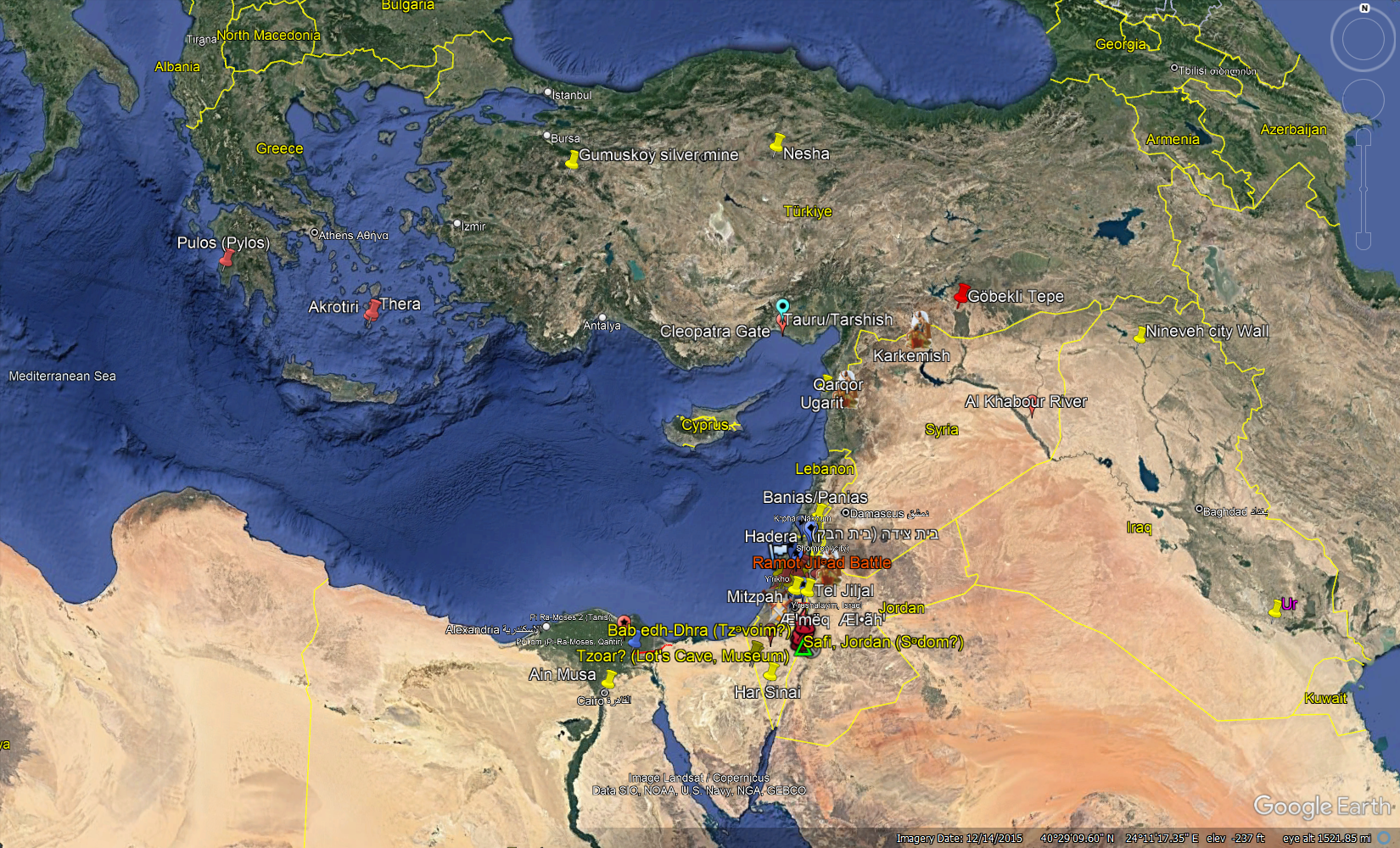 Eastern Mediterannean Basin, Nesha/Khattusha Eastern Mediterannean Basin, Nesha/Khattusha |
Mythical "Minoan(s)" redirects here.
(Kʰat•tūꞋsha)/Kit•imꞋAs Emeritus Professor of Asian and Middle Eastern Studies at the University of Pennsylvania James D. Muhly remarked, "The first thing to realize about the Hittites is that they are not Hittites."
In fact, traditional historians and archaeologists (as contrasted to recent hard scientists specializing in these and related fields) have made a terribly confused mess, conflating a series of successive ruling Anatolian citydoms, whom the ancient Egyptians lumped together as the "Sea Peoples". 19ᵗʰ and early 20ᵗʰ century CE "Indiana Jones" -style European "superior" explorers, unable to properly identify the origin-peoples of the bones and artifacts they were excavating, began to simply fabricate their own names for ancient "John or Jane Does".
This is the archaeologically-embarrassing origin of several non-existant peoples; e.g., "Minoans" and "Natufians" as well as most species of early hominins (neanderthals, etc.) as well as identifying their earliest tool-making. Not incidentally, these were European whites who regarded their European selves—wrongly including Pelopónnese and Anatolia as original Greece (European) and—as "superior"; and today remain adamantly skewed to insist that post-LBAC Pelopónnese and Anatolian "Greek Europeans" (rather than African-related Pelopónnese and Anatolians) have always been and must today remain the sole indigenous claimants to Pelopónnese, Anatolia and Cyprus origins. (Full disclosure: I'm blue-eyed white of Dutch descent; just not racist nor supremist.) Thus, the west-east longitudinal geotectonic "seam" running through Pelopónnese and Turkey, where the two continents were joined, differentiates the Laurussian (European) continent from the subducting African continent (with its Cimmerian Terranes island chain). This "seam" then becomes increasingly critical to distinguish the remains of ancient Africans-cousin Homo subspecies from European-cousins Homo subspecies.
Kᴴat•tūꞋshans (aka כִּתִּים (Kit•imꞋ), collectively transgarbled to modern "Hattians" & "Hittites")—Autochthonous Anatolians (modern western Turkey)—defined by their NëꞋshan language (as also defined their "cousin" Anatolians who succeeded them).
The ᴷH•ãrꞋrians of Anatolia were the earliest—likely autochthonous—human inhabitants of Anatolia (modern western Turkey)—along with their cousin "ocean-like" islanders (particularly Pelopónnese, Crete and Cyprus) that are now part of the Cycladic civilization remnant of the Cimmerian Terranes island chain.
However, it was their more successful NëꞋsha-speaking, neighbor-Anatolian Kᴴat•tūꞋshan/Kit•imꞋ cousins who developed the first truly seaworthy shipbuilding architecture technology, enabling them to build the world's first international cargo and naval fleets. In addition to their land-based caravans, their unique and exclusive fleet of seaworthy ships (partially dependent upon Tzūran cypress wood, probably paid for in seaworthy ships, which also boosted Tzūr into international maritime trade) enabled the Kᴴat•tūꞋshan/Kit•imꞋ to becoome the world's first international land & sea superpower and international traders; navigating and controlling the Mediterranean Sea.
חָצֵר [Glos K-M, updated: 2020.02.06]
khã•tzeirꞋ;
חֲבַקּוּק [Glos K-M, updated: 2006.04.27]
Kha•va•quqꞋ;
חָבֵר [Glos K-M, updated: 2006.04.27]
Khã•veirꞋ;
"Friend," by comparison, more accurately reflects יָדִיד (yã•didꞋ), often inaccurately exaggerated to "beloved"; see Dã•widꞋ
חַברוּתָא [Glos K-M, updated: 2006.04.27]
(Aramaic)Kha•vᵊr•utꞋã; company, companionship, society—yᵊshivꞋãh slang: "learning companion." See our Kha•vᵊr•utꞋã "Distance Learning Companion" Syllabus by clicking the appropriate Ministry in our navigation panel at left—"Tᵊshuv•ãhꞋ Center" [only for Jews recognized by Orthodox rabbis] or "Non-Jews"—where you'll find the Kha•vᵊr•utꞋã track geared to your perspective.
A male candidate in our Kha•vᵊr•utꞋã is a חַבְרָא (kha•vᵊr•ãꞋ). A female candidate in our Kha•vᵊr•utꞋã is a חֲבֶרְתָּא (kha•vë•rᵊ•tãꞋ). Candidates (plural) in our Kha•vᵊr•utꞋã are חַבְרַיָּיא (kha•vᵊr•a•yãꞋ).
חֲבוּרָה [Glos K-M, updated: 2008.02.12]]
kha•vur•ãhꞋ, company, party, association; a band or small group of people. Colloquially, a small religious fellowship, generally focused on tᵊphil•ãhꞋ and Tōr•ãhꞋ study.
חַוָּ֑ה [Glos K-M, updated: 2022.08.18]
 350x450.jpg "Mitochondrial Eve, ca. BCE 125,000 (bradshawfoundation.com)") |
ᴷhaūꞋwãh. This was later Hellenized, then Anglicized to "Eve."
Mother of all humans lived 200,000 years ago Rice [Univ.] statisticians confirm date of 'mitochondrial Eve' with new method
HOUSTON — (Aug. 17, 2010) — The most robust statistical examination to date of our species' genetic links to "mitochondrial Eve" — the maternal ancestor of all living humans — confirms that she lived about 200,000 years ago. The Rice University study was based on a side-by-side comparison of 10 human genetic models that each aim to determine when Eve lived using a very different set of assumptions about the way humans migrated, expanded and spread across Earth.
The research is available online in the journal Theoretical Population Biology.
See also Ä•dãmꞋ
חֲזֶרֶת [Glos K-M, updated: 2021.06.19]
|
| BH: Biblical-era Egyptian & Eastern Mediterranean Coastlands (modern Romaine) lettuce |
kha•zërꞋët — a type of mã•rōrꞋ.
BH: long-leaved, Lactuca sativa, var. longifolia (Romaine) lettuce; a variety popular in ancient Egypt and Israel. This variety of lettuce had an early and intimate idolatrous history with the Egyptian god of sexuality, Min.
MH: — (resulting from Medieval European Ultra-Orthodox Ash•kᵊnazꞋim assimilation & reform): horseradish
חֲזֶרֶת derives from חָזַר. Klein noted that this base is related to the base חָדַר, from which חֶדֶר derives.
Shō•meirꞋ Tōr•ãhꞋ Jews, because they practice kã•shᵊr•ūtꞋ, will be aware of the innumerable tiny chambers enclosing, concealing and surrounding insects that Tōr•ãhꞋ prohibits us from eating, and the resulting difficulty of examining and cleaning–notoriously exasperating in חֲזֶרֶת–would give חֲזֶרֶת signature notoriety as a khasꞋã for insects—a fitting metonym. This seems likely not only the correct derivation, but secondarily confirmed in its subsequent association with חַסָּא—a metonym for lettuce.
Because Medieval (11ᵗʰ-12ᵗʰ centuries CE) European Jews were sometimes unable to obtain lettuce in time for Khag ha-Matz•ōtꞋ, French Ash•kᵊnazꞋim Ultra-Orthodox rabbis reformed (assimilated) חֲזֶרֶת to mean horseradish. Because Ash•kᵊnazꞋim (secular) Jews have dictated modern Hebrew and Israel, חֲזֶרֶת has come to be accepted as horseradish in MH.
 khã•zōnꞋ
חֵרֶם [Glos K-M, updated: 2023.05.17]
khærꞋëm;
KhærꞋëm can also refer to an exclusionary segregation—segregating and quarantining apart from; i.e. excommunicating or excising. KhærꞋëm also sometimes refers to permanent quarantine: i.e. as a synonym of kã•reitꞋ.
KhærꞋëm is the origin of the modern English term, "harem."
KheiꞋshëv-□ of… (compound form of the pi•eilꞋ verbal noun derived from חָשַׁב).
KheiꞋshëv-□ is found only 8x in Ta•na״khꞋ, where it is reserved exclusively for the buckling system that belted the bottom of the KhōꞋshën Mi•shᵊpãtꞋ (holder-pouch, in which the marvelous divining Ūr•imꞋ wᵊ-Tūm•imꞋ was secured) to the Ei•phōdꞋ; in other words, the Marvelous Divining Buckle [of the Ei•phōdꞋ]—world's only Divining belt-buckle!
Interestingly, PEMRH: for "computer" is a close cognate, מַחְשֵׁב (ma•khᵊsheivꞋ).
חֵטא [Glos K-M, updated: 2020.03.23]
kheit,); derived from the pi•eilꞋ חִטֵּא; in turn derived from the shōrꞋësh חָטָא.
חֶלֶף — Κλωπᾶς [Glos K-M, updated: 2011.04.04]
KhëlꞋëph;
Greek names mixed with Hebrew names of the ossuary inscriptions in the Talpiot Tomb and Har ha-Zeit•imꞋ ossuary complexes demonstrate that, particularly consequent to the crucifixion of RibꞋi Yᵊho•shuꞋa, the Nᵊtzãr•imꞋ, Yᵊhud•imꞋ—and even the family—were forced to lower their profile, under the radar of both their Hellenist Roman occupiers and Hellenist pseudo-Tzᵊdoq•imꞋ informers, downplaying their royal Davidic lineage, concealing their identity as Nᵊtzãr•imꞋ and even becoming known publicly by Greek names.
חֵפֶץ [Glos K-M, updated: 2020.07.13]
KheiꞋphëtz; ambition (i.e. desire, wish. drive) to succeed materialistically, for worldly (physical) fortune and fame; the essential element distinguishing mᵊlãkh•ãhꞋ, prohibited on Sha•bãtꞋ, from other strenuous effort or work permitted on Sha•bãtꞋ.
As is generally the case involving two or more enigmatically different meanings, the Biblical meaning of this term is the intersection of the two modern meanings (which are based on traditional—susceptible to the same foibles as today—translations of ancient texts: 1. material, worldly physical things; i.e. an object or article. 2. a desire, want or wish (for, and in pursuit of, #1).
חֶסֶד [Glos K-M, updated: 2026.01.29]
ᴷhësꞋëd;
"The first [ᴷha•sid•imꞋ]… were an ancient Jewish sect that [became distinct] between [BCE] 300 and [BCE] 175. They were the most rigid adherents of Judaism in contradistinction to those Jews who were beginning to be affected by Hellenistic influences. The Hasidim led the resistance to the hellenizing campaign of Antiochus IV of Syria, and they figured largely in the early phases of the revolt of the Maccabees."
Modern "Hasidim," which "Bᵊal Shæm Tōv" [Master Onomancer] began in the 18ᵗʰ century C.E.—the American Revolutionary War era, was apparently an attempt to imbue the iy-ra•tzᵊyon•ãlꞋim (popular during the lifetime of Ram•ba"mꞋ and led ultimately to the 13ᵗʰ century mysticism of Qa•bãl•ãhꞋ) with the authenticity, reputation and imprimatur of the ancient ᴷha•sid•imꞋ, who are documented at least as early as the time of Dã•widꞋ ha-MëꞋlëkh (click "further info" icon for documentation). Thus, today's ᴷha•sid•imꞋ, primarily represented by חב"ד, are iy-ra•tzᵊyon•ãlꞋim—opposite to both Ram•ba"mꞋ and the ancient ᴷha•sid•imꞋ.
(חֶבְרֶה) חבר'ה [Glos K-M, updated: 2008.02.12]
(pl.) KhëꞋvᵊr•ëh,
חֶברוֹן [Glos K-M, updated: 2006.04.27]
Khë•vᵊr•ōnꞋ,
חִלָּזוֹן [Glos K-M, updated: 2008.04.02]
 407x313.jpg "Khilazon - Murex trunculus (encyclopedie-universelle.com)") |
| Khilazon — Murex trunculus (encyclopedie-universelle.com) |
Khi•lãz•onꞋ,
More specifically חֶלזוֹן-הָאַרגָמָן (khël•zonꞋ hã-ar•gã•mãnꞋ; Murex trunculus, lit. purple [dye] snail).
חִלְבָּה [Glos K-M, updated: 2020.05.22]
Tei•mãn•iꞋ condiment made from חִלְבָּה (khilꞋbãh)
 |
2 Tsp חִלְבָּה
1 tsp green or red — usually green — skhug (to make green or red חִלְבָּה)
2 cloves pressed garlic
Purée of 1 fresh ripe tomato
Salt to taste
Check seeds properly, then grind to a very fine powder. Add boiling water to ground חִלְבָּה and cover; let it sit until thickened, at least for 3 hours. Drain well. Then beat with a wire whisk
To conserve the חִלְבָּה for a few days, warm it over fire, stirring continuously, bring to a boil, remove scum and cool.
Add salt, garlic, grated tomato purée, either red or green skhug and mix well. For green חִלְבָּה, use green skhug and leave out the tomato purée.
חִלּוּל הַשֵּׁם [Glos K-M, updated: 2008.09.15]
khi•lulꞋ ha-Sheim;
Note that this encompasses immensely more than the narrow concept of "defamation." One can be guilty of khi•lulꞋ ha-Sheim without ever "defaming" or "blaspheming" the Name, merely by falling short of performing Qi•dushꞋ ha-Sheim—thereby "diminishing" His kã•vodꞋ. Ha•lãkh•ãhꞋ considers any consciously rebellious act against ha-Sheim as khi•lulꞋ ha-Sheim (Maim. Yad, Yᵊsodei ha-Torãh 5.10).
These counter-balancing pillars, khi•lulꞋ ha-Sheim and, lᵊ-hav•dilꞋ, Qi•dushꞋ ha-Sheim, constitute one of the most significant concepts in Tōr•ãhꞋ, based on wa-Yi•qᵊr•ãꞋ 22.31-32. See also Qi•dushꞋ ha-Sheim.
חֹדֶשׁ [Glos K-M, updated: 2025.08.26]
 |
| |
khōꞋdësh,
"Moon," specifically, in Hebrew, is יָרֵחַ (yã•reiꞋakh) and is often referred to by its feminine metonym לְבָנָה (lᵊvãn•ãhꞋ; a white object, especially a white mud-brick, see below).
The first day of the new lunar month is רֹאשׁ (the head or top of) חֹדֶשׁ
The Biblical names of months are simply Firstmonth through Twelfthmonth. These became assimilated by Babylonian Jews, who assimilated the Babylonian names (Ni•sãnꞋ, …) so thoroughly that even the earliest extant texts of Ta•na״khꞋ include the Babylonian names to ensure clarity in important dates.
However, this was not an authorization to assimilate the Babylonian names. This is only one of a number of assimilations through the millennia that need to be restored.
🌑 N9—New moon (≈1 day)
🌒️ N9—Waxing crescent (≈6⅜ days)
🌓 N10—First quarter (≈1 day)
🌔 N10—Waxing gibbous (≈6⅜ days)
🌕 N11—Full moon (≈1 day)
🌖 N11—Waning gibbous (≈6⅜ days)
🌗 N12—Last quarter (≈1 day)
🌘 N12—Waning crescent (≈6⅜ days)
 לְבֵנָה, irregular masc. pl. suffix לְבֵנִים; refers to special, Egyptian
  brick 115x50.png "dzhebet (adobe) brick") ("d•zhëbꞋët", origin of "adobe") mud-bricks (in Mediterranean countries dating back to cBCE 12,000), to which crushed (powdered) white shale, quarried from nearby valley sediments, was added to whiten them—i.e. white-bricks (cf. Shᵊm•ōtꞋ 1.14). Ordinary mud-bricks retained the natural reddish color of the clay soil or were further reddened by the addition of crushed red shale—from faraway quarries. Whitening the bricks represented added manufacturing burdens—quarrying white shale from nearby valley sediment, transporting it, crushing it to powder and then adding the proper mixture to whiten the damp mixture before sun-baking them to hardened bricks.
("d•zhëbꞋët", origin of "adobe") mud-bricks (in Mediterranean countries dating back to cBCE 12,000), to which crushed (powdered) white shale, quarried from nearby valley sediments, was added to whiten them—i.e. white-bricks (cf. Shᵊm•ōtꞋ 1.14). Ordinary mud-bricks retained the natural reddish color of the clay soil or were further reddened by the addition of crushed red shale—from faraway quarries. Whitening the bricks represented added manufacturing burdens—quarrying white shale from nearby valley sediment, transporting it, crushing it to powder and then adding the proper mixture to whiten the damp mixture before sun-baking them to hardened bricks.
חֹל [Glos K-M, updated: 2020.09.05]
khōl; pl. (Aramaic) חֻלִּין (khul•inꞋ);
חֹל derives from the verb shōrꞋësh חָלָל, which takes 4 senses from a common etymological theme:
a hollow or empty—i.e. profane—priest (illegitimate or defrocked) void of priestly holiness;
a person who was stabbed or slain (profaned)—hollowed, emptied or void of sacred blood/soul;
HH hollow, empty cavity, void, space; and
NH: flutist (player of hollowed wood).
חֹק / חוֹק [Glos K-M, updated: 2006.04.27]
khōq; pl. חֻקִּים and connective pl. חֻקֵּי,
חֻקָּה, and pl. חֻקָּוֹת, are passive verb forms.
Anomalously, Hebrew conveys more precisely than English the sense of legal and lawful v illegal and unlawful, which, in reality, is relative to legislated-law: חֻקִּי v בִּלְתִּי חֻקִּי
A legislative body or parliament is a beit ha-מְחוֹקְקִים, overseeing חֲקִיקָה (making the חֻקִּים) — but the parliament in Israel is the KᵊnësꞋët — yet a beit kᵊnësꞋët is where Orthodox Jews assemble to pray. 
In MH, חֻקָּה means "constitution." In BH, there was no appreciable distinction between the masc. and fem. forms of these nouns.
חֹרֵב [Glos K-M, updated: 2006.04.27]
KhōrꞋeiv;
The location and identity of this mountain, like the location and identity of Har Sin•aiꞋ itself, are uncertain — but close to each other. In early Hebrew, the names could easily have become corrupted either to הר חרוז (Har Khar•ozꞋ; ≈4km [≈2½ mi] NE of Har Kar•komꞋ) or to הר חדר (Har Khad•arꞋ; ≈27km [≈17 mi] NE of Har Kar•komꞋ).
Because of its proximity to the neighboring Har Kar•komꞋ (the probable modern identity of Har Sin•aiꞋ), it was a metonym for Har Sin•aiꞋ; Hellenized and de-Judaized to "Mt. Horeb."
חֹשֶׁךְ [Glos K-M, updated: 2021.08.09]
KhōꞋshëkh;
בְּנֵי-חֹשֶׁךְ — enemies of Yi•sᵊr•ã•eilꞋ, including those who abandon Tōr•ãhꞋ; in contrast with the בְּנֵי-אוֹר (from the DSS, especially 1Q 1.1, The "War Scroll").
חֹשֶׁן מִשׁפָּט [Glos K-M, updated: 2022.10.13]
KhōꞋshën Mi•shᵊpãtꞋ, .
The KhōꞋshën Mi•shᵊpãtꞋ was belted to the chest of the Kō•heinꞋ ha-Jã•dōlꞋ by means of threading the AvᵊneitꞋ through the gold rings at the bottom of the KhōꞋshën Mi•shᵊpãtꞋ; simultaneously incorporating the KhōꞋshën Mi•shᵊpãtꞋ, its interior pouch housing the Ūr•imꞋ wᵊ-Tūm•imꞋ, as an integral part of the חֵשֶׁב הָאֵפוֹד—the Marvelous Divining-Buckle of the Ei•phōdꞋ
In the pouch sewn underneath this gold frame, the אוּרִים וְתֻמִּים were kept — closest to the heart. The חֹשֶׁן מִשׁפָּט was fastened to the אֵפוֹד, which was similarly woven from threads of gold, tᵊkheilꞋët, purple and scarlet.
חֹשֶׁן is called "breastplate" (or "chest piece") only because the original meaning has been lost and it was the thing tied over the chest. There is no likely etymology connecting חֹשֶׁן to the chest, "breastplate" or any of its synonyms. It more likely derives, via חוׂשׁ, from חֲשָׁשׁ and cognate חַשְׁשָׁן. Thus, חֹשֶׁן more likely alludes to the overwhelming gravity/gravitas, apprehension and cautious deliberation due in weighing matters of mi•shᵊpãtꞋ or deferring to the last resort: committing the outcome to the אוּרִים וְתֻמִּים within (its pouch).
 230x175.gif "בָּרֶקֶת (baREQet=malachite, green tourmaline or emerald): לֵוִי (LeiWIY)") |
 |
 |
Right: אֹדֶם, Targum: סָמְקָן —      Center: פִּטְדָה, Targum: יָרְקָן —  Left: בָּרֶקֶת, Targum: בָּרְקָן — |
 |
 |
 |
Right: נֹפֶךְ, Targum: אִזְמַרַגְדִּין —   Center: סַפִּיר, Targum: שַׁבְזֵיז — Left: יַהֲלוֹם , Targum: סַבְהֲלוֹם —   |
 |
 |
 |
Right: לֶשֶׁם, Targum: קַנְכֵּירִי —  Center: שְׁבוֹ, Targum: טְרַקְיָא — Left: אַחְלָמָה, Targum: עֵין עִגְלָא — |
 |
 |
|
Right: תַּרְשִׁישׁ, Targum: כְּרוּם יַמָּא —  Center: שֹׁהַם, Targum: בֻּרְלָא —  Left: יָשְׁפֵה , Targum: פַּנְתֵּירִי — |
Ancient Hebrew fonts courtesy of Ancient Hebrew Research Center
Unlike non-Jewish attempts (typically ignorant of ancient Judaism, Aramaic, Hebrew or even Greek) and rabbinic interpretations (suffering from tunnel-visioned exclusion of any information outside of Ta•lᵊmudꞋ), this table also incorporates my research comparing translations of Ta•na״khꞋ Hebrew later Hellenized into Greek, primarily Josephus and LXX.
חוּמוּס [Glos K-M, updated: 2008.03.30]
 |
| Khumus |
(Arabic) KhūmꞋus
2 cups canned chick-peas
drained juice of 2 lemons
1 tsp. salt
1/4 tsp. cumin
3 tbs. pure tekhina paste or 1 cup tekhina (raw sesame seeds)
2 garlic cloves, mashed (more if desired)
2-3 tbs. Israeli extra-virgin olive oil
parsley (for garnish, if desired)
Place all the ingredients in a food processor or blender, mix until chick-peas are smooth. Refrigerate khumus in a covered container. Serve well-chilled on a saucer or cake plate. Rather than make a depression in middle like in the photo, most homes and restaurants simply splash extra-virgin Israeli olive oil on top, leaving scattered little puddles of olive oil on top. (That also minimizes too much olive oil in some servings and not enough in other servings.) Best sprinkled with pine nuts. Optional: lightly stir in green skhug (leaving green streaks in khumꞋus; it's hot, don't use too much) or sprinkle chopped parsley on top. Make a meat sandwich by spreading khumꞋus liberally, insert desired kã•sheirꞋ meat, then stuff with shredded cabbage or tossed salad; or just khumꞋus and stuff with shredded cabbage or tossed salad—and, in any case, top with Salat Turki.
חֻפָּה or חוּפָּה [Glos K-M, updated: 2018.11.07]
 |
 Friend's wedding Khūp•ãhꞋ, officiated by Rav QãꞋpakh (1998) Friend's wedding Khūp•ãhꞋ, officiated by Rav QãꞋpakh (1998) |
Khūp•ãhꞋ; a protective or concealing cover; PEMRH: a wedding "concealing ceiling" (a baldachin representing the bridal chamber); canopy of a parachute.
 810x542.jpg "Yael's Wedding 2012") |
| Wedding — Khūp•ãhꞋ, Tzᵊvi & Yã•eilꞋ (2012) |
The wedding khūp•ãhꞋ symbolizes the new home being created by the bride & groom.
While ni•sū•inꞋ is conducted within the symbolic new home (i.e. the khūp•ãhꞋ), the preceding ei•rūs•inꞋ is traditionally enacted in a public — field — venue, reminiscent of the ancient community wells (bᵊ-Reish•itꞋ 24 & 29).
 |
 Date palms at el-Ar•ishꞋ (Arabic: "the date-palm huts"; nedomex, Flickr) Date palms at el-Ar•ishꞋ (Arabic: "the date-palm huts"; nedomex, Flickr) |
Intersecting with the meaning of canopy, רְפִיד, with its pl. place-name רְפִידִים, refers to a properly covered made-bed, spread-bed or dressed-bed — reminiscent of the upholstered baldachin of an ancient sedan-chair. (PEMRH: upholstering, covering).
The placename, רְפִידִים, on the northeastern coast of the Sin•aiꞋ, probably likens the frond-canopy of a date-palm grove to the baldachins draped over ancient sedan-chairs.
As an "island boy" tween in the '50s who lived in a coconut grove on a sandy beach on the Atlantic in Islamorada on the Florida keys, I can easily relate to strolling through this date palm grove, surrounded by the trunks of date palms like upright frameworks of giant sedan-chairs, shaded by their frond-רְפִידִים overhead.
רְפִידִים was located on northeastern coast of Sin•aiꞋ within the corridor of the annual spring (northerly) & autumn (southerly) quail migrations across the Mediterranean Sea to and from Europe; i.e. probably modern el-Arish.
חֹטֶר (also חוֹטֶר) [Glos K-M, updated: 2016.07.09]
 |
| חֹטֶר |
khōꞋtër;
Contrast חֹטֶר, often translated as "a shoot," against נֵצֶר, which is also often translated as "a shoot." As is often the case, clarity is found only in the original Hebrew.
חֻצְפָּה [Glos K-M, updated: 2017.10.25]
Khū•tzᵊp•ãhꞋ;
כִּפָּה [Glos K-M, updated: 2023.11.06]
 |
| Modern kip•ōtꞋ Mood & Color-Coordinate Your Outfits |
kip•ãhꞋ, arch, dome covering, pl. כִּיפּוֹת or כִּפּוֹת (kip•ōtꞋ);
This undercap helped to minimize chafing from the tō•tëphꞋët gold head-ornament (for the Kō•hænꞋ ha-Jã•dōlꞋ) or leather headdress, which held the mi•tzᵊnëphꞋët (Pharoanic-style scarf) of the Kō•hænꞋ ha-Jã•dōlꞋ (or the mi•gᵊba•atꞋ headdress of the other kō•han•imꞋ) in place on the head, and from blowing off one's head in a gust of wind.
Confusing the following general guidelines, Liberal and unaware Jews, for Jewish events, wear whatever type of כִּפָּה they fancy.
Silk is popular in this category, with black for funerals and white for more joyful events).
A כִּפָּה with an obvious crease in it probably indicates that the כִּפָּה spends more time folded in the wearer’s pocket than on his head. This usually means that the person is observant enough to want to cover his head while attending "temple" or saying blessings, but not all the time.
Fabric:
Velvet or Terylene—(Black) favored by yᵊshivꞋōt, ᴷha•sid•imꞋ, Kha•reid•iꞋ and Khab״d.
Knitted (infrequently crocheted)—generally indicates dati leumi Israeli-nationalist rather than kha•reid•iꞋ. However, size matters; smaller indicating "modern-leaning Orthodox Lite" while larger indicates more extreme or fanatic zealous nationalist and-or Ultra-Orthodox.
Satin or Silk—generally indicates a liberal or non-observant Jew, simply respectful at "temples" or Jewish events.
Size: The bigger the כִּפָּה the more devout—or sanctimonious—the wearer.
Color:
Black generally indicates an Ultra-Orthodox kha•reid•iꞋ wearer.
Colors on a white background generally indicate an Israeli-Nationalist (or unaware non-Orthodox) rather than an Ultra-Orthodox or kha•reid•iꞋ. Again, size matters.
The Romans destroyed the genealogical yo•khas•inꞋ and Ta•lᵊmudꞋ declares (Ma•sëkꞋët Qi•dush•inꞋ 70b) that genealogical records, once lost, are forever lost. Today's kō•han•imꞋ are recognized as strictly ceremonial, having no legitimate genealogical claim to the priesthood. Thus, strictures of headdress for priests are irrelevant for today's Jews.
כִּפֵּר [Glos K-M, updated: 2024.01.22]
Ki•peirꞋ
Literal — To "Wipe-on" or "smear-over", especially applying pitch, tar or asphalt to weatherproof an object, then smoothing, by "Wiping-off," "Sopping-up" or "Blotting-up", to produce a finished surface.
Metaphoric — To "Wipe-on" or "smear-over", applying a Tōr•ãhꞋ-prescribed, transgression-covering agent (e.g., blood of the sacrifice evidencing payment of the Tōr•ãhꞋ (court) -imposed fine/penalty, spattered on the appointed non-anthropomorphic mi•zᵊbeiꞋakh (and annually on Yōm ha-Ki•pūr•imꞋ to "transgress-proof" the penitent from the Tōr•ãhꞋ-defined offense, then smoothing by "Wiping-off," "Sopping-up" or "Blotting-up" to produce a finished surface.
The Encyclopedia Judaica acknowledged that the customary rendering of כִּפֵּר as "to atone for", or even "to expiate", is misleadingly inaccurate
כָּפַר (kã•pharꞋ), to smear-over (as with pitch or a protective coating), besmear, cover-up, cover-over, paper-over. (Note: This verb should be distinguished from "to deny", more accurately translated by the hiph•ilꞋ of כַּחַשׁ.)
כִּפּוּר — a Tōr•ãhꞋ-prescribed, post-reparations, expiatory-covering remedy for Tōr•ãhꞋ-defined transgression.
כַּפֹּרֶת — the kᵊrūv•imꞋ-surmounted, expiatory-cover on the mobile A•rōnꞋ ha-Bᵊrit.
כַּפָּרוֹת (pl. of כַּפָּרָה) — a post-9ᵗʰ century C.E., contra-Tōr•ãhꞋ sacrificial ritual practiced by some Ash•kᵊnazꞋim, ᴷha•sid•imꞋ & Sᵊphã•rãd•imꞋ cults of "Orthodox" Judaism, who believe the sins of a person are symbolically transferred to a chicken they swing around their head (and then slaughter, cook and eat).
כִּסֵּא/כֵּס [Glos K-M, updated: 2021.06.03]
כִּסֵּא (ki•seiꞋ); pl. כִּסְאוֹת (ki•sᵊōtꞋ)
כֵּס (keis; same meaning as above; a hapax legomenon in Ta•na״khꞋ (Shᵊm•ōtꞋ 17.16); probably a sing. combinative form.
| 𐀐𐀩𐀳 |
| Kᵊrēt´ë (Linear-B) |
|
| cBCE 3000–1150 ᴷH•ãrꞋrian-Kᴴat•tūꞋshan (Kit•imꞋ); cBCE 1450 confederated with, then eclipsed by Tzi•yᵊd•ōnꞋi•an-TzūrꞋi•ans, finally eclipsed by Pūlossians Mediterranean Maritime Trade Routes |
Kᵊrēt´ë, pl. Kᵊrit•im´ b.p.
Who were this Mediterranean island's original, techhnologically advanced maritime super-civilization and culture mislabeled "Minoans" & "Sea Peoples"?
Were they neighboring relatives from the Cimmerian Terranes keys, which broke off from proto-South America in Gondwana, Pangea ≈270 Ma and drifted imperceptibly slowly across the Paleotethys (now the Atlantic & Mediterranean) Ocean until ≈50 Ma?
 0350x385.png "Crete-Turkey-Greece 260Ma (Stampfli)") |
 1200x1320.png "Click to enlarge") Crete-Turkey-Greece 260 Ma (graphic: Prof. Gérard Stampfli, Professeur Honoraire, Institute of Earth Sciences, University of Lausanne, Switzerland) Crete-Turkey-Greece 260 Ma (graphic: Prof. Gérard Stampfli, Professeur Honoraire, Institute of Earth Sciences, University of Lausanne, Switzerland) |
The Kit•imꞋ (Anatolian, Turkish) or Tzi•yᵊd•ōnꞋi•an-TzūrꞋi•an (exonym: Phoenicians) were all areas of the Cimmerian Terranes keys, on the far side of the planet from European Greece until ≈50 Ma—the time, over tens of thosands of years, when anthropoids, then Hominidae, began emerging among mammals wherever conditions were favorable.
This is about the time when the Kit•imꞋ (Anatolia, Turkey), Tzi•yᵊd•ōnꞋi•an-TzūrꞋi•ans (exonym: Phoenicians) of the Cimmerian Terranes keys slow-mo crashed and subducted, imperceptibly slowly, into and under the European continent—first meeting Europe and Greece. Combined with rising waters from glacial melting Crete reached its present island location and form in the Mediterranean Sea.
Greeks and Europeans argue that the first Hominoids on Crete only occurred hundreds of millions of years after the Cimmerian Terranes keys broke off from South America and drifted across what is now the Atlantic Ocean to crash into Europe—finally meeting European-Greek colonists?
Yet, they were a pre-Greek technologically-advanced, seagoing super-civilization of Cretans. They appear to have evolved within the Cimmerian Terranes independently. In such case, autochthonous Cretans shared their history with Anatolians (Turks) and Incas for eons before the first European, initially from the far side of the planet, identifying as Greek ever set foot on earth.
כִּיּוֹר [Glos K-M, updated: 2020.02.04]
ki•yōrꞋ;
KJ/V [Glos K-M, updated: 2025.06.06 (Paul)]
The King James [per]Version; i.e. Καινής Διαθήκης, was published 1611 C.E. (ridiculously recent) under the rule of a misojudaic King James of England—in which Jews had been banned for more than three centuries (since 1290 C.E.; a lot these misojudaic English gentiles knew about Jewish Scripture… some "authorities"!)—from which, outrageously, the later Elzevir Textus Receptus of 1624 C.E. (not a typo! look at the anachronism!) was translated into Greek.
Perversely, most Christians think that the Textus Receptus is the Greek source text of their NT! Although one Christian door-to-door pentecostal responded to this news, before walking off in a huff, eliminated any Hebrew or Greek sources altogether by declaring "If the KJV was good enough for the Excised-Apostate Hellenist Paul, it's good enough for me!" 
This KJ/V ⇒ 1611 C.E. Greek source text ⇒ KJ/V created a closed, circular, misojudaic text-source, preserving the intrinsic Hellenist (antinomian / misojudaic) nature, which is intractably incompatible with the Ta•na״khꞋ and from which all subsequent Christian versions emanate. For its veracity and relevance, see NT).
Klein, Ernest [Glos K-M, updated: 2012.08.26]
 |
| Klein's (Etymological Dictionary) |
A Comprehensive Etymological Dictionary of the Hebrew Language For Readers of English (Jerusalem: Carta, Haifa: Univ. of Haifa, 1987.
כֹּהֵן [Glos K-M, updated: 2021.07.11]
kō•heinꞋ, pl. כֹּהֲנִים (kō•han•imꞋ); .
To be legitimate, each was required to prove his genealogy from the ancient yō•khas•inꞋ public registers—which were destroyed c. 135 CE by the Romans!!!
הַכֹּהֵן הַגָּדוֹל was the High (lit. "big") Priest.
Cognate: כְּהֻנָּה (kᵊhun•ãhꞋ; priesthood). 
כּוֹלֵל [Glos K-M, updated: 2014.10.26]
ko•leilꞋ;
𐎤𐎢𐎽𐎢𐏁 ("Cyrus" 2nd, the Great) [Glos K-M, updated: 2024.02.13]
 |
 Shãh Kū•ū•rū•shã the Great with an Egyptian-style triple atef Hemhem crown on corkscrew ram horns book-ended by an uraei on each side. He also features a four-winged kᵊrūv tutelary divinity. (from a relief in the residence of Shãh Kū•ū•rū•shã in his ancient capital ciy, Pasargadae (134 km [83 mi] NE of modern Shiraz), Iran (also where his tomb is located Shãh Kū•ū•rū•shã the Great with an Egyptian-style triple atef Hemhem crown on corkscrew ram horns book-ended by an uraei on each side. He also features a four-winged kᵊrūv tutelary divinity. (from a relief in the residence of Shãh Kū•ū•rū•shã in his ancient capital ciy, Pasargadae (134 km [83 mi] NE of modern Shiraz), Iran (also where his tomb is located  ). ). |
b. cBCE 600 in Persia (modern Iran) – d. 530. Transliterated into Hebrew כּוׁׂרֶשׁ, to Greek ΚΥ͂ΡΟΣ ὁ Πρεσβύτερος, Latinized then Anglicized to "Cyrus".
 4961x2791.png "map Herodotus Achaemenid Neo-Persian Empire of Darius 1<sup>st</sup> the Great") |
| Achaemenidian-Persian Empire of Shãh Kū•ū•rū•shã BCE 559-539; expanded beyond Persia (Iran) cBCE 539-465.08 |
Kū•ū•rū•shã becomes Shãh of Neo-Persia (Iran).
Shãh Kū•ū•rū•shã conquers Neo-Bã•vëlꞋ, establishing the Akh•sa•kh•ëmꞋ Neo-Persian (Iranian) Empire.
Neo-Bã•vëlꞋ and YᵊhūdꞋãh absorbed as Akh•sa•kh•ëmꞋ SãꞋtrap•ies.
Shãh Kū•ū•rū•shã was widely noted, even in his day, for extending humanitarianism beyond that introduced to the world by Shar NãꞋbū-kūd•ūri•ūt•zūrꞋ.
Shãh Kū•ū•rū•shã viewed respect for individual rights, politics, and military strategy as means to a more orderly and cooperative empire. His influence is found in subsequent traditions of both the Eastern world and the Western world. Many of the great inventions, wisdom and cultural advances claimed by LBAC Greeks, were arrogated from, and correctly track back to Shãh Kū•ū•rū•shã. Particularly, as the founder of the first Persian empire, Shãh Kū•ū•rū•shã has played a crucial role in defining the original national identity of today's Iranian nation. He would be deeply ashamed of Iran's rulers today!
—The דָבָ֗ר Of Shãh Kū•ū•rū•shãFor this, Shãh Kū•ū•rū•shã became the only foreigner in history to be called a מָשִׁ֣יחַ!!!
In this context, it must be said that Shãh Kū•ū•rū•shã did this when he ruled unquestioned over practically all of the ancient world. While he certainly merits the title מָשִׁ֣יחַ as granted in Scripture, it must also be acknowledged that his righteous act was significantly bettered by 45ᵗʰ U.S. Pres. Donald John Trump (b. 1946.06.14), in recognizing—and declaring in defiance of practically the whole planet!—that Yᵊrū•shã•laꞋyim is the historical and eternal exclusive capital of Yi•sᵊr•ã•eilꞋ !!! Pres. Trump's decree is, then, by Scriptural definition and standard, even more meritorious of the title מָשִׁ֣יחַ than Shãh Kū•ū•rū•shã הַמָשִׁ֣יחַ!
Note: It must be noted also that all of these Mᵊshikh•imꞋ, like every Kō•hænꞋ ha-Jã•dōlꞋ, MëlꞋëkh Yi•sᵊr•ã•eilꞋ and Nã•viꞋ are all are mere paradigms distinct from their realization: the Mᵊshikh•imꞋ: the Mã•shiꞋakh Bën-Yō•seiphꞋ and Mã•shiꞋakh Bën-Dã•widꞋ.
If calculated from BCE 538, Dãn•iy•ælꞋs 70 septuples ("weeks", sevens) of years (70 x 7 = 490 years) brings us (538 - 490) to BCE 48! The only historical event of note that year seems to have been a new Roman calendar system. No מָשִׁ֣יחַ!
A priori, one must look to another, follow-up דָבָ֗ר, by the grandson of his successor, Shãh Dā•a•ra•ya•va•ū•shã: namely, Shãh A•rᵊta•khᵊshaꞋsᵊtã Sr.
כּוּשִׁי [Glos K-M, updated: 2018.02.07]
Kūsh•iꞋ, fem. Kūsh•itꞋ, pl. Kūsh•imꞋ;
כֹּתֶל [Glos K-M, updated: 2006.04.27]
 |
Pã•qidꞋ Yi•rᵊmᵊyãhꞋu at the כֹּתֶל (1985). |
KōꞋtël;
כֻּתֹּֽנֶת [Glos K-M, updated: 2020.02.08]
kū•tōnꞋët (pl. כֻּתֳּנֹת); cotton — origin of associating cotton with underwear).
לְהִתרָאוֹת [Glos K-M, updated: 2006.08.10]
Lᵊhit•rã•ōtꞋ;
לְ [Glos K-M, updated: 2016.11.27]
lᵊ- prefix; lit. "{toward, to, for}…"
Contraction of לְ and ה (ha-, the); form depending on subsequent letter:
לֵאָה [Glos K-M, updated: 2015.10.25]
LeiꞋãh;
לֵב \ לֵבָב [Glos K-M, updated: 2019.02.25]
Leiv/leiv•ãvꞋ
Remnants of this surface centuries later. "In his treatise On the Usefulness of the Parts of the Body, written in the second century [C.E.], Galen reaffirmed common ideas about the heart… as the organ most closely related to the [nëphꞋësh]… He argued that the expansion and contraction of the heart was a function of its role as an intelligent organ: "The complexity of [the heart's] fibers… was prepared by Nature to perform a variety of functions… enlarging when it desires to attract what is useful, clasping its contents when it is time to enjoy what has been attracted, and contracting when it desires to expel residues."
Thus, חָכָם לֵב is to be understood as excelling in sapience, reasoning, logic and intelligence; i.e. perspicacious, astute. This was especially applied to a top expert artisan or craftsman in a given field of expertise.
לֵוִי [Glos K-M, updated: 2006.04.27]
Lei•wiꞋ,
The most famous descendent of Lei•wiꞋ was Mōsh•ëhꞋ Bën-AmᵊrãmꞋ ha-Lei•wiꞋ—the Mi•tzᵊr•ayꞋim-adopted Par•ōhꞋ-Nã•sikhꞋ who led Yi•sᵊr•ã•eilꞋ in the Yᵊtzi•ãhꞋ!
His big brother, A•ha•rōnꞋ Bën-AmᵊrãmꞋ, was the next most famous descendent of Lei•wiꞋ: appointed by Mōsh•ëhꞋ as the first Kō•hænꞋ ha-Jã•dōlꞋ
[Glos K-M, updated: 2023.04.08] 640x480.jpg "Pitah Iraqit (haShipudia)") |
| ËrꞋëv Shab•ãtꞋ: PitꞋãh I•raq•itꞋ/LãfꞋah (photo: ha-Shi•puꞋdi•a Restaurant, Yᵊru•shã•laꞋyim) |
LëkhꞋëm; a flatbread; PEMRH: bread.
In the time of Av•rã•hãmꞋ, long before Har Sin•aiꞋ, leavened (yeast-risen fluffy) bread referred to something very similar to the qu•bãn•ãhꞋ of the Tei•mãn•imꞋ.
|
| Shab•ãtꞋ noon: Qu•bãnꞋãh (popularly corrupted "Kubaneh"; i.e., Khal•ãhꞋ Tei•mãn•itꞋ), with baked egg in shell. |
Until the 15ᵗʰ century, all Jews used their weekday rectangular loaves or round loaves for Shab•ãtꞋ. Eventually, however, German (Ash•kᵊnazꞋi) Jews began assimilating a "new form of Sabbath bread, an oval, braided loaf modeled on [i.e. assimilated from] a popular Teutonic bread."
מַצּ֖וֹת לֶ֣חֶם עֹ֑נִי (Dᵊvãr•imꞋ 16.3): an unleavened-flatbread of response—barley being the spring crop variety of unleavened-flatbread in the panicked fleeing response of the Yᵊtzi•ãhꞋ bug-out.
לֶחֶם הַפָּנִים (LëkhꞋëm ha-Pãn•imꞋ; Bread of the Inner [Sanctum]). הַפָּנִים can mean either "the face(s)" or "the interior/inner". The popular stretch, from "Face Bread" to "Display Bread" is logically indefensible and without credible precedent or support. The correct understanding is "Bread of the Inner Sanctum." The Israeli מִשְׂרַד הַפְּנִים (Mis•radꞋ ha-Pᵊn•imꞋ) is the Office (i.e., Ministry) of the Interior—not the Office of the Face (or Display Office). One should keep in mind that the difference in vowels is a product of the 9ᵗʰ-10ᵗʰ centuries C.E. and represents evolution in the language rather than indicating any particular difference in meaning.
Even PEMRH: פִּתָּה derives from the Greek πίτα—which was Greek for lëkhꞋëm.
בֵּית-לֶחֶם (Beit-LëkhꞋëm; House of Bread, the bread house), Hellenized to today's Arab-occupied "Bethlehem."
See also khal•ãhꞋ.
לְחִי-חֲמוֹר [Glos K-M, updated: 2019.10.30]
 |
 Bronze Age LᵊkhiꞋ-Kha•mōrꞋ (”Jawbone Of An Ass”) Sword Bronze Age LᵊkhiꞋ-Kha•mōrꞋ (”Jawbone Of An Ass”) Sword |
LᵊkhiꞋ-Kha•mōrꞋ
 |
| Jawbone of an ass; either side resembling a weapon. |
לְשׁוֹן הָרָע [Glos K-M, updated: 2018.08.22]
Lᵊshōn hã-Rã;
"Death and life are in the hand [i.e. power] of the lᵊshōn" (Mi•shᵊl•eiꞋ ShᵊlōmꞋōh 18.21). Lᵊshōn hã-rã is regarded so serious in Tōr•ãhꞋ that it has historically been equated to murder, incest and idolatry; the three only cardinal transgressions of Tōr•ãhꞋ not overridden by pi•quꞋakh nëphꞋësh! (I.e. one must choose to die rather than commit any of these three cardinal transgressions of Tōr•ãhꞋ.) Murder of a person's reputation equates to murder of that person, the penalty for which was capital punishment by stoning! (Ma•sëkꞋët Arãkh•inꞋ 15b)
This historic correlation of lᵊshōn hã-rã with murder derives directly from Tōr•ãhꞋ — Shᵊm•ōtꞋ 23.7: "Distance yourself from baseless-chatter — don't kill anyone with clean hands or who is a tza•diqꞋ; for neither will I exonerate-as-a-tza•diqꞋ anyone who is a rëshꞋa!"
Lᵊshōn hã-rã also includes unnecessary and harmful communication even when it's true; e.g., divulging confidential information (financial, etc.) detrimental to the victim; e.g., the "bottom line" buying or selling price of an item leaked to victim's competitor (see Ta•lᵊmudꞋ Bã•vᵊl•iꞋ, Ma•sëkꞋët Yom•ãꞋ 4b). However, the notion that because some true communications are lᵊshōn hã-rã excludes defamatory lies from the definition — making it ok to to defame someone as long as it's a lie — is non sequitur and does extreme perversion to the words of the Sages (Ram•ba"mꞋ, Mi•shᵊn•eihꞋ Tor•ãhꞋ, Hi•lᵊkh•ōtꞋ Dei•ōtꞋ 7.4).
See also the more serious transgression of publishing or broadcasting defamation—mō•tziꞋ sheim ra.
Levantin (Fr.) [Glos_K-M, updated: 2022.08.12]
 |
 BCE 5ᵗʰ Century, Herodotus' Description of Eastern Mediterranean coastlands from Syria in the North to Egypt; including the 4 Pulossian (Philistine/Palestina;) colonies BCE 5ᵗʰ Century, Herodotus' Description of Eastern Mediterranean coastlands from Syria in the North to Egypt; including the 4 Pulossian (Philistine/Palestina;) colonies |
"East, toward sunrise"
The most widely-used "geographic-ish", supposed synonym of the (ambiguous) term "Levant" is Syrian-Palaistine (Philistines, who were Greek, not Arab)—first mentioned by Herödötös as a region north (limegreen on the accompanying map) of the endonymic Tzi•yᵊd•ōnꞋi•an-TzūrꞋi•ans (exonym: Phoenicians (modern Lebanon) and modern Turkey!!! This location, next to what is Turkey today, continued until 135 CE, when Roman Emperor Hadrian changed Roman Law to move the southern border of the Roman Province of Syrian Palaistine south to envelop YᵊhūdꞋãh (pale blue on map). No Arab nation today accepts 135 CE Roman law as the defining their historical boundaries; they only want it to apply to Israel! Historical (rather than Roman perverted) BCE 5ᵗʰ century Palaistine-assimilated Proto-Sheimia was the northernmost part of Mediterranean-coastal Syria bordering Turkey!!!
Practically everyone has a politically-agendized—wrong—notion of this term, which misdirects discussion to a displacement mythology regarding the geographic location of the ancient land of Avᵊrã•hãmꞋ and Yi•sᵊr•ã•eilꞋ.
What we can rely on is that language (in this case, Semitic) greatly defines people who communicate; a community: i.e. Sheimites, of "Sheimia" (sometimes corrupted to Shemites, "people of the Name"; Semites and Semitic), and the land they originally settled—Anglicized to Proto-Sheimite(s).
לְצַד [Glos K-M, updated: 2019.03.13]
lᵊtzad;
In Dãn•iy•eilꞋ's prophecy of the 11ᵗʰ qërꞋën (popularly the 666 "antichrist"), this is the key word in the original language (Aramaic Dãn•iy•eilꞋ 7.25): וּמִלִּין לְצַד עליא [עִלָּאָה] יְמַלִּל—(and he shall absolutely proclaim proclamations as a peer beside the Most-High). See also Hō•sheiꞋa 13.4 & Yᵊsha•yãhꞋu 45.21-22.
Logical/scientific interpretations of Scripture (Ha•lãkh•ãhꞋ) is unavoidable and complementary to Scripture. Rabbinic or other adding to (or, even worse, contradicting) Scripture transgresses an explicit mi•tzᵊwãhꞋ ! Those who pō•seiqꞋ Dark Ages rabbinic or Christian, or even later and further removed Muslim, additions or contradictions of Scripture blaspheme; vaunting themselves to be peer spokespersons of י‑‑ה.
A millennium after Dãn•iy•eilꞋ, the earliest extant Christian Church historian, Eusëbios, recorded all ten of these original "beams of the beast"; i.e. the first 10 gentile/Christian Church episkopos who "changed the times and the religion", from the original and first gentile/Christian episkopos: Marcus, in 135 C.E. For further details, see my 1990 book, which later proved accurate: The 1993 Covenant Live-LinkT
Linear A & Linear B [Glos_K-M, updated: 2023.01.31]
 0350x465.png "Kitim hieroglyph stele (Anatolian Hittite, Luwian dialect)") |
 1536x2048.png "Click to enlarge") Kit•imꞋ hieroglyph stele; Anatolian Hittite, Luwian dialect (photo: Georges Jansoone) Kit•imꞋ hieroglyph stele; Anatolian Hittite, Luwian dialect (photo: Georges Jansoone) |
Linear A & Linear B are BCE 2nd millennium Mediterranean Basin Semitic-TzūrꞋi•an international maritime trade pidgin, written (clay tablet) records, scrutable to both parties of a contract.
Linear A—Early BCE 2nd millennium Semitic-TzūrꞋi•an international pidgin maritime trade written (clay tablet) records, scrutable to both parties of a contract; with seemingly strong ties to Egyptian trade and hieroglyphic symbols; and likely a pre-Hellenic maritime rival: the Kit•imꞋ—who also used a hieroglyphic script.
"There is sufficient evidence that Linear B is a derivative from Linear A, so the question is, how did this transmission process happen? … Linear B is the Greek Mycenaean dialect, used in administration of not only the Mycenaean palaces of Crete but also in Thebes, Myceanae, Pylos, and Τίρυνς on the Greek mainland."
The multilingual communication and contractual needs of blossoming maritime trade throughout the Mediterranean Basin provide the answer to that question. Linear A was the parent of Linear B, the latter reflecting expanding international and multilingual maritime trade records not only with Egyptian but, increasingly, with Mycenaean, Aegean and other Mediterranean Basin trade partners—as well as a rising rival maritime competitor: the Pūlossians.
Linear B—Late BCE 2nd millennium Mediterranean Basin Greek-Pūlossian extension of TzūrꞋi•an pidgin Semitic-TzūrꞋi•an maritime trade international written (clay tablet) records scrutable to both parties of a contract.
לִשְׁכַּת הַגָּזִית [Glos K-M, updated: 2011.04.04]
 |
| Beit ha-Mi•qᵊdãshꞋ — Sanhedrin (red dot) |
Lish•katꞋ ha-Gã•zitꞋ (connective form of לִשְׁכָּה);
λόγος [Glos K-M, updated: 2011.04.03]
The origin of λογος traces back to Heraclitus (ca. B.C.E. 535—475), who used the term for the principle of [spoken] order and knowledge, in other words, intellectual oral discourse. Aristotle, similarly, used λογος in the sense of reasoned oral (rhetorical) discourse.
לוּחַ [Glos K-M, updated: 2019.10.12]
(m.s./f.p.) lūꞋakh calendar or game-board); pl. לוּחוֹת (lūkh•ōtꞋ).
לוּלָב [Glos K-M, updated: 2008.07.15]
 |
| Lu•lãvꞋ Tei•mãn•iꞋ and ri•mōnꞋ (pomegranate, not post-500 C.E. Ët•rōgꞋ) |
lū•lãvꞋ
LXX [Glos K-M, updated: 2006.04.27]
 |
| LXX — in Codex Sinaiticus with the Christian Διαθηκη Καινη (Diathækæ Kainæ; NT) |
The Septuagint / 70; Greek translation of Ta•na״khꞋ translated by 70 (LXX) Hellenist Jews in Yᵊru•shã•layꞋim ca. B.C.E. 200 for Hellenist Jews of the tᵊphutz•ãhꞋ in Alexandria, Egypt).
מַעֲרִיב [Glos K-M, updated: 2020.07.16]
Ma•a•rivꞋ; thus beginning the new day with praise.
Mi•nᵊkh•ãhꞋ is popularly recited late in the afternoon, yet early enough to allow congregants to finish in time to take a couple of minutes break and still begin reciting Ma•a•rivꞋ a bit before sunset, timing the service so that it's dark, having begun the new day, before reciting the Shᵊm•aꞋ.
מַעֲשֶׂה [Glos K-M, updated: 2018.09.02]
Ma•as•ëhꞋ
Ma•as•ëhꞋ was also the name of the corpus of case law—stare decisis—court adjudications (i.e. interpretations) of the Biblically commanded khuq•imꞋ and mi•shᵊpãt•imꞋ, comprising the Oral Law of the Qum•rãnꞋ ᴷha•sid•imꞋ Tzᵊdoq•imꞋ.
When the Hellenist pseudo-Tzᵊdoq•imꞋ priest, Iason (Yәho•shuꞋa Bën-Shim•onꞋ Jr.), purchased control over the Beit ha-Mi•qᵊdãshꞋ and priesthood from the Hellenist Syrian overlord, Antiochus IV Epiphanes, in B.C.E. 165, the Ma•as•ëhꞋ served as the blueprint that was subsequently re-interpreted, and adopted as Oral Law, by the Hellenized pseudo-Tzᵊdoq•imꞋ (i.e. Χειρόγραφον Τοις Δόγμασιν) and "Enlightened"/"Reformed" (of their day) Pᵊrush•imꞋ (i.e. Ha•lãkh•ãhꞋ).
Together, khuq•imꞋ and mi•shᵊpãt•imꞋ comprised MiꞋshᵊnãh, the Oral (interpretations of the) Law until the codification of all three:
the Qum•rãnꞋ ᴷha•sid•imꞋ-Tzᵊdoq•imꞋ interpretations as documented in Dead Sea Scroll 4Q MMT,
the post-B.C.E. 165 Hellenized Pseudo-Tzᵊdoq•imꞋ interpretations, in their Χειρόγραφον Τοις Δόγμασιν, and
the rabbinic Pᵊrush•imꞋ interpretations—the interpretations endorsed by RibꞋi Yᵊho•shuꞋa in The Nᵊtzãr•imꞋ Reconstruction of Hebrew Ma•ti•tᵊyãhꞋu (NHM, in English) 23:1-3—in Tal•mudꞋ. See also Ha•lãkh•ãhꞋ.
מַעֲשֵׂר [Glos K-M, updated: 2006.04.27]
(m.s./f.p.) ma•a•seirꞋ, pl. מַעַשׂרוֹת (ma•a•sᵊr•ōtꞋ); See also qãrᵊbãnꞋ
Πράξεις Αποστόλων [Glos K-M, updated: 2011.04.04]
PraxꞋeis A•pös•tölꞋōn
The απόστολοι (A•pösꞋtöl•öi; "apostles") are the Hellenist (i.e. Christian) interpretation/perversion of the Nᵊtzãr•imꞋ שְׁלִיחִים (shᵊlikh•imꞋ; emissaries).
Nᵊtzãr•imꞋ Reconstruction of Ma•a•vãrꞋ (Transition) is a more accurate title for the Καινής Διαθήκης book Hellenized (de-Judaized) to "Acts." Ma•a•vãrꞋ records the transition of the Nᵊtzãr•imꞋ from the direct and personal supervision of historical RibꞋi Yᵊhō•shūꞋa to the operation of the Nᵊtzãr•imꞋ branch of the Beit Hi•leilꞋ Beit Din, under the first Nᵊtzãr•imꞋ Pã•qidꞋ, Pã•qidꞋ Ya•a•qōvꞋ "ha-Tza•diqꞋ" (the brother of RibꞋi Yᵊhō•shūꞋa) in the RūꞋakh ha-QōꞋdësh.
מַבּוּל [Glos K-M, updated: 2006.04.27]
Ma•būlꞋ;
מד"א [Glos K-M, updated: 2006.04.27]
 |
 MDA ambulance MDA ambulance |
MadꞋ"a;
מַדְרִיךְ [Glos K-M, updated: 2013.03.25]
Ma•dᵊrikhꞋ;
מִגְדָּלָה [Glos_K-M, updated: 2024.07.06]
 |
 Mi•gᵊdãl•ãhꞋ & NW shore of Yãm Ki•nërꞋët Mi•gᵊdãl•ãhꞋ & NW shore of Yãm Ki•nërꞋët |
Mi•gᵊdãl•ãhꞋ
𐎶𐎦𐎢𐏁 ("Magi") [Glos_K-M, updated: 2024.02.18]
Old Persian Ma•gū•ū•shã or 𐎶𐎦𐎢 ; Hellenized to Μάγος ("Magi"; modern Iran & India "Mobed");
Prior to the 21st century advent of actual and increasingly extensive, scientific involvement in archaeology—particularly extensive radiocarbon dating (extensively annotated in my Chron ), Christian- and Muslim-apologist explorer-adventurers ("Indiana Jones"-style "archaeologists"—in truth only religious apologists—trivialized the "OT" chronologies; helped enormously by silly rabbinic datings "from Creation". World History Encyclopedia vacuously boldly boasts "Zoroastrianism, in fact, is the first monotheistic faith to advance the concepts of individual responsibility for salvation, judgment after death, a messiah, an end-time, and a heaven and hell, and should rightly be regarded as the precursor to the later religions which claim an original vision which was actually established centuries before by Zoroaster and was so confident of its truth that it never needed to try to silence any others."
In fact, Zoroaster birth claims range from only cBCE 1500 to as recent as BCE 500! Again, if not entirely mythical, his questionable birth must be taken as no later than BCE 500. The earliest extant mss. (K1) of any Avestan language is dated to 1323 CE! Thus, even the Muslims' Quran is older than that, and the DSS, corroborating every book in Ta•na״khꞋ except Ës•teirꞋ, are millennium older than the Muslims' knock-off Quran!!!
By enormous contrast, earliest extant mss. of Ta•na״khꞋ, the DSS, date back a full millennium earlier than any Avestan ms. Moreover, Ta•na״khꞋ presents a full chronology from the birth of AvᵊrãmꞋ in Ūr in BCE 21st century—cBCE 2039! AvᵊrãmꞋ emigrated to Aram (enroute to Kᵊna•anꞋ) where, about the chronological age of 35 (cBCE 2004), his name changes to Avᵊrã•hãmꞋ—signalling his eureka moment vision of monotheism from which all else sprouted. Subsequent history and 21st century CE scientific archaeology continually corroborates Biblical dating from these points uninterruptedly through today (see my Chron )
מָג֔וֹג [Glos K-M, updated: 2024.03.29]
mã•GōgꞋ;
מַכַּבִּים [Glos K-M, updated: 2026.05.27]
(pl.) Ma•kab•imꞋ;
מַכָּה pl. מַכּוֹת [Glos K-M, updated: 2006.04.27]
mak•ãhꞋ, plural mak•ōtꞋ;
מָחַל [Glos K-M, updated: 2012.01.29]
mã•khalꞋ;
See also סָלַח (sã•lakhꞋ) and חָנַן (khã•nanꞋ).
מַחֲזוֹר [Glos K-M, updated: 2016.07.03]
ma•kha•zōrꞋ;
מְעָרַת הַמַּכפֵּלָה [Glos K-M, updated: 2006.04.27]
 |
| Pã•qidꞋ Yi•rᵊmᵊyãhꞋu, Karen & Yã•eilꞋ visiting and praying at מְעָרַת הַמַּכפֵּלָה (1996) |
Mᵊ•ãr•atꞋ ha-Makh•peil•ãhꞋ;
מַלְאָךְ [Glos K-M, updated: 2018.12.03]
 |
| ≈BCE 7000—Kᵊna•an•iꞋ Neolithic anthropomorphist ritual mask |
ma•lᵊãkhꞋ, pl. מַלְאָכִים (ma•lᵊãkh•imꞋ), pl. conn. -מַלְאֲכֵי (ma•lᵊakh•eiꞋ-…);
 |
 ≈BCE 1338 Egyptian priest in animist mask ( ≈BCE 1338 Egyptian priest in animist mask ( |
The מַלְאָךְ traces back to Neolithic times when the tribal leader or village shaman-priest would don a mask representing their primary god, which, they believed, transformed the wearer of the mask into the priest-Spokesman/Voice of their deity — the "Angel" of their deity speaking through the Unchanging Eyes and Mouth of their deity.
At Har Sin•aiꞋ, soon after the Yᵊtzi•ãhꞋ (c. B.C.E. ), Mōsh•ëhꞋ relayed an absolute prohibition on the idolatry of anthropomorphism — which banned such ritual masks. However, in his absence, his priest-brother, A•ha•ronꞋ, produced and used a gold mask that was familiar to them from Egypt, of Hãt-HōrꞋ — the calf-faced Egyptian goddess with cow horns (usually framing a solar disk representing their sun-god).
The unused root verb is לאך, meaning to send. To distinguish this connotation from שָׁלַח (shã•lakhꞋ; to send [something or someone]), לאך seems closer to the English "dispatch."
מַלְאָכִי (Ma•lᵊãkh•iꞋ; My ma•lᵊãkhꞋ; Hellenized to "Malachi" or "My angel," is the last of the twelve minor Nᵊviy•imꞋ in Ta•na״khꞋ.
See also the cognate mᵊlᵊãkh•ãhꞋ
מַלַאווַח [Glos K-M, updated: 2008.07.27]
 |
| Malawakh |
Ma•laꞋwakh;
2½ cups pastry (or white) flour
1 cup warm water
1 teaspoon salt
¼ lb butter
Put flour and salt in food processor and add water. (Use plastic blade.)
Process until dough forms a ball
Add more flour or water as needed. Dough should be very soft, but not sticky
Transfer dough to a bowl, cover and let stand 1 hour
Divide it into 2 parts
Roll out 1 part and spread with half the butter.
Fold in thirds, roll out and fold in thirds again. Do this 1 more time
Let stand covered with a damp towel for 1 hour.
Do the same with rest of dough
Divide dough in thirds
Roll out each piece thinly
Heat skillet add 1 tsp butter and fry bread until golden brown. Flip over and cook second side until golden too
Serve with a sauce of mashed tomatoes with skhug and salt to taste
מַלְשִׁין [Glos K-M, updated: 2017.12.22]
ma•lᵊshinꞋ, pl. מַלְשִׁינִים (ma•lᵊshin•imꞋ);
מַמָּשׁ [Glos K-M, updated: 2006.06.25]
ma•mãshꞋ;
מַמְלָכָה [Glos K-M, updated: 2006.06.25]
ma•mᵊlãkh•ãhꞋ,
מָן [Glos K-M, updated: 2017.12.05]
 |
 Manna/رمت in Manna/رمت in |
Mãn ("what"; corrupted to "manna") — A plethora of botanists and other scholars have suggested identifying מָן with the sweet exudations of aphids (scale insects, mealybugs) found on Haloxylon salicornicum (aka salicornia), which is reportedly abundant around the salty marshes and waters along the northern coast of the Sinai peninsula.
Not knowing what מָן was, Scripture (and modern scholars) seem to confuse and conflate the bread/dough source(s), the honeydew sweetener and the resulting combined (and then baked) מָן.
maps [Glos K-M, updated: 2016.03.12]
Chronologically ordered history in maps:
מַפטִיר [Glos K-M, updated: 2010.06.27]
Ma•phᵊtirꞋ;
מַקֵּל [Glos K-M, updated: 2017.02.05]
 sekhem (r) 0350x297.jpg "Egyptian heqa (l) & sekhem (r) scepters") |
 sekhem (r) 1716x1456.jpg "Click to enlarge") Egyptian heqa (l) & שְׂכֶם (r) scepters. Rulers would hold one in each hand when adjudicating a matter; the שְׂכֶם in the right hand and the heqa in the left hand. Egyptian heqa (l) & שְׂכֶם (r) scepters. Rulers would hold one in each hand when adjudicating a matter; the שְׂכֶם in the right hand and the heqa in the left hand. |
ma•qeilꞋ;
יהוה = הַמָּקוֹם [Glos K-M, updated: 2015.10.04]
הַ (ha-; the) + מָקוֹם
Note: Only the prepositional prefix changes for "in, at or by" the place: בַּ (ba-; in the) + מָקוֹם (mã•qōmꞋ; fixed or standing place, location), where בַּ is the contraction of בְּ + הַ.
מָקוֹם derives from קוּם, to stand-up. (Compare and contrast קוּם with its synonym עָמַד (ã•madꞋ; to be standing).
מָרוֹר [Glos K-M, updated: 2023.12.22]
 |
 מָרוֹר |
Ultra-Orthodox rabbis of Christian-era, Dark Ages Europe syncretized (assimilated into Ta•lᵊmudꞋ) local European traditions, producing new, reformed redefinitions of מָרוֹר—including horseradish, which didn't even exist in Biblical Yi•sᵊr•ã•eilꞋ.
Eastern Aramaic Gᵊmãr•ãꞋ to Ta•lᵊmūdꞋ Bã•vᵊl•iꞋ Ma•sëkꞋët Pᵊsãkh•imꞋ 39a listed 5 varieties of מָרוֹר; the 5ᵗʰ being מָרוֹר itself. Since most rabbis hold that these are listed in order of diminishing efficacy, it's oxymoronic that they hold מָרוֹר to be the least satisfactory variety of מָרוֹר!
Although Mã•rōrꞋ is described as a stipulation from earlier, pre-rabbinic times, as the bitter leafy-green (which included other leafy greens such as mustard and collard greens, kale, chard, spinach and Romaine lettuce) to be dipped (in the second dipping of the PësꞋakh SæꞋdër), that doesn't imply the Christian-era European rabbinic assumption that Mã•rōrꞋ was intended to be an exclusive course, much less a repellant taste!
The special, additional, dipping of the PësꞋakh SæꞋdër) is inserted as the first dipping: a sprig of fresh hyssop dipped in red-wine vinegar—commemorating the original dipping of hyssop in the blood of the PësꞋakh sëh and brushing it on their mëzūz•ōtꞋ! Thus, the customary everyday dipping (thought by earlier historians to be a salt-water or olive-oil, garlic and salt mixture) then became the second dipping in the PësꞋakh SæꞋdër.
These two dippings became confused and conflated over the centuries; resulting in salt-water becoming associated with the wrong dip, leading to an explanatory-attempt symbolism of crying salty tears. This distancing from red-wine/blood symbolism was an attempt by early Orthodox rabbis to assimilate a disconnect from blood symbolism at a time when pogroms accusing Jews of "blood libel" were rampant and it was deemed pi•qūꞋakh nëphꞋësh.
In fact, however, the list of available, plentiful, ingredients in Mi•tzᵊr•ayꞋim inform us that even a modest traditional household dip recipe was likely customary as a garnish or savory sauce condiment, enhancing the main course of their usual meals.
Although the Tei•mãn•iꞋ have the oldest extant traditional dip (DūkꞋã), and modern Ashkenazim introduced European Kha•rōꞋsët, customary ancient dips probably emphasized olive oil, crushed garlic, chopped onions, salt and perhaps some ground hot chili peppers. Household dip recipes today can range from a garlic dip to a khūmꞋūs or relish sauce dip, to a hot chili sauce dip—adding sliced or chopped garden veggies (tomatos, onions, etc.) & pickles, relishes and veggie condiments, and any combination of these, as your (kã•shærꞋ—no dairy ingredient or utensils for a meat meal!) household tradition may prefer. Ideally, each participant at the SæꞋdër should be able to garnish the Mã•rōrꞋ in their Hi•lælꞋ with their favorite veggie dip; from khūmꞋūs to garlic, onion, pickles and/or hot chili peppers, to salsa or BBQ sauce—as long as Mã•rōrꞋ remains prominent. See
מַסֵכָה [Glos_K-M, updated: 2022.05.11]
|
| ≈BCE 1338 Egyptian priest in animist mask ( |
|
| ≈BCE 7000—Kᵊna•an•iꞋ Neolithic anthropomorphist ritual mask |
ma•sækh•ãhꞋ— used figuratively of a treatise illustrating a topic, "tractate".
מַסֶּכֶת אֳהָלוֹת [Glos K-M, updated: 2006.06.27]
 |
| IDF Tents |
Ma•sëkꞋët Õhãl•otꞋ;
מַסֶּכֶת עֲרָכִין [Glos K-M, updated: 2006.06.27]
Ma•sëkꞋët A•rãkh•inꞋ;
מַסֶּכֶת עָרלָה [Glos K-M, updated: 2006.09.02]
Ma•sëkꞋët Õrᵊl•ãhꞋ;
מַסֶּכֶת עֲבוֹדָה זָרָה [Glos K-M, updated: 2006.06.27]
Ma•sëkꞋët A•vōd•ãhꞋ Zãr•ãhꞋ;
מַסֶּכֶת אָבוֹת [Glos K-M, updated: 2006.06.27]
Ma•sëkꞋët Ãv•ōtꞋ;
מַסֶּכֶת בָּבָא בַּתרָא [Glos K-M, updated: 2006.06.27]
 |
| Property Law |
Ma•sëkꞋët Bã•vãꞋ Bat•rãꞋ;
מַסֶּכֶת בָּבָא מְצִיעָא [Glos K-M, updated: 2006.06.27]
 |
| Civil Law |
Ma•sëkꞋët Bã•vãꞋ Mᵊtziy•ãꞋ;
מַסֶּכֶת בָּבָא קַמָּא [Glos K-M, updated: 2006.06.27]
 |
| Tort Law |
Ma•sëkꞋët Bã•vãꞋ QamꞋãꞋ;
מַסֶּכֶת בֵּיצָה [Glos K-M, updated: 2006.06.27]
 |
Ma•sëkꞋët Beitz•ãhꞋ;
מַסֶּכֶת בְּכוֹרוֹת [Glos K-M, updated: 2006.06.27]
Ma•sëkꞋët Bᵊkhōr•ōtꞋ;
מַסֶּכֶת בְּרָכוֹת [Glos K-M, updated: 2006.06.27]
Ma•sëkꞋët Bᵊrãkh•ōtꞋ;
מַסֶּכֶת בִּכּוּרִים [Glos K-M, updated: 2006.06.27]
Ma•sëkꞋët Bi•kūr•imꞋ;
מַסֶּכֶת דְמַאי [Glos K-M, updated: 2006.06.27]
Ma•sëkꞋët DᵊmaiꞋ;
מַסֶּכֶת עֵדֻיּוֹת [Glos K-M, updated: 2006.06.27]
Ma•sëkꞋët Eid•ūy•ōtꞋ;
מַסֶּכֶת עֵרוּבִין [Glos K-M, updated: 2006.06.27]
Ma•sëkꞋët Ei•rūv•inꞋ;
מַסֶּכֶת גִטִּין [Glos K-M, updated: 2006.06.27 ]
 |
 |
| A•gun•ãhꞋ (chained woman — husband refuses to grant get) |
Ma•sëkꞋët Git•inꞋ
מַסֶּכֶת הוֹרָיוֹת [Glos K-M, updated: 2006.06.27]
 |
 |
Ma•sëkꞋët Hō•rãy•ōtꞋ;
מַסֶּכֶת כֵּלִים [Glos K-M, updated: 2006.06.27]
 250x188.jpg "keilim (kitchenware & utensils)") |
| Kitchenware & Utensils |
Ma•sëkꞋët Keil•imꞋ;
מַסֶּכֶת כְּרִיתוֹת [Glos K-M, updated: 2006.06.27]
 |
Ma•sëkꞋët Kᵊrit•ōtꞋ;
מַסֶּכֶת כְּתֻבּוֹת [Glos K-M, updated: 2006.06.27]
|
| Kᵊtub•ãhꞋ |
Ma•sëkꞋët Kᵊtūb•ōtꞋ;
מַסֶּכֶת חֲגִיגָה [Glos K-M, updated: 2020.06.04]
 |
 Northern Khag Route—Har MᵊgidꞋo (Hellenized to ''Armageddon''), choke/control point in EiꞋmëq Yiz•rᵊëlꞋ Northern Khag Route—Har MᵊgidꞋo (Hellenized to ''Armageddon''), choke/control point in EiꞋmëq Yiz•rᵊëlꞋ  of the Trunk Road of the Trunk Road connecting to the King's Highway on the ancient trade (& Khag) routes between Africa & Egypt via DërꞋëkh ha-Yãm to Damascus, Turkey, Europe, Iraq & Persia (Iran). connecting to the King's Highway on the ancient trade (& Khag) routes between Africa & Egypt via DërꞋëkh ha-Yãm to Damascus, Turkey, Europe, Iraq & Persia (Iran). |
Ta•lᵊmudꞋ Mask (i.e. Tractate) "Khaging"—annual pilgrimaging to Yᵊru•shã•laꞋyim (verbal noun of חָגַג).
Contrary to this European (not Holy Land) Dark Ages Orthodox reform (a priori syncretizing the Romans' traditional Easter egg on the SeiꞋdër plate), the "Pilgrim's/Peace Offering" was nothing other than the Khag-ShëlꞋëm (pl. shᵊlãm•imꞋ; Khag-completion) yearling lamb/goat-kid qã•rᵊb•ãnꞋ for each triannual Khag-Shᵊlãm•imꞋ—i.e. the qã•rᵊb•ãnꞋ celebrating the shëlꞋëm (completion) of a Khag.
חַֽיִל [Glos_K-M, updated: 2022.04.22]
KhaꞋyil
מַסֶּכֶת חַלָּה [Glos K-M, updated: 2006.06.27]
|
| Pita Iraqit (ha-Shipudia) |
Ma•sëkꞋët Khal•ãhꞋ;
מַסֶּכֶת חֻלִּין [Glos K-M, updated: 2006.06.27]
 |
| Kã•sheirꞋ deli counter where I ate in St Pete, Florida |
Ma•sëkꞋët Khūl•inꞋ;
מַסֶּכֶת כִּלאַיִם [Glos K-M, updated: 2006.06.27]
Ma•sëkꞋët Ki•layꞋim;
מַסֶּכֶת קִנִּים [Glos K-M, updated: 2006.06.27]
 Beit-Guvrin 250x188.jpg "columbarium (dove pigeon cote rookery) Beit-Guvrin, Israel") |
Columbarium (dove pigeon cote rookery) Beit-Guvrin  Beit-Guvrin 560x420.jpg "Click to enlarge") |
Ma•sëkꞋët Kin•imꞋ;
מַסֶּכֶת מַעֲשֵׂר שֵׁנִי [Glos K-M, updated: 2006.06.27]
Ma•sëkꞋët Ma•a•seirꞋ Shein•iꞋ;
מַסֶּכֶת מַעַשׂרוֹת [Glos K-M, updated: 2006.06.27]
Ma•sëkꞋët Ma•a•sᵊr•ōtꞋ;
מַסֶּכֶת מַכשִׁירִין [Glos K-M, updated: 2006.06.27]
|
| Typical Certificate of Kash•rutꞋ: Khã•lãv•iꞋ |
|
| Typical Certificate of Kash•rutꞋ: Bᵊsãr•iꞋ |
Ma•sëkꞋët Ma•khᵊshir•inꞋ;
מַסֶּכֶת מַכּוֹת [Glos K-M, updated: 2006.06.27]
 |
| Egyptian (crook &) flabellum — 3 stranded flail |
Ma•sëkꞋët Mak•ōtꞋ;
"It appears that, where no other punishment was expressly prescribed, flogging was in biblical law the standard punishment for all offenses (Deut. 25:2)… There is no record of the manner in which floggings were administered in biblical times. Various instruments of beating are mentioned in the Bible (Judg. 8:7, 16; Prov. 10:13; 26:3; I Kings 12:11, 14; et al.), but any conclusion that they (or any of them) were the instruments used in judicial floggings is unwarranted." ( Jewish Virtual Library; 2012.05.06).
Thus, the method and instrument likely derived from their Gãl•utꞋ in Egypt.
"The flail was a rod with three attached beaded, strands. The strands could [vary] considerably, using different types of beads and the lengths between the beads could be broken up into several segments." (touregypt; 2012.05.06).
מַסֶּכֶת מְגִלָּה [Glos K-M, updated: 2006.06.27]
 350x340.gif "Megilat Esteir (nosachteiman.co.il)") |
| Mᵊgil•atꞋ ës•teirꞋ (nosachteiman.co.il) |
Ma•sëkꞋët Mᵊgil•ãhꞋ;
מַסֶּכֶת מְעִילָה [Glos K-M, updated: 2006.06.27]
Ma•sëkꞋët Mᵊ•il•ãhꞋ;
מַסֶּכֶת מְנָחוֹת [Glos K-M, updated: 2006.06.27]
Ma•sëkꞋët Mᵊnãkh•ōtꞋ;
מַסֶּכֶת מִדּוֹת [Glos K-M, updated: 2006.06.27]
Ma•sëkꞋët Mid•ōtꞋ;
מַסֶּכֶת מִקוָאוֹת [Glos K-M, updated: 2006.06.27]
 |
| 1st-century Mi•qᵊwëhꞋ beside Har ha-•BaꞋyit |
Ma•sëkꞋët Miq•wã•ōtꞋ;
מַסֶּכֶת מוֹעֵד קָטָן [Glos K-M, updated: 2006.06.27]
Ma•sëkꞋët Mō•eidꞋ Qã•tãnꞋ;
מַסֶּכֶת נָזִיר [Glos K-M, updated: 2006.06.27]
Ma•sëkꞋët Nã•zirꞋ;
מַסֶּכֶת נְדָרִים [Glos K-M, updated: 2006.06.27]
Ma•sëkꞋët Nᵊdãr•imꞋ;
מַסֶּכֶת נְגָעִים [Glos K-M, updated: 2006.06.27]
Ma•sëkꞋët Nᵊgã•imꞋ;
מַסֶּכֶת נִדָּה [Glos K-M, updated: 2006.06.27]
Ma•sëkꞋët Nid•ãhꞋ;
מַסֶּכֶת פָּרָה [Glos K-M, updated: 2006.06.27]
 250x181.jpg "American Red Brangus Grand Champion Heifer, 2012 Houston Livestock Show & Rodeo") |
 467x339.jpg "Click to enlarge") Red Heifer (American Brangus, 2012 Grand Champion) Red Heifer (American Brangus, 2012 Grand Champion) |
Ma•sëkꞋët Pãr•ãhꞋ;
מַסֶּכֶת פֵּאָה [Glos K-M, updated: 2006.06.27]
 |
| NE EiꞋmëq Yiz•rᵊëlꞋ (corrupted to "Jezreel Valley"): hay at foot of Har MᵊgidꞋo (corrupted to "Armageddon") |
Ma•sëkꞋët Pei•ãhꞋ;
מַסֶּכֶת פְּסָחִים [Glos K-M, updated: 2006.06.27]
 |
| PësꞋakh Table |
Ma•sëkꞋët Pᵊsãkh•imꞋ;
מַסֶּכֶת קִדּוּשִׁין [Glos K-M, updated: 2006.06.27]
|
| רַב קָאפֵח (next to the groom) performing the marriage of my friend. (1998) |
Ma•sëkꞋët Qi•dūsh•inꞋ;
מַסֶּכֶת רֹאשׁ הַשָּׁנָה [Glos K-M, updated: 2006.06.27]
 500x330.jpg "Shophar (ayal-ram)") |
Ma•sëkꞋët Rōsh ha-Shãn•ãhꞋ;
Συνέδριον מַסֶּכֶת [Glos K-M, updated: 2006.06.27]
|
| Beit-Din ha-Jã•dolꞋ (red dot) |
Ma•sëkꞋët Συνέδριον
Interestingly, although this is one of the few Hellenist (Greek) words that made it into wide Jewish usage, the KJ/V buries the reference to the Beit-Din ha-Ja•dolꞋ by rendering "council" instead of "Sanhedrin." This demonstrates the lengths to which Christians go to conceal the Judaism they displaced.
מַסֶּכֶת שַׁבָּת [Glos K-M, updated: 2006.06.27]
 |
| Shab•ãtꞋ Collage |
Ma•sëkꞋët Shab•ãtꞋ;
מַסֶּכֶת שְׁקָלִים [Glos K-M, updated: 2006.06.27]
 800x424.gif "Sheqel Tetradrachm Bar-Kokhva (Obverse: Temple facade w-rising star; Reverse: Lulav, To freedom of Jerusalem)") |
| Sheqel Tetradrachm Bar-Kokhva (Obverse: Temple facade w-rising star; Reverse: Lulav, "To freedom of Jerusalem") |
Ma•sëkꞋët Shᵊqãl•imꞋ;
מַסֶּכֶת שְׁבִיעִית [Glos K-M, updated: 2006.06.27]
 |
| Shᵊmit•ãhꞋ year fallow field |
Ma•sëkꞋët Shᵊvi•itꞋ;
מַסֶּכֶת שְׁבוּעוֹת [Glos K-M, updated: 2006.06.27]
Ma•sëkꞋët Shᵊvū•ōtꞋ;
מַסֶּכֶת סֹוטָה [Glos K-M, updated: 2006.06.27]
Ma•sëkꞋët Sōt•ãhꞋ;
מַסֶּכֶת סֻכָּה [Glos K-M, updated: 2006.06.27]
 |
Ma•sëkꞋët Sūk•ãhꞋ;
מַסֶּכֶת תַּעֲנִית [Glos K-M, updated: 2006.06.27]
 |
Ma•sëkꞋët Ta•an•itꞋ;
מַסֶּכֶת טָהֳרוֹת [Glos K-M, updated: 2006.06.27]
|
| 1st-century Mi•qᵊwëhꞋ beside Har ha-•BaꞋyit |
Ma•sëkꞋët Tã•hãr•ōtꞋ;
מַסֶּכֶת תָּמִיד [Glos K-M, updated: 2006.06.27]
Ma•sëkꞋët Tã•midꞋ;
מַסֶּכֶת תְּמוּרָה [Glos K-M, updated: 2006.06.27]
Ma•sëkꞋët Tᵊmūr•ãhꞋ;
מַסֶּכֶת תְּרוּמוֹת [Glos K-M, updated: 2006.06.27]
Ma•sëkꞋët Tᵊrum•ōtꞋ;
מַסֶּכֶת טְבוּל יוֹם [Glos K-M, updated: 2006.06.27]
 |
 מִקְוֶה מִקְוֶה |
Ma•sëkꞋët TᵊvūlꞋ Yōm;
מַסֶּכֶת עוּקְצִין [Glos K-M, updated: 2006.06.27]

Ma•sëkꞋët Ū•qᵊtz•inꞋ;
מַסֶּכֶת יָדַיִם [Glos K-M, updated: 2006.06.27]
 |
| Cup for washing hands |
Ma•sëkꞋët Yãd•ayꞋim;
מַסֶּכֶת יְבָמוֹת [Glos K-M, updated: 2006.06.27]
Ma•sëkꞋët Yᵊvãm•ōtꞋ;
מַסֶּכֶת יוֹמָא [Glos K-M, updated: 2006.06.27]
|
Ma•sëkꞋët Yōm•ãꞋ;
מַסֶּכֶת זָבִים [Glos K-M, updated: 2006.06.27]
Ma•sëkꞋët Zãv•imꞋ;
מַסֶּכֶת זְבָחִים [Glos K-M, updated: 2006.06.27]
Ma•sëkꞋët Zᵊvãkh•imꞋ;
מָשָׁל [Glos K-M, updated: 2019.01.14]
Pl. מְשָׁלִים (mᵊshãl•imꞋ) and pl. connective …מִשְׁלֵי (mi•shᵊl•eiꞋ…, allegories, similes, metaphors or parables of…).
מִשְׁלֵי שְׁלֹמֹה (Mi•shᵊl•eiꞋ ShᵊlōmꞋōh; the allegories, similes, metaphors or parables of ShᵊlōmꞋōh ha-MëlꞋëkh); a book of Kᵊtuv•imꞋ in Ta•na״khꞋ de-Judaized (Hellenized) to 'Proverbs (of Solomon).'
מָשִׁיחַ [Glos K-M, updated: 2025.09.09]
mã•shiꞋakh (pl. מְשִׁיחִים),
מָשִׁיחַ has never implied nor even suggested a "salvific" connotation. Neither Christianity nor this Christian-introduced connotation ever existed among Jews until introduced by the Excised-Apostate Hellenist Paul—based entirely upon his "epiphany"—assimilating his "Hellenist Roman-Jewish" theology into the "popular" Roman pantheon—on the road to Damascus (where the Excised-Apostate Hellenist Paul first and originally founded his resulting Tōr•ãhꞋ-displacing Christianity and resulting first & original Christian Church (7 of them)—in Turkey (neither Yᵊrū•shã•laꞋyim nor even Rome!
In ancient times, this official public proclamation was consummated by "anointing" with oil or wine, performed by the highest officials below the level of the appointee. This was the accepted public recognition in all of the major ancient civilizatons. Though elements of the ceremony have changed, this practice endures today in the inauguration of a president, governor, mayor, etc., the coronation of a king or queen, the commissioning of an officer in the military, or the installation (consecrtion, anointing) of a priest, rabbi, pastor, preacher, etc.
With the exception of all religious offices, neither is there any ancient physicomorphic (mystical supernatural notion, which is explicitly prohibited in Tōr•ãhꞋ)—neither in olive-oil, nor (logically) in any bᵊrãkh•ãhꞋ (unless it is an "approved holy" precise incantation). Nor is there necessarily and inherent physicomorphism in any ceremony—which is merely recognition of an appointment to office, publicly commissioning and demonstrating their official support of the anointee. Unfortunately, there are at least 2 exceptions: 1. the appointee claims "divine right" to rule, and 2. any sort of prayer or "vesper" to a popular god is offered.
Finally, note that the connotation of "divine rule", however distantly divorced from יְהוָׂה/Existant & reality, is claimed in all cultures according to their particular claimed gods—still today. (Still, none have the intelligence to look outward from their own culture and realize that each believes in their god(s) as ardently as any other, none questioning why there beliefs in logically lacking "faith" is any more realistic than any other. Only reality, the Existant of our universe, everything within it—can demonstrate Truth. While "scientists" practically all fail to apply hard science to this ultimate enigma, hard science remains the only mortal path to such an "ah-ha", logically-correct Path to really deep-dive solid Truth.)
מָשַׁח (shōrꞋësh), he anointed.
לִמְשֹׁחַ, to be or for anointing (inf. & pres. participle).
מִשְׁחָה, pure olive-oil tinctured by at least a Ta•lᵊmūdꞋ-specified minimum of pure-olive oil that has been properly dedicated for sacred use. (This is how a small amount of sacred olive-oil stretched for 8 days, inspiring Kha•nūkh•ãh.)
Ta•lᵊmūdꞋ Bã•vᵊl•iꞋ, interpreting ZᵊkharᵊyãhꞋ 12.10, recognizes two Mᵊ•shikh•imꞋ (see PësꞋakh Ha•gãd•ãhꞋ: יַחַץ):
מב"י — Mã•shiꞋakh Bën-Yō•seiphꞋ, i.e. the Riyb"y &
מב"ד — Mã•shiꞋakh Bën-Dã•widꞋ.
מִטְבָּל [Glos_K-M, updated: 2023.12.30]
mi•tᵊbãlꞋ,
Ancient Mediterranean-Basin peoples customarily dipped meat (on special occasions), vegetables and bread in a dip (sauce) consisting of combinations and household recipes of olive oil, red wine vinegar, garlic, onions, chopped leeks or scallions, hot chili or sweet peppers, mustard, pickles and tomatoes, hyssop (Origanum syriacum, a Syrian variety of the oregano genus), herbs & spices of the day to enhance their meals.
However, for Yi•sᵊr•ã•eilꞋ, who sojourned in Mi•tzᵊr•ayꞋim, Scripture fairly sparkles and effervesces over the bounty of garlic, leeks, olive oil and melons. (Even the hedjet crown of Upper Mi•tzᵊr•ayꞋim was modeled after a ripe white Cucumis melo Conomon melon.) Together, this suggests that ancient Mediterranean-Basin recipes to augment everyday meals were quite sophisticated.
מַטֶּה [Glos K-M, updated: 2017.02.05]
|
| Egyptian heqa (l) & שְׂכֶם (r) scepters. Rulers would hold one in each hand when adjudicating a matter; the שְׂכֶם in the right hand and the heqa in the left hand. |
ma•tëhꞋ;
μαθητής [Glos K-M, updated: 2024.12.29]
Apprentice, disciple, student, pupil (pl. μαθηταί).) 1ˢᵗ ever & original Christians—not in Yᵊrū•shã•laꞋyim but in Antioch, Turkey —before Rome!!!
מַתִּתְיָהוּ הַלֵּוִי [Glos K-M, updated: 2006.04.27]
Ma•ti•tᵊyãhꞋu ha-Lei•wiꞋ
Extant Nᵊtzãr•imꞋ source documents underlying Hebrew Ma•ti•tᵊyãhꞋu comprise Greek codices from the 3rd -4ᵗʰ century (א and β), Aramaic PᵊshitᵊtãꞋ, Latin a-3, and earlier Greek papyri, some of which may date back into the 1st century C.E. Other mss. are either of later vintage—and, hence, more extensively redacted to reflect Christian doctrines—or spurious.
מַצָּה [Glos K-M, updated: 2025.04.05]
 |
 Biblical-style (soft) barley מַצָּה (Karen Ben-David; photo © 2021 Yirmeyahu Ben-David) Biblical-style (soft) barley מַצָּה (Karen Ben-David; photo © 2021 Yirmeyahu Ben-David) |
Matz•ãhꞋ;
Kã•sheirꞋ Note: For PësꞋakh and other bã•sãrꞋ meals, don't add butter at the end!—video "chapati".
Following the Yᵊtzi•ãhꞋ c. BCE , the annual week-long celebration of Khag ha-Matz•ōtꞋ was established, making matz•ãhꞋ the central symbol of the Yᵊtzi•ãhꞋ.
In Biblical ancient Israel, before the existence of yeast was even identified, מַצָּה was a soft flatbread. During the Babylonian Exile it became (unleavened) Babylonian (now Iraqi) pita, in Arabic countries, it was called (unleavened) لَفَّ (Laffa).
"[B]y the end of the 18th century [CE]," Medieval European (Spanish & Russian) rabbis evolved "our thin cracker-like [מַצָּה]"—and the cracker was born. Subsequently, the "start-to-finish" deadline of 18 minutes, producing a cracker, is an even more recent reform-innovation of the late 18ᵗʰ century C.E. introduced by a Lithuanian European Rebbe (see חָמֵץ).
מַיִם [Glos K-M, updated: 2017.11.30]
 |
 Abba & Yael on rock, shore of Yãm Ki•nërꞋët (1992) Abba & Yael on rock, shore of Yãm Ki•nërꞋët (1992) |
(pl.) maꞋyim,
See also the phrase מַיִם חַיִּים (maꞋyim khaꞋyim; lit. "living water(s)".
מְגִלָּה [Glos K-M, updated: 2006.04.27]
|
| Mᵊgil•atꞋ ës•teirꞋ (nosachteiman.co.il) |
Mᵊgil•ãhꞋ;
מֵי נִדָּה [Glos K-M, updated: 2006.04.27]
mei nid•ãhꞋ;
מְכִירַת חָמֵץ [Glos K-M, updated: 2019.10.02]
Mᵊkhir•atꞋ Khã•meitzꞋ,
מְעִיל [Glos K-M, updated: 2020.03.08]
mᵊil;
מְלָאכָה [Glos K-M, updated: 2020.08.07]

mᵊlãkh•ãhꞋ
Secular, temporal/material-worldly—i.e. khōl (profane)—effort (work, service) in pursuit of primarily worldly gain; efforts primarily oriented to goals or pursuits in this ephemeral and evanescent corporeal (physical, material) world as contrasted against the incorporeal, eternal, supernal (i.e., spiritual) Realm of י‑‑ה. Work that is primarily related to the pursuit of worldly needs and goals, including worldly-related work that may reasonably be done or prepared before Sha•bãtꞋ, or deferred without suffering unreasonable damage until after Sha•bãtꞋ.
Includes 1. work, trade, skill, art or occupation; a practical profession in which a person works. 2. worker and work products, objects, tools and appurtenant movable property.
מְלָאכָה is energy, effort or exertion expended in this-worldly (secular, profane, ordinary — khol) pursuits that can reasonably be done during week-days, in contrast to energy, effort or exertion expended pursuant to incorporeal spiritual, קֹדֶשׁ, missions (goals). מְלָאכָה includes income-related, occupational or non-imperative worldly work, including preparations that can be done during week-days. מְלָאכָה also includes work performed as a result of being dispatched or paid by, or in the employ of, human beings, including preparation, education and training for such work, all, lᵊ-hav•dilꞋ (as distinguished from), work for י‑‑ה, i.e., work that is קֹדֶשׁ.
Since קֹדֶשׁ is appropriate and encouraged at all times while מְלָאכָה, alone, is prohibited on Sha•bãtꞋ, it's imperative to be able to differentiate מְלָאכָה from other types of עֲבוֹדָה that are not only permitted on Sha•bãtꞋ but are often unavoidable (e.g., picking up a glass of water or a fork, carrying food to the table) and even commanded by Tōr•ãhꞋ to be performed on Sha•bãtꞋ (e.g., picking up a Qi•dūshꞋ goblet or lifting and carrying a SeiphꞋër Tōr•ãhꞋ in order to read it).
It is מְלָאכָה, i.e., מְלֶאכֶת-עֲבוֹדָה, not exertion or עֲבוֹדָה generally, that is prohibited on Shab•ãtꞋ
There are a number of cognates deriving from the same root verb לאך.
The combinative form, …-…-מְלֶאכֶת
מְלָאכָה is the fem. noun counterpart of מַלאָך
the adj. formed from the f.n. מְלָאכָה is מְלָאכוּתִי
From the contra-science rabbinic-supposed date of creation (exactly BCE 3760) to science-ignorant assumptions about electricity and fire, rabbinic argumentation, at its most fundamental level, typically reasons from post-Biblical, logical fallacies (rabbinic interpretations) comprised of invalid generalizations and naked assumptions frequently contradicting science and the archaeological-historical record. Unsurprisingly, the product of this mass ex falso quodlibet routinely presumes to contradict the Laws of the Creator-Singularity — reality; which, science demonstrates, define and operate His universe.
Next time you're asked what you "are" (i.e., what you do for a living, your zodiac sign, your sexual or political orientation, your citizenship, fraternal affiliation, etc.), will you answer "I'm a [truck driver, chef, plumber, doctor, accountant, Jew, Pisces, American, liberal, conservative, Labor, Likud, Ashkenazi, Sephardi, Democrat, Republican, fraternity or sorority affiliation, Mason, Marine, vet, etc. — all profane מְלָאכָה]?" Or are you more? Have you the nëphꞋësh to answer: "I'm a servant of י‑‑ה" (e.g., merely earning a living as a [truck-driver, et al.] to enable me and my family to serve the incorporeal קֹדֶשׁ Realm י‑‑ה)? So what are you really?
מֶלֶךְ [Glos K-M, updated: 2009.06.14]
MëꞋlëkh,
The possessive form, מַלכִּי (malk•iꞋ; my king) is connected to צֶדֶק (tzëdꞋëq; justice) to form the name מַלְכִּי-צֶדֶק (Ma•lᵊk•iꞋ-TzëdꞋëq), Hellenized to "Melchizadek."
Cognate 1: מַלְכוּת (ma•lᵊkh•utꞋ; kingship, monarchy, kingdom)
Cognate 2: מֽׂלֶךְ (MōꞋlëkh (or MōꞋlãkh), a Semitic king-god to which Kᵊna•an•imꞋ and other Shæm•imꞋ sacrificed their first-born sons by fire in a tōꞋphët.
מְנַשֶּׁה [Glos K-M, updated: 2017.02.02]
Mᵊnash•ëhꞋ (Hellenized to "Manasseh.")
מְנוֹרָה [Glos K-M, updated: 2019.01.08]
 |
| Mᵊnōr•ãhꞋ (most historically accurate depiction found as of 2019.01; source unknown). |
mᵊnōr•ãhꞋ; of the Beit ha-Mi•qᵊdãshꞋ.
מְנוֹרַת הַמָּאוֹר (Mᵊnor•atꞋ ha-Mã•ōrꞋ; "The Candelabra of the Luminary") is the text codifying Middle Ages Yemenite views on Talmudic Ha•lãkh•ãhꞋ, was authored by יִצְחָק אֲבּוּהָב (Yi•tzᵊkhãqꞋ A•bu•hãvꞋ), a Jew who was perhaps in contact with the Tei•mãn•imꞋ (as Maimonides was), and may have been Tei•mãn•iꞋ himself. A•bu•hãvꞋ lived in the Netherlands, or perhaps Spain, at the end of the 14ᵗʰ century. His grandson lived in the Netherlands.
"His use of passages from aggadic works now lost and the variants in the talmudic and midrashic texts he cites make the Mᵊnor•atꞋ ha-Mã•orꞋ of great importance for establishing the text of the Tal•mūdꞋ used in the Spanish-North African [i.e., Sᵊpha•rad•iꞋ; ybd] academies as distinct from that of the Franco-German [i.e. Ash•kᵊnazꞋi; ybd] school" ("Aboab, Isaac I," Ency. Jud., 2.91).
מֶרְכָּבָה [Glos K-M, updated: 2021.04.21]
 Assyria 9th or 8th century Ivory 300x269.gif "Keruv / Merkhavah - Assyria 9th or 8th century Ivory") |
 Kᵊruv — Assyria, B.C.E. 9ᵗʰ-8ᵗʰ century ivory perception of animated figure that powered a celestial Më•rᵊkãv•ãhꞋ Kᵊruv — Assyria, B.C.E. 9ᵗʰ-8ᵗʰ century ivory perception of animated figure that powered a celestial Më•rᵊkãv•ãhꞋ |
 |
 Më•rᵊkãv•ãhꞋ Më•rᵊkãv•ãhꞋ |
Më•rᵊkãv•ãhꞋ;
The Më•rᵊkãv•ãhꞋ is the subject of the visions in chapter 1 of Yᵊkhëz•qeilꞋ ha-Nã•viꞋ
מְשֻׁמָּד [Glos K-M, updated: 2019.01.23]
BH: mᵊshū•mãdꞋ (pl. מְשֻׁמָּדִים);
While widely misused in PEMRH: among Israeli and Tᵊphutz•ãhꞋ Jews today, this term is not appropriate to describe willful apostasy by choice (for which see mū•mãrꞋ), whether of tō•ëhꞋ neglect/backsliding, or by hitᵊbō•leilꞋ acculturation or intermarriage.
Fem. מְשֻׁמֶּדֶת (mᵊshu•mëdꞋët).
מְשֻׁמָּדוּת (mᵊshu•mãd•utꞋ) — n. forced apostasy from Tōr•ãhꞋ.
DAEH: Consequent to mass forced-conversions of Jews coupled with the genocide of refuser-Jews in Dark Ages Spain and Portugal of 1391 C.E., Jews began to refer to the forced-converts as victims of (religious) rape — אָנוּסִים.
See also mū•mãrꞋ, geir, hitᵊbō•leilꞋ, kheit and tō•ëhꞋ.
"Messianic" Jews / "Messianic" Judaism [Glos K-M, updated: 2013.09.20]
For the legitimate use and historically accurate meaning of the term messianic, see a legitimate Judaic authority, e.g. Gershom Scholem, The Messianic Idea in Judaism. Historically, "messianic" implies a non-divine Mã•shiꞋakh who must (Dᵊvãr•imꞋ 13.1-6) unalterably oppose Displacement Theology.
Lᵊ-hav•dilꞋ— According to Christian theology, "Christ" purportedly displaced the OT—what the Christian "Fathers" referred to as "the law of sin and death."
Lᵊ-hav•dilꞋ— The Mã•shiꞋakh, by contrast, refines, repairs the breaches (Yᵊkhëz•qeilꞋ 22.30) and restores Tōr•ãhꞋ. The Mã•shiꞋakh is a mortal Jew who serves יהוה. References to the Davidic נָשִׂיא (corrupted to "Prince"; cryptonym for the Mã•shiꞋakh) officiating in a Beit ha-Mi•qᵊdãshꞋ forever (inter alia, Yᵊkhëz•qeilꞋ 44.1-4; 45.7-9; 46.4-18) refer to the after-life of a physically ordinary mortal human being descendant of Dã•widꞋ ha-MëlꞋëkh — not a man-god!
מְצֹרָע [Glos K-M, updated: 2006.04.27]
(adjectival n.) mᵊtzōr•ãꞋ;
מָוֶת [Glos_K-M, updated: 2025.01.12]
mãvꞋët, מָוֶת (BH: m.n.) death.
מֵת (m.s. n. (to be) dying, dead; (adj.) dying, dead.
מֵתָה (f.s. n. (to be) dying, dead; (adj.) dying, dead.
מִיתָה (HH f.n.) (to be) dying, dead. Since 6 CE: implies only kã•ræt´ (spiritual, eternal cut-off), due to Roman prohibition against Jews executing the death penalty.
Prior to the subjugation of YᵊhūdꞋãh to the Roman Empire, these terms applied to the (literal) death penalty for a capital felony against Tōr•ãhꞋ.
In 6 CE however, 24 years before the crucifiion of Rib´i Yᵊhō•shū´a (0030.04.18 CE), Gaius Octavius Augustus) deposed Herod Archelaus, subjugating YᵊhūdꞋãh as a Roman province and reducing Archelaus to a Roman Ethnarch over the Shōm•rōnꞋ, YᵊhūdꞋãh and Ë•dōmꞋ. Thereafter, only Roman officials were empowered to authorize and execute the death penalty.
This is also why the Roman Italian Prefectus over YᵊhūdꞋãh, Pontius Pilate (most likely from south-cental Italy), was the only authority who could authorize a death penalty in YᵊhūdꞋãh in 30 CE.
Christians documented this in their Καινής Διαθήκης: Jn. 19.6: "As soon as the [Hellenist Tzᵊdōq•imꞋ ] chief priests and their [infamous Tzᵊdōq•imꞋ-party of the aristocracy and Boethusians—namely their Beit Sha•maiꞋ συνέδριον]
aristocracy
authorized by a , at night (The Nᵊtzãrim Reconstruction of Hebrew Matitᵊyãhū (NHM) 26:57-68. Corroborated in xNT in Mark 14:53-65 & Luke 22:54-71), on a NHM 26:17-30, Mark 14:12-26, Luke 22:7-23). Since the Συνέδριον of Pᵊrūsh•imꞋ of Beit Hi•leilꞋ forebade convening a Beit Din: either at night or on a Khag! These courts were clearly a contravention of not a Pᵊrūsh•imꞋ—legitimate according to the Beit Din of Beit Hi•leilꞋ Hileil vs Shamai!!! A priori, these were Tzᵊdōq•imꞋ, xBeitShamaiL3 courts! And even these courts had no power under Roman rule to execute a death penalty. In the case of Rib´i Yᵊhō•shū´a, necessarily, kã•ræt´—by illegitimate xBeitShamaiL3 courts—had already displaced capital punishment. And the only kã•ræt´ by the legitimate, Beit Hi•leilꞋ court, was upon those of the xBeitShamaiL3 courts!!! Thus, the fact is that the crucifixion of Rib´i Yᵊhō•shū´a was carried out by the Roman Italians!!! The same Roman Italians that appropriated Paul's Churches forming their own Roman Catholic Church!!!
מְזוּזָה [Glos K-M, updated: 2006.04.27]
 |
| Qᵊlaph Mᵊzuz•ãhꞋ Tei•mãn•iꞋ |
mᵊzūz•ãhꞋ;
מִדָּה [Glos K-M, updated: 2011.04.07]
mid•ãhꞋ;
"Rules of hermeneutics" or "rules for interpreting Scripture" are called מִידּוֹת. Contrast מִידּוֹת against the Hebrew term popularly understood as logic: הִגָּיוֹן (hi•gã•yonꞋ; common sense, intuition), which is inadequate to express mathematically precise logic, though popularly rendered as such despite its inadequacy.
Notice that the Hebrew theological meaning differs significantly from Aristotelian analytics and mathematical logic—which the rabbis dismiss as "Hellenist." This is one of the two unreliable pillars of rabbinic evolution that has, in a number of significant cases, caused logically-incompetent rabbis to stray far from Tōr•ãhꞋ.
מִדבָּר [Glos K-M, updated: 2007.03.06]
 300x225.jpg "Negev, Midbar Paran (Mark A. Wilson, Wooster.com)") |
| NëgꞋëv, Mi•dᵊbarꞋ Pa•ranꞋ |
mid•bãrꞋ;
מִדרָשׁ [Glos K-M, updated: 2017.09.16]
 170x181.jpg "Beit Midrash Teiman (Rav Amram, WIZO mitaiman.com)") |
| Beit Mid•rãshꞋ Tei•mãnꞋ (Rav Amram, WIZO mitaiman.com) |
Mi•dᵊrãshꞋ
Mi•dᵊrãshꞋ was originally oral and conducted in a Beit ha-Mi•dᵊrãshꞋ.
The earliest extant Mi•dᵊrãshꞋ is embedded in the Ta•lᵊmudꞋ.
מִדרָשׁ רַבָּה, collection of 10 Babylonian agadic legends and homilies allegorized, by different authors in different eras of the C.E., from the 5 books of Tōr•ãhꞋ and the 5 Mᵊgil•ōtꞋ:
מִדְיָן [Glos K-M, updated: 2019.08.01]
Mi•dᵊyãn•imꞋ; inhabiting what is, today, western Saudi Arabia along the Gulf of Eil•atꞋ.
מִגְבַּעַת [Glos K-M, updated: 2018.10.09]
mi•gᵊba•atꞋ;) — this seems to have been a mi•tzᵊnëphꞋët wound, untwisted (bandage-like, not rope-like), atop the head in a turban style, as Arabs sometimes do today. The mi•gᵊba•atꞋ was worn by ordinary kō•han•imꞋ. Contrasts with twisted (rope-like) mi•tzᵊnëphꞋët worn by the kō•heinꞋ ha-Jã•dolꞋ.
Ordinary Yi•sᵊr•ã•eil•imꞋ seem to have worn a mi•tzᵊnëphꞋët draped over their shoulders, typical of all ancient Egyptians and Middle-Easterners; the style preserved by modern Arab native dress.
מִיכָה [Glos K-M, updated: 2006.04.27]
Mikh•ãhꞋ;
מִלְחָמָה [Glos_K-M, updated: 2024.03.13]
mi•lᵊkhãm•ãhꞋ
מִלְחָמָה לַי‑‑ה [Glos K-M, updated: 2006.04.27]
מִלְחָמָה לַי‑‑ה (Mi•lᵊkhãm•ãhꞋ la-י‑‑ה; י‑‑ה has a war, there is a war for/[belonging] to י‑‑ה; i.e. ha-SheimꞋ's War), Shᵊm•ōtꞋ 17.16.
Pl. מִלחָמוֹת הַשֵּׁם (Mi•lᵊkhãm•ōtꞋ ha-SheimꞋ; Wars of י‑‑ה); bᵊ-Mi•dᵊbarꞋ 21.14; Shᵊmu•eilꞋ ãlꞋëph 18.17 and 25.28. Also, commentary polemicizing the Christian NT by Ya•a•qovꞋ Bën-Rᵊu•veinꞋ in 1170 C.E.
מִלּוּאִים [Glos K-M, updated: 2019.06.11]
mi•lū•imꞋ; serving (lit. fulfilling) annual TzaꞋh"l reserve duty; derived from מָלֵא.
ShëvꞋa (seven/swearing-in) -day commissioning (i.e. filling one’s hand; i.e. enabling) i.e. Hi•lūl•ãꞋ.
The qãr•bãnꞋ מִלּוּאִים, which was a type of שְׁלָמִים, was preceded by a khat•ãtꞋ and an ōl•ãhꞋ.
מִנְהָג [Glos K-M, updated: 2009.10.15]
mi•nᵊhãgꞋ;
מִינִים [Glos K-M, updated: 2026.05.23]
(pl.) min•imꞋ;
Min tracks, via Josephus and the LXX, to the Greek αἵρεσις, the origin of the English "heresy"—see בִּרְכַּת הַמִּינִים.
אַרְבַּעַת הַמִּינִים—The Four Species (Of Suk•ōtꞋ Flora Native To Biblical Yi•sᵊr•ã•eilꞋ): ët•rōgꞋ, ha•dasꞋ, a•rãv•ãhꞋ and lū•lãvꞋ.
חֲמֵשֶׁת הַמִּינִים—The Five Species (of grain native to Biblical Israel).
שִׁבְעַת הַמִּינִים—The Seven Species (Of Grains & Fruits Native To Biblical Yi•sᵊr•ã•eilꞋ): wheat, barley, vines, figs, pomegranates, olives and dates. (Further details see ët•rogꞋ.)
מִנחָה [Glos K-M, updated: 2020.07.16]
Mi•nᵊkh•ãhꞋ;
מִנּוּי [Glos K-M, updated: 2017.10.30]
min•ūꞋi (unvowelled מנוי);
"After the *Bar-KōkhꞋvã Revolt (132–35 C.E.), the Roman emperor Hadrian attempted to end the spiritual authority still wielded by the Great (Judean) Συνέδριον, which had been shorn of all government support, by forbidding the granting of [sᵊmikh•ãhꞋ] to new scholars. It was declared that 'whoever performed [a sᵊmikh•ãhꞋ] should be put to death, and whoever received [sᵊmikh•ãhꞋ] should be put to death, the city in which the [sᵊmikh•ãhꞋ] took place demolished, and the boundaries wherein it had been performed uprooted'."
Consequently, in 135 CE yet another reform, מנוי, was devised to replace the eliminated sᵊmikh•ãhꞋ.
מִניָן [Glos K-M, updated: 2018.10.19]
mi•nᵊyãnꞋ; is required for
the Qa•dishꞋ,
the public (i.e. aloud) recitation of the A•mid•ãhꞋ and
the Bã•rᵊkh•uꞋ.
Also, when saying the Bi•rᵊk•atꞋ ha-Mã•zōnꞋ, if a mi•nᵊyãnꞋ is lacking the parts marked "בַּעֲשָׂרָה" (ba-a•sãr•ãhꞋ; by 10) or "וּ)מַעֲשָׂרָה)" ((u-)ma-a•sãr•ãhꞋ; (and) from [at least] 10) in the si•durꞋ Tei•mãn•iꞋ are skipped.
Ancient Middle-Eastern societies considered women to be female human livestock property of men. Ancient Yi•sᵊr•ã•eilꞋ correspondingly, and understandably from their ancient societal perspective, interpreted Tōr•ãhꞋ from that world perspective. As a result, Orthodox rabbis today typically additionally stipulate 10 adult male Jews.
While Tōr•ãhꞋ is as Immutable as its Author, י‑‑ה the Creator-Singularity, human interpretations are fallible and often proven vastly inferior. הָעוֹלָם הִשְׁתַּנָּה (mundus mutatus), women are not livestock, they are not owned by men and neither their status nor their rights may be adjudicated by res judicata or stare decisis that have been derived from property law. While reflecting biological differences in gender, laws governing women must also reflect societal advancements in medicine, science and sanitariness (abandoning Dark Ages superstitions of evil spirits) and be rederived, not from property law, but from the same set of Tōr•ãhꞋ Principles as are applied to men.
מִקְדָּשׁ [Glos K-M, updated: 2017.08.13]
 |
| Beit ha-Mi•qᵊdãshꞋ ha-Shein•iꞋ |
Mi•qᵊdãshꞋ;
בֵּית-הַמִקְדָּשׁ/ביהמ"ק (Beit ha-Mi•qᵊdãshꞋ; The House of the Holy Place) Hellenized / de-Judaized, to the Greek ιερον (ieron; an idolatrous pagan temple), to "Temple." (See also Hei•khãlꞋ.)
Beit ha-Mi•qᵊdãshꞋ hã-Rish•ōnꞋ (corporeal)
Beit ha-Mi•qᵊdãshꞋ ha-Shein•iꞋ (corporeal)
Beit Tᵊphil•ãhꞋ (eternal incorporeal "'House of Prayer' for all kindreds"; Yᵊsha•yãhꞋu 56.7; Yᵊkhë•zᵊq•eilꞋ 40-47; Qum•rãnꞋ DSS 11QTa).
"ה' cannot dwell in a physical palace or temple like an idol. Ergo, any reference to qōꞋdësh dwelling in a Beit ha-Mi•qᵊdãshꞋ can only refer to the Shᵊkhin•ãhꞋ / RuꞋakh ha-QoꞋdësh dwelling in the hearts of His human ma•lãkh•imꞋ who serve within the complex [e.g., the human ma•lãkhꞋ Mã•shiꞋakh]." (quoted from soon-to-be-published "Science-Friendly Tōr•ãhꞋ Family Bedtime Bible Stories."
מִקְרָא קֹדֶשׁ [Glos K-M, updated: 2019.07.24]
מִקְרָא refers to that which is read (in the call-to-reading); the liturgical reading of the most pristine text of Ta•na״khꞋ, chanted according to the most ancient and pristine tradition—No•sakhꞋ Tei•mãnꞋ. Thus, מִקְרָא means the oral recitation of Ta•na״khꞋ. This is the Mi•shᵊnaic term for Scripture or "Bible".
מִקוֶה [Glos K-M, updated: 2006.08.24]
|
| מִקְוֶה |
miq•wëhꞋ;
מִרְיָם [Glos K-M, updated: 2013.09.20]
MiꞋrᵊyãm
In the NT, it is transliterated into Greek as Μαριαμ, Hellenized to Μαρια, then anglicized to "Marian" — and "Mary".
The Aramaic name so often associated with her, מַרְתָּא, may well derive from the adverb מָרָתָה, in this same verse (15.23).
The etymology of her name is unclear. Some mistakenly connect her name with the incident of מָרִים, interpreting her name as some form of "bitter." However…
מִי שֶׁבֵּרַךְ [Glos K-M, updated: 2006.04.27]
Mi shë-beir•akhꞋ;
Recovered from an illness,
Been released from prison,
Returned safely from a trip (all trips are dangerous these days), and /or
Returned safely from the sea.
מִשְׁכָּן [Glos K-M, updated: 2019.03.24]
 | |||
| |||
| Mi•shᵊkãnꞋ / OꞋhël Mo•eidꞋ (click photos to enlarge) |
Mi•shᵊkãnꞋ; 01, year 2 after the Yᵊtzi•ãhꞋ.
The Mi•shᵊkãnꞋ consisted of the
ŌꞋhël Mō•eidꞋ (namely, of the שְׁכִינָה of י‑‑ה),
The Copper Ki•yōrꞋ, and
The Copper-Clad Mi•zᵊbeiꞋakh
שְׁכִינָה is the verbal noun of שָׁכַן and the gerund לִלִשׁכֹּן.
This was the pre-fab Traveling Sanctuary which served as the nomadic pre-Beit ha-Mi•qᵊdãshꞋ while bivouacking in the arid-wilderness. Popularly de-Judaized (Hellenized, then Anglicized) to "Tabernacle."
מִשְׁנָה [Glos K-M, updated: 2021.01.06]
MiꞋshᵊnãh;
Not to be confused with מִשְׁנֵה תּוֹרָה
The term MiꞋshᵊnãh derives from שָׁנָה (shãn•ãhꞋ; he memorized by rote).
MiꞋshᵊnãh is the oldest part of Ta•lᵊmudꞋ. The final redaction of MiꞋshᵊnãh was compiled by R. YᵊhudꞋãh ha-Nã•siꞋ ca. 200 C.E. (greatx4-grandson of Hi•leilꞋ Sr. "the Babylonian", of the Royal Beit-Dã•widꞋ) and comprises the Ha•lãkh•ãhꞋ taught by the Tanã•imꞋ.
The Tannaitic exposition in Ta•lᵊmudꞋ contrasts with Gᵊmãr•ãꞋ, To•sëphꞋtã and Bã•ra•yᵊtãꞋ, which, in that order, follow the statement of MiꞋshᵊnãh in the Ta•lᵊmudꞋ.
MiꞋshᵊnãh is often used, inaccurately, to describe the complete body of oral tradition, including the Mi•dᵊrãshꞋ, Ha•lãkh•ãhꞋ and Ha•gãd•ãhꞋ. This confusion arises because Jews regularly abbreviate (or confuse) the מִשְׁנֶה תּוֹרָה of Ram•ba"mꞋ with MiꞋshᵊnãh.
For further details, see box in The Nᵊtzãr•imꞋ Reconstruction of Hebrew Ma•ti•tᵊyãhꞋu (NHM, in English) note 7.1.1.
מִשְׁנֵה תּוֹרָה [Glos K-M, updated: 2012.07.08]
(also called סֵפֶר יָד הַחֲזָקָה)
 |
| Rambam's Mishneh Torah, autograph draft in cursive Sephardic (Cairo Genizah) |
Mi•shᵊn•eihꞋ Tōr•ãhꞋ, not to be confused with the מִשְׁנָה (MiꞋshᵊnãh), is a comprehensive compendium, in י"ד books (hence the recursive backronym יָד abbreviating סֵפֶר יָד הַחֲזָקָה), of Ha•lãkh•ãhꞋ.
Composed by Ram•ba"mꞋ ca. 1180 C.E., after having moved from Israel to Cairo, Egypt, it was designed to be everyman's "FAQ" complement of Tōr•ãhꞋ shë-bikh•tãvꞋ for interpretive explanations.
מִשְׁפָּחָה [Glos K-M, updated: 2010.08.01]
Mi•shᵊpãkh•ãhꞋ,
מִשׁפָּט [Updated: 2018.07.06]
|
| Civil Law |
mi•shᵊpãtꞋ; a sentence (in both senses: jurisprudence & grammar); adjudication/judgment of a Beit Din (court of law); especially a judicial precedent serving for Stare Decisis; pl. מִשׁפָּטִים.
In modern usage, מִשׁפָּט has been corrupted to refer exclusively to a trial or court hearing, in a "secular" court, but not in a Beit Din.
On the other hand, a מִשְׁפְּטָן is recognized in both courts.
מִשׁפָּט derives from the shōrꞋësh שָׁפַט, a cognate of שׁוֹפֵט. (The connective plural is …מִשׁפְּטֵי).
This term has been Hellenized (de-Judaized, Christianized) and anglicized to "judgment" and various other renderings to avoid recognition of the historic Biblical Beit-Din system. In Biblical times, מִשׁפָּט concerned the definitive, authoritative and just interpretation of Tōr•ãhꞋ applied to real life situations—case law. All other interpretations are "following one's own heart and one's own eyes" (Shᵊm•ōtꞋ 15:39; Dᵊvãr•imꞋ 17:9-13). Although מִשׁפָּטִים became corrupted by the post-70 C.E. European Gãl•utꞋ Tzᵊdoq•imꞋ during the Dark Ages and Medieval times, they had, until then, been handed down by the Beit-Din in a chain uninterrupted from MoshꞋëh at Har Sin•aiꞋ.
Misojudaism/Misojudaic [Glos K-M, updated: 2020.10.17]
 247x358.jpg "misojudaism") |
μισο-, from μισεω + Judaism or Judaic, which is intrinsic to the Διαθηκη Καινη (NT): Lu 19.27; Jn 8.44-47; 14.6; Rom. 8.1-7; 1 Corinthians 16:22; I Thes. 2.15-16; I Jn 2.22.
For the primary cause of, & solution to, miso-Judaism see Kha•reid•imꞋ.
As our Arab cousins are correct in pointing out, being Semites themselves, hatred of Jews or Israel on their part cannot be anti-Semitism because they are not anti-themselves or anti- other Arabs. Even non-Arab Muslims and racists argue that they don't hate Arabs, therefore they are not anti-Semitic—and they are right! They hate Israel and Jews, not Semites. Not even all Jews are Semites (viz., converted Jews); certainly, not all Semites are Jews.
Judeophobic, "an irrational fear of Judaism / Jews" is even more inaccurate than anti-Semitism.
The Nᵊtzãr•imꞋ borrow from the authoritative definition that the International Holocaust Remembrance Association (IHRA) carelessly termed "anti-Semitism", to neologically define miso-Judaism and miso-Judaic:
“Miso-Judaism and miso-Judaic is
the perception of Tanakh-centrism or Biblical Judaism, the nation of Israel, Jews or other Tanakh-centric individuals or community institutions
that may find expression in hatred toward Tanakh-centrism, Jews, Israel or anyone who is Tanakh-centric.
Rhetorical and physical manifestations directed toward
anyone who is Tanakh-centric and/or their property or their Tanakh-centric symbols (e.g., a mᵊzuz•ãhꞋ), toward Jewish community or Israel-oriented institutions or Tanakh-centric religious facilities
comprise miso-Judaic views and miso-Judaism.
These include, inter alia,
anti-Zionism,
refusing to acknowledge Israel's right to exist,
assertions assuming an Israeli "occupation"
comparing Israel to Nazi Germany or apartheid South Africa
alluding to Καινής Διαθήκης references Lu 19.27; Jn 8.44-47; 14.6; Rom. 8.1-7; 1 Corinthians 16:22; I Thes. 2.15-16; I Jn 2.22 or alluding that Ta•na״khꞋ ("Bible")—the Tōr•ãhꞋ of יהוה via Mōsh•ëhꞋ at Har Sin•aiꞋ—is "the law of sin and death".
Calling Ta•na״khꞋ the "Old (i.e. displaced, superseded) Testament".
Ta•na״khꞋ is the fons et origo definition of the people-nation of Jews and Israel—thus elevating Ta•na״khꞋ, and its Author, יהוה, to the #1 target bullseye Sã•tãnꞋ-figure
מִשׂרַד הַחוּץ [Glos K-M, updated: 2006.04.27]
Mis•radꞋ ha-KhutzꞋ;
מִשׂרַד הַקְּלִיטָה [Glos K-M, updated: 2006.04.27]
 | ||||
| Spartan conditions — Më•rᵊkãzꞋ ha-Qᵊlit•ãhꞋ (Absorption Center) Ra•a•nanꞋã(h) (Our first home in Yi•sᵊrã•eilꞋ) |
Mis•radꞋ ha-Qlit•ãhꞋ;
מִצְנֶפֶת [Glos K-M, updated: 2018.10.08]
 |
| Par•ohꞋ |
mi•tzᵊnëphꞋët, pl. מִצְנָפוֹת (mi•tzᵊnãph•ōtꞋ, from צָנַף;) —
The mi•tzᵊnëphꞋët was worn either as shown in the burial mask or wound atop the head in a turban. In either case, it was held in place by a tō•tëphꞋët.
 250x376.jpg "Egyptian nemes scarf (front)") |  250x376.jpg "Egyptian nemes scarf (back)") |
 426x640.jpg "Click to enlarge") Egyptian nemes striped headscarf: front (polkadotpanther.com) Egyptian nemes striped headscarf: front (polkadotpanther.com) |  423x637.jpg "Click to enlarge") Egyptian nemes striped headscarf: back (polkadotpanther.com) Egyptian nemes striped headscarf: back (polkadotpanther.com) |
| מִצְנֶפֶת Middle-Eastern head scarf headdress of the kō•heinꞋ ha-Jã•dolꞋ follows the Egyptian style of the striped scarf of the Par•ohꞋ, held in place by a tō•tëphꞋët royal tiara-diadem crown). | |
To protect the head from chafing under the tō•tëphꞋët, a kip•ãhꞋ was worn under the mi•tzᵊnëphꞋët.
 |
| Ghutrah-agal Arab head scarf (Trump visiting Saudi palace; NBC News 2017.05.20) |
This ancient Middle-East practice is evidenced today in the Arab طاقية (taqiyah; dome), worn by Arabs under their غُترَة (ghutrah; head scarf) and عقال (agal; black goat-hair rope).
By the end of the Talmudic period (5ᵗʰ century C.E.), the rabbinic "Sages" assimilated and reformed the ancient fringed kaftan, conflating it with the mi•tzᵊnëphꞋët, resulting in today's ta•litꞋ.
In Biblical Hebrew this is not a shtreimel, nor a fur hat, nor a mitre, nor any modern "Jewish" head covering, all of which, except for the kip•ãhꞋ, are relatively recent reforms entirely alien to Biblical Israel and Jews!
Thus, it would appear that (in addition to wearing a fringed-kaftan, probably not much different than modern Arab dress, with a thread of tᵊkheilꞋët on each corner), Jews should be wearing the mi•tzᵊnëphꞋët-ta•litꞋ over their kip•ãhꞋ, held in place by their tō•tëphꞋët-tᵊphil•inꞋ.
 |
 Kᵊmët km-m-t 𓆎 [A diving duck’s hallux is: visually distinctive, anatomically specific, tied to bottom-feeding/diving behavior, and symbolically closer to the Nile mud/black-soil interface than a non-existant "crocodile scale". The sign’s design is best explained as a duck hallux cue linked to Kemet’s black-soil ecology, rather than as crocodile scales. A diving duck’s hallux is:
visually distinctive,
anatomically specific,
tied to bottom-feeding/diving behavior,
and symbolically closer to the Nile mud/black-soil interface than a generic scaly texture.] 𓅓 G17 m, 𓏏 X1 t; with "City-Region" determinative '𓊖' O49 {trail intersection, i.e. village, town, city}, "kmt") (Obelisk of pre-Hellenic Rã-mōsës Jr. from Luxor, Egypt; 1831 gift to France as a diplomatic gesture, now in Concorde Sq, Paris) Kᵊmët km-m-t 𓆎 [A diving duck’s hallux is: visually distinctive, anatomically specific, tied to bottom-feeding/diving behavior, and symbolically closer to the Nile mud/black-soil interface than a non-existant "crocodile scale". The sign’s design is best explained as a duck hallux cue linked to Kemet’s black-soil ecology, rather than as crocodile scales. A diving duck’s hallux is:
visually distinctive,
anatomically specific,
tied to bottom-feeding/diving behavior,
and symbolically closer to the Nile mud/black-soil interface than a generic scaly texture.] 𓅓 G17 m, 𓏏 X1 t; with "City-Region" determinative '𓊖' O49 {trail intersection, i.e. village, town, city}, "kmt") (Obelisk of pre-Hellenic Rã-mōsës Jr. from Luxor, Egypt; 1831 gift to France as a diplomatic gesture, now in Concorde Sq, Paris) |
[Glos K-M, updated: 2026.02.16]Kᵊmët — black soil, earliest name of the northern Nile lands from the Upper (southern) Nile north to the Mediterranean Sea. This earliest documented name was renamed, millennia later, by Greeks and transgarbled in Latin/English to ΑἼΓΥΠΤΟΣ; contemporary "Egypt".
While the oldest human settlement in Lower (Delta) Kemet was merely 6 Ka, the earliest hominins. "Out of Africa" and migrating north, left Oldowan (Mode 1) stone tools behind ― along the Kᵊmët banks of the Nile and as far north as Ankh-TãꞋwi, entrance to central Kᵊmët! To buy into the pre-scientific arts-degreed archaeologists claim that the Delta wasn't inhabited by humans simply because archaeological artifacts don't endure as well as further north, is mindless. The Delta was the more fertile and inviting region; not limited to a thin band of Kᵊmët on each side of the Nile River. Theorizing regional governance from xDesh, the Red Lands of Upper (southern) Nile is even further stretched to remoteness by the early development and dominance of the world's first superpower, the ᴷHat•tūꞋsha in Anatolia (modern Turkey).
A prior,
(Kᵊmët)It is silly to supposed that no one noticed the Kᵊmët beneath their feet, which the earliest inhabitants of the Nile Banks plowed and sowed for 37 millennia (from ≈42 Ka to ≈BCE 3000, before the name תָּוִי first emerged! There can be no reasonable doubt that from the earliest time, these cooperative farmers coordinated their efforts, at first using crude depictions, millennia before they developed written, hieroglyphic language. There can be no doubt that the earliest farmers and irrigators agreed on the word for water and their fertile black soil (in contrast to the A•dãm•ãhꞋ wilderness beyond) along the banks of the Nile!
Egypt)/South to Lower/North (Delta Excluded) |
 (Kᵊmët map of ancient regional boundaries. (Kᵊmët map of ancient regional boundaries. |
The skeleton excavated at modern NaꞋzᵊlët ᴷhat•ærꞋ, ≈BCE 33 Ka, reflects sustained occupancy and cultural development in the Upper/Southern Nile.
The A•dãm•ãhꞋ-Crown over the A•dãm•ãhꞋ-soil excluded the Kᵊmët-soil Delta. When Arts-degreed archaeologists' nationalist assumptions to the contrary are tested thoroughly, they fall apart like a T-1 Jenga tower!
The first compelling, documented evidence of the physical imposition of Kᵊmët rule over the Delta (as opposed to early foreign Libyan tribal kings from the west tracing back into the BCE 3ʳᵈ millennium and Kᵊna•an•imꞋ from the eastern coastlands of A•dãm•ãhꞋ) appears to be at the Yᵊtzi•ãhꞋ (BCE ≈) ParꞋōh YakhꞋū-Mōses Sr.)—and that didn't last! (Libyan tribes reasserted rule in the BCE 10ᵗʰ century!)
BCE 5600—4400 The  (NãꞋkʰᵊn) Neolithic Culture indicates the establishment of farming communities that led to permanent settlements, continuing into Kᵊmët’s later historical periods.
ParꞋōh, NᵊarꞋmãr |
 The "NᵊarꞋmãr Palette" (≈BCE 31ˢᵗ century). Obverse: ParꞋōh NᵊarꞋmãr, wearing the white ᴷhadꞋtã crown (Upper/South Kᵊmët), wielding his ceremonial mace. Outlined top center in red: his sërꞋëkh, framing a chisel surmounted by a fish-deity. The "NᵊarꞋmãr Palette" (≈BCE 31ˢᵗ century). Obverse: ParꞋōh NᵊarꞋmãr, wearing the white ᴷhadꞋtã crown (Upper/South Kᵊmët), wielding his ceremonial mace. Outlined top center in red: his sërꞋëkh, framing a chisel surmounted by a fish-deity. |
The relief obverse depicts ParꞋōh NᵊarꞋmãrNᵊarꞋ-mãr wearing the bulbous white ᴷhad-tãꞋ crown of Upper/Southern Kᵊmët — symbolizing kingship, authority, fertility, purity, and divine strength.
The first known (pictogram, primitive) writing developed not along the Nile, but among the ᴷha•tᵊtū´sha (e.g., Göbekli Tepe). Some 30 millennia later when humans' writing shows up in the Delta, we can be confident that the Nile lands were known as
כְּמֶת (First extant—written—name ≈BCE 3000)qqq
Summary trnsp e5d3b9 bkgd 125x100.png "hieroglyph: Egypt Tawᵊ (Land-land {2 Lands, Upper & Lower}; Hellenized by disputed but errant means to Αἴγυπτος (Aiguptos), Anglicized to Egypt; N16 ta landx2 dual)") |
| Tã Tã (pair of lands; N-16 twice)) |
מִצְרַיִם—"Pair-Of-Straits" obliteratonym for Egyptian `TãꞋūi ("Pair-Of-Lands")
 e5d3b9 bkgd 255x100.png "ᵏhūt-ᵏhᵊa-Pᵊtaᵏh (modern Memphis, Egypt)") |
| House of the nëphꞋësh of |
 White Chapel Karnak (Wiki) 175x84.jpg "hieroglyphs Inebu-hedj (White Walls, Memphis, Cairo) White Chapel Karnak") |
 White Chapel Karnak (Wiki)1922x1586.jpg "Click to enlarge") Inebu-hedj ("White Walls"), i.e. Memphis, modern Cairo (White Chapel, Karnak) Inebu-hedj ("White Walls"), i.e. Memphis, modern Cairo (White Chapel, Karnak) |
While the modern land of Egypt was known to ancient Egyptians as qqq tawi=toponym; ankh-tawi Pharaonic titulary epithet; hieroglyph Egypt Tawᵊ (N16 ta landx2 dual = תָּוִי /tãꞋūi) PinkGranite bkgd 125x100.png & replace with Ankh-Tawi (anekh-tauy wiki-Memphis,_Egypt 284z102.png Inebu-hedj (also Inbu-Hedj, White Walls; Old Kingdom), at 𓇾 (tꜣ); anekh-tauy (Ankh-Tawi qqq pi + [anx/ankh S34 nx; N35 ripple n; Aa1 Placenta or sieve ḫ ᵏh; N16 N16 land with grains, earth tꜣ; N23 N23 irrigation canal determinatives for 2 land esp farmland) = anx nx; tA tA; N23; N23 (Life of Two-Lands; Middle Kingdom: ankh-nᵏh land-land irrigated-irrigated); Modern Memphis-Cairo, the name Egypt was derived from 𓉗𓏏𓉐𓂓𓏤𓊪𓏏𓎛𓀭 (ᵏhūt-ᵏhᵊa-PhëtꞋah, House/temple of the ᵏhᵊ•a of PhëtꞋah). This transliterated into Akkadian cuneiform: 𒄭𒆪𒌒𒋫𒀪 (ḫi-ku-uph-ta-aḫ /ḫikuphtaḫ/), which mutated into Ugaritic cuneiform 𐎈𐎋𐎔𐎚. Finally, these were Hellenized (transgarbled) into Linear B Mycenæean Greek as 𒄭𒆪𒌒𒋫𒀪 (ḫi-ku-uph-ta-aḫ /ḫikuphtaḫ/) & finally to LBAC Greek Αἴγυπτος (Aíguptos)—from which Latin & English misread the Greek, deriving "Egypt"!
(house-temple of the ka of PhëtꞋah) — the name of the temple of Ptakh, in Inebu-hedj ("White Walls"), i.e. Memphis, modern Cairo, Egypt. The Hellenist Greeks transliterated Khawet-ka-PhëtꞋah into Greek as Αἴγυπτος; which morphed to Latin Aegyptus to French Egypte and English Egypt.
Hebrew: Mi•tzᵊr•ayꞋim;
Adj. & m.s. מִצרִי (Mi•tzᵊr•iꞋ; Egyptian); pl. מִצרִים (Mi•tzᵊr•imꞋ; Egyptians).
מִצְוָה
[Glos K-M, updated: 2006.04.27]
Mi•tzᵊwãhꞋ,
מִצְוָה derives from the verb צִוָּה (tzi•wãhꞋ; he commanded as a Mi•tzᵊwãhꞋ), with its various conjugations.
A Bar Mi•tzᵊwãhꞋ (son of the Mi•tzᵊwãhꞋ) is a young male Jew who has reached the religious age of majority (12), becoming responsible and accountable in his own right for keeping Tōr•ãhꞋ.
מִזבֵּחַ [Glos K-M, updated: 2011.04.05]
 |
| Har ha-•BaꞋyit: view of Har ha-Zeit•imꞋ from ancient site of the Mi•zᵊbeiꞋakh ha-QᵊtorꞋët |
Mi•zᵊbeiꞋakh;
Among all ancient peoples, their מִזבֵּחַ was the dining table of their deity—and all other altars were dining tables of rival demons. A diner's religion and nëphꞋësh was determined by which מִזבֵּחַ his or her table identified — to which they offered blessings.
מִזְרָח [Glos K-M, updated: 2026.04.24]
Mi•zᵊrãkhꞋ;
These are exiled communities of Jews who historically lived in the Middle East, North Africa, Central Asia, and the Caucasus.
One particular of these exiled communities must be especially singled out as exceptional! The Tæ•mãn•imꞋ were significantly less assimilated by their exile environment than any other—including pre-1948 Israel, because of their enforced isolation from their Islamic slave-masters!
Since ≈625 CE, when Tæ•mãnꞋ was conquered by Islam, Yemen—the Tæ•mãn•imꞋ, have been (and, like other Jewish communities in many Muslim countries, still are) demonized as enemies of their deity: forcibly segregated, marginalized, taxed, and confined to ghettos (as Christians did before them)!
Other Islamic-states that have historically enslaved exiled historical MH: Mi•zᵊrakhꞋim Jewish populations as "dhimmis" include, among others: pre-1948 Israel, Iraq, Iran, Syria, Lebanon, Egypt, Libya, Tunisia, Algeria, Morocco, Turkey, Afghanistan, Uzbekistan, Tajikistan, Azerbaijan & Georgia. (See also Ãd•otꞋ.)
Also adjective m.s. מִזרָחִי (Miz•rãkhꞋi), m.p. מִזְרָחִיִּים (Miz•rãkhꞋi•yimꞋ); easterner(s); Eastern (i.e., "Middle Eastern" or "Oriental").
 |
מִקצָת מַעֲשֶׂה הַתּוֹרָה [Glos K-M, updated: 2019.07.11]
מִקצָת מַעֲשֶׂה הַתּוֹרָה
(Mi•qᵊtzãt Ma•as•ëhꞋ ha-Tōr•ãhꞋ; "some Ma•as•ëhꞋ of Tōr•ãhꞋ.") conventionally abbreviated to MMT; ca. B.C.E. 156).
MMT is the only insider’s view of the Yᵊhud•imꞋ community predating Hellenist influences of the Apostate Paul. Familiarity with MMT is, therefore, essential—square one—to the undistorted understanding of 1st-century “Jewish” community and Judaism in which RibꞋi Yᵊhō•shūꞋa was born, educated in Mi•tzᵊraꞋyim (most likely in the ancient world’s greatest university in Alexandria) and taught!
The writer of MMT is thought to have been Yᵊkhōn•yãhꞋ Bën-Shim•ōnꞋ II Bᵊn-Tzã•dōqꞋ (Hellenized to “Khonyo”)—the last Tōr•ãhꞋ-faithful Kō•heinꞋ ha-Jã•dōlꞋ, who subsequently became the MōrꞋeih TzëꞋdëq, founder of the Ōs•inꞋ (see also ᴷha•sid•imꞋ). MMT was written only 9 years or so after his brother, Yᵊhō•shūꞋa Bën-Shim•ōnꞋ II Bën-Tzã•dōqꞋ (Hellenized to “Jason”; who became the first Kō•heinꞋ hã-RëshꞋa in the resulting succession) Hellenized the Temple. MMT was a plea for his rabidly Hellenist brother to make tᵊshuv•ãhꞋ.
No less important, MMT acknowledges the Jewish community in which RibꞋi Yᵊhō•shūꞋa was born as comprising only his own min (true Tzᵊdoq•imꞋ = Ōs•inꞋ), his Hellenist brother’s min (Hellenist Pseudo-Tzᵊdoq•imꞋ) and the “slippery sophist” Pᵊrush•imꞋ min—the 3 min•imꞋ counted by Josephus.
מוֹאָב [Glos K-M, updated: 2006.04.27]
 250x364.jpg "Amaleiq") |
 980x1427.jpg "Click to enlarge") Map: Israel ca. B.C.E. 1000 Map: Israel ca. B.C.E. 1000 |
Mō•ãvꞋ
מוֹעֵד [Glos K-M, updated: 2019.07.24]
|
חֹל הַמּוֹעֵד (khōl ha-mō•eidꞋ; profane [days contained in] the convocation) refers to the intermediate "profane" days between the 1st & 7ᵗʰ "Convoked" days of Khag ha-Matz•ōtꞋ and between the 1st & 8ᵗʰ "Convoked" days of Suk•ōtꞋ.
מוֹעֲדִים לְשִׂמחָה (mō•ad•im lᵊ-si•mᵊkh•ãhꞋ; convocations for rejoicing), the greeting for Khaj•imꞋ, refers to the convoked Khaj•imꞋ being days "convoked" specifically and explicitly "convoked" for rejoicing.
אֹהֶל מוֹעֵד (ŌꞋhël Mō•eidꞋ; Tent of Convoking, Convocation) demonstrates that מוֹעֵד (convoked) can refer to the place of convocation as well as the time or event.
סֵדֶר מוֹעֵד (SeiꞋdër Mō•eidꞋ—Order: Convocation, Convoking), 2nd order of the MiꞋshᵊnãh (i.e., Tal•mūdꞋ)
מוֹהֵל [Glos K-M, updated: 2013.12.30]
mōꞋheil; )
מוׂפֵת [Glos_K-M, updated: 2023.11.12]
mō•phætꞋ;
מָר/מָרָא [Glos K-M, updated: 2020.03.05]
mãr/mãr•ãꞋ; Also masc. מוֹרֶה and fem. מוֹרַה. These terms derive from the same root as Tōr•ãhꞋ (Instruction). Thus, whenever found in the context of Ta•na״khꞋ, Tōr•ãhꞋ is the implied Instruction.
See also MōrꞋeih ha-TzëdꞋëq; "The Teacher of Justness" (universally mistranslated "Teacher of Righteousness")
מוֹרֶשֶת אָבוֹת [Glos K-M, updated: 2006.04.27]
Mō•rëshꞋët Ãv•ōtꞋ;
Name of the largest Beit ha-KᵊnësꞋët ha-Tei•mãn•iꞋ (Orthodox) in Ra•a•nanꞋa, perhaps in the world.
הַר הַמּוֹרִיָּה [Glos K-M, updated: 2006.04.27]
Har ha-Mōr•i•yãhꞋ;
Some translate this as "the Mount of Myrrh." However, this name more likely derives because it is from this same mount (also symbolizing a principal, leader or power in the Bible) that Av•rã•hãmꞋ and Yi•tzᵊkhãqꞋ Ãv•iꞋnu were yãr•ãhꞋ concerning the A•qeid•ãhꞋ—the paradigm for the mor•ëhꞋ (instructor) in every generation, the Bible promises, binding Yi•sᵊr•ã•eilꞋ to Tōr•ãhꞋ, causing Tōr•ãhꞋ to go forth (Yᵊsha•yãhꞋu 2.3; Mikh•ãhꞋ 4.2).
מוֹשָׁב [Glos K-M, updated: 2010.10.05]
mō•shavꞋ;
[Glos K-M, updated: 2025.06.02]
 |
|
|
 Ankh-Tawi Memphis Cairo (Belova 2018).) 0350x235.png "ccc") |
 Ankh-Tawi Memphis Cairo (Belova 2018).) 1642x1096.png "Click to enlarge") Prince Moses' front door in hometown of then Egypt's capital Ankh-TãꞋwi (originally Inᵊbū-hëdꞋyᵊ, "White Walls"). Princess (Photo: Belova 2018) Prince Moses' front door in hometown of then Egypt's capital Ankh-TãꞋwi (originally Inᵊbū-hëdꞋyᵊ, "White Walls"). Princess (Photo: Belova 2018) |
□-incarnate — demigod born of [deity], [deity]-reborn.
Scripture records that Egypt's Royal Pharaonic Princess adopted M▫S into Egypt's Royal Pharaonic Household, Palace and Karnak Temple in the Egyptian capital of WãsꞋët on the east bank of the Nile River.
 |
 Ancient Egypt Ancient Egypt |
Scripture documents that MoS was perceived by those around him not as a Hebrew but as "an Egyptian"! He grew up as the adopted little-brother of the Egyptian Royal Pharaonic Princess, in the Egyptian Royal Pharaonic Palace, in the Egyptian capital of WãsꞋët, speaking Egyptian as his first language (learning "halting" Hebrew as a second language) — so much so that all those who saw him, even those who personally interacted with him, identified him as a Royal Egyptian Pharaonic Prince of Egypt!
 0350x235.png "Inᵊbū-hëdꞋyᵊ renamed Ankh-Tã•wi (later Memphis; Google Earth)") |
 1295x875.png "Click to enlarge") Inᵊbū-hëdꞋyᵊ renamed Ankh-Tã•wi. The 3 pyramids are only 11.3 miles to the NW. If there was no hill in the way, the surface was otherwise flat. If the front door of the palace faced NW, then Moses would have seen the pyramids from his front door. Later Memphis, today a suburb SE of Cairo, Egypt (Google Earth) Inᵊbū-hëdꞋyᵊ renamed Ankh-Tã•wi. The 3 pyramids are only 11.3 miles to the NW. If there was no hill in the way, the surface was otherwise flat. If the front door of the palace faced NW, then Moses would have seen the pyramids from his front door. Later Memphis, today a suburb SE of Cairo, Egypt (Google Earth) |
that it was the Egyptian Royal Pharaonic Princess, not his Hebrew birth parents, who named him, i.e. according to her, Egyptian surname—"!
The realization that M▫S was the surname of the Pharaonic Princess is a critical piece of information essential to homing in on when M▫S lived and, therefore, when the Yᵊtzi•ãhꞋ occurred. Searchers have never found a shred of evidence to support the Biblical Yᵊtzi•ãhꞋ because they've been looking in the wrong places and ruling-out evidence from the correct period.
□-מוׂצָאֵי [Glos_K-M, updated: 2022.09.29]
Mō•tzã•æꞋ-□; (root of Yᵊtzi•ãhꞋ). Most often found in the phrase "Mō•tzã•æꞋ-Sha•bãtꞋ", marked by Ha•vᵊdãl•ãhꞋ.
Jastrow (ibid.) points out, regarding the Aramaic origin, that Shãv•ū•ōtꞋ is the parallel, or corollary, of ShᵊminꞋi A•tzërꞋët; as each are distinct and constitute the culmination of their respective theme--barley to wheat (with their debated symbolisms) & temporary shelters to permanent homeland. Thus, "culmination" (which subsumes a cessation) is more apt than merely cessation.
מוֹצִיא שֵם רַע [Glos K-M, updated: 2018.08.22]
Mō•tziꞋ sheim rã;
𝕸 or MT [Glos K-M, updated: 2024.09.06]
Masoretic Text;
MT was primarily compiled, edited and distributed by a group of Jews known as the Masoretes, derived from מָסוֹרָה (mã•sor•ãhꞋ), between the 7ᵗʰ-10ᵗʰ centuries CE — the era of the Vikings & the Golden Age of Islamist Spain!!!
"It is believed that the Masoretes began to establish themselves in [טְבֶרְיָה (TᵊvërꞋyãh, Roman "Tiberias")] during the 7ᵗʰ century CE, during the Byzantine period. [טְבֶרְיָה] was an important center of Jewish learning and culture at the time, and it's likely that the Masoretes were attracted to the city because of its reputation as a hub of scholarship and intellectual activity.
"As for [Yᵊrū•shã•laꞋyim], the Masoretes may have had a presence in the city as early as the 8ᵗʰ century CE, although it's likely that their activities were more limited there [under Christian rule] compared to Tiberias."
Consequently, the Masoretes had never heard conversational Hebrew as it was spoken in 2ⁿᵈ century CE YᵊhūdꞋãh!
Though the consonants differ little from the text generally accepted in the early 2ⁿᵈ century C.E., MT frequently differs significantly from LXX.
Klein holds that, contrary to popular misconception, מָסוֹרָה is "A secondary form of מָסֹרֶת [mã•sorꞋët]. The word מָסֹרֶת is prob. contracted from מַאֲסוֹרֶת and is formed with instr. suff. ❏מַ from אָסַר (= to bind). Later, however, the word מָסוֹרָה was explained as the summary of traditions concerning the correct writing and reading of the Bible and, accordingly, was regarded as a derivitave of the verb מָסַר (= to hand down, hand over)." (Ernest Klein. A Comprehensive Etymological Dictionary of the Hebrew Language For Readers of English. Jerusalem & Haifa: Carta & Univ. of Haifa, 1987. p. 360).
מוּל [Glos K-M, updated: 2007.09.02]
mūl;
מוּם [Glos K-M, updated: 2006.06.20]
mūm (rhymes with "broom," not "dumb");
מוּמָר [Glos K-M, updated: 2019.01.18]
mū•mãrꞋ; BH: a Jew who exchanges, as in exchanging currency or importing something — esp. religion. From the Jews' perspective, that means one who converts-out from Tōr•ãhꞋ to another religion (historically Christianity). However, in contrast to mᵊshū•mãdꞋ, there is no implication of coercion or force.
מוּמָרִית (mū•mãr•itꞋ; a Jewess who changes (converts-out) from Tōr•ãhꞋ to another religion.
See also geir, hitᵊbō•leilꞋ, kheit, mᵊshū•mãdꞋ and tō•ëhꞋ.
מָסוׂר [Glos K-M, updated: 2017.12.22]
(m.s./f.p.) mã•sōrꞋ, pl. מָסוׂרוׂת (mã•sōr•ōtꞋ);
מֻקצֶה [Glos K-M, updated: 2007.07.30]
mū•qᵊtz•ëhꞋ;
מוּסָף [Glos K-M, updated: 2006.04.27]
Mū•sãphꞋ;
 |
|
|
 800x600.jpg "Mishkan / Ohel Moeid full-scale replica, Timna Park")
 1136x852.jpg "Mishkan / Ohel Moeid full-scale replica, Timna Park - Courtyard Altar & Tent")
 482x315.jpg "Mishkan / Ohel Moeid full-scale replica, Timna Park - Courtyard Tent of Meeting")


 bathroom.jpg "Bathroom, Merkaz Qlitah Raanana")
.jpg "No-stall, open shower area (bathroom), Merkaz Qlitah Raanana")

 403x383.jpg "Omer (barley or wheat) - Shavuot")
